

Gestures and language understanding are closely connected because children do not listen with their ears alone. They watch hands, faces, body movement, rhythm, pauses, and voice tone to figure out what adults mean. That matters especially for children who find spoken language difficult to process. When adults add clear visual Continue Reading
When School Bilingual Support Pauses, Home Languages Can Still Grow

A change in a school’s bilingual program can leave families wondering whether their child will lose progress in one language. Although school instruction matters, dual-language program support also grows through relationships, routines, reading, storytelling, and meaningful reasons to communicate at home. Families do not need to recreate a classroom after Continue Reading
AI Story Play for Kids Needs Human Turn-Taking

AI story play for kids is arriving fast, from story generators to talking characters and personalized reading tools. These tools may help children imagine new plots, but language learning still depends on something technology cannot fully supply: a real person who listens, responds, waits, and helps the child take another Continue Reading
The Best Screen Swap Is Not Another Perfect Activity

Safe screen swaps are not about making parents feel guilty for using technology. They are about protecting the small daily moments when children are most likely to talk, listen, ask, point, protest, pretend, and connect. Meals, bedtime, and waiting periods are often when screens appear because families are tired or Continue Reading
Bilingual Support at Home Is Bigger Than Flashcards and Translation

Bilingual home language support is often mistaken for translation practice. Parents may feel they need to ask “How do you say this in English?” or create matching vocabulary lists in both languages. That view is too small. Children build bilingual communication through routines, relationships, stories, songs, books, play, and everyday Continue Reading
Not Every Speech Sound Mistake Means Wait and See

A young child may say “tar” for car, “wabbit” for rabbit, or leave sounds off longer words. Many speech sound mistakes are part of development, but some patterns deserve closer attention because they affect how well a child can be understood. Parents often receive mixed advice: wait, practice more, stop Continue Reading
The Best Language Moments May Be the Short Ones Parents Almost Miss

Short talk bursts may matter more than parents realize because babies and toddlers often communicate in small windows, not long lessons. A few responsive minutes during dressing, feeding, bath time, or play can give a child a reason to look, vocalize, gesture, and take another turn. Parents do not need Continue Reading
The Laundry Basket Can Teach More Words Than Another Worksheet

Laundry looks like a chore to adults, but to a child it can become a pile of colors, textures, sizes, actions, and decisions. That is what makes laundry language games useful: they turn an ordinary household task into a practical setting for sorting, describing, and using action words. Parents do Continue Reading
AI Story Apps Can Talk to Children, But They Cannot Replace Being Heard

AI story tools are quickly moving into family life. They can generate characters, invent adventures, ask questions, and adapt a story around a child’s interests in seconds. That makes AI story apps for kids tempting for families who want more language practice. The opportunity is real, but so is the Continue Reading
Speech Practice at Home Should Not Feel Like a Daily Test
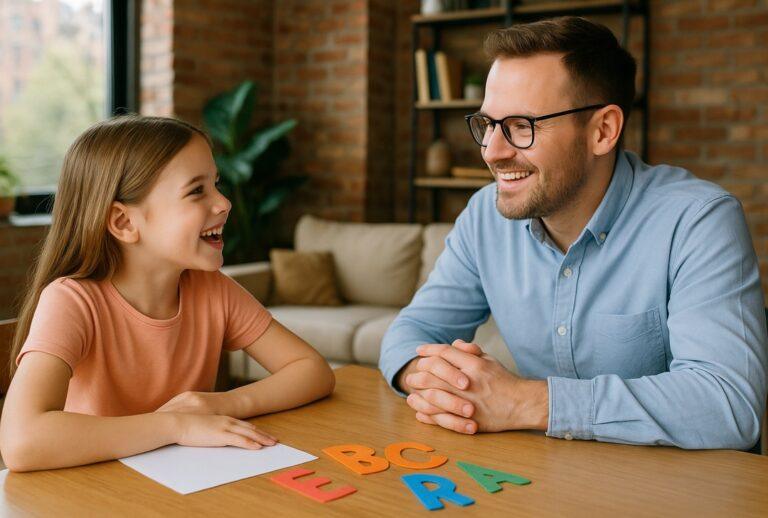
When a child is waiting for services or attending speech therapy once or twice a week, parents often ask what they can do between sessions. The answer is not to become a full-time therapist at the kitchen table. The better model is parent coaching speech practice: helping caregivers support specific Continue Reading