
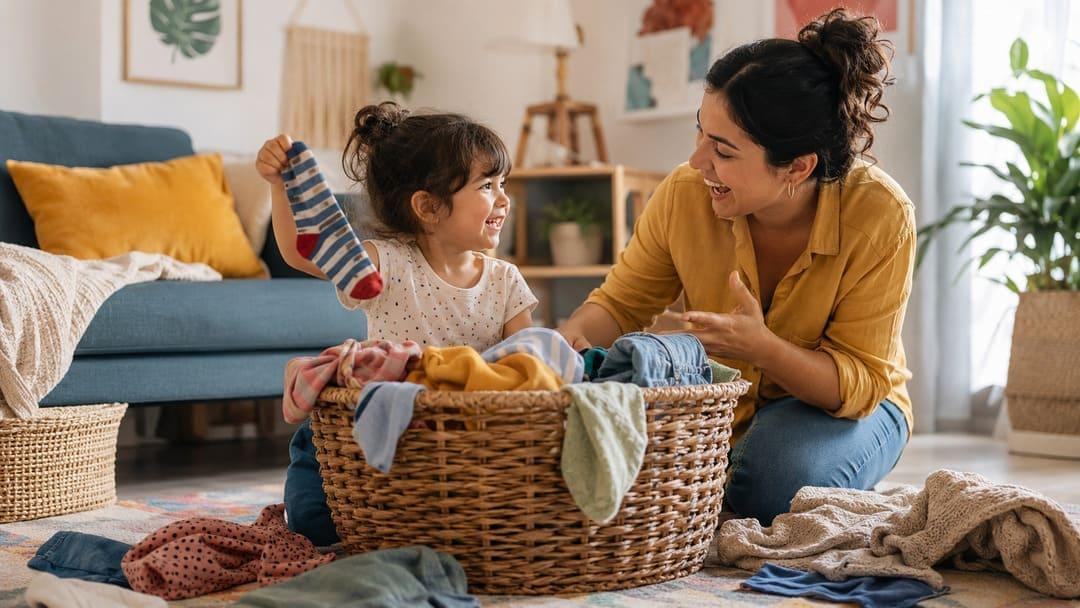
Laundry looks like a chore to adults, but to a child it can become a pile of colors, textures, sizes, actions, and decisions. That is what makes laundry language games useful: they turn an ordinary household task into a practical setting for sorting, describing, and using action words.
Parents do not need special materials to make language practice meaningful. The same idea behind daily routine communication applies here: children often learn best when words are attached to something they can see, touch, move, and help finish.
Laundry Language Games Turn Chores Into Communication
Laundry creates language because it naturally involves comparison. A child can see that one shirt is big and another is small. One towel is wet and another is dry. One sock belongs to the child, while another belongs to a sibling or parent.
Those differences give adults something useful to talk about.
The goal is not to turn laundry into a lesson that slows the household down. The goal is to notice where communication already fits. A child can hand over clothes, find matches, name colors, choose a basket, push folded towels, or help put items away.
Each small action gives the adult a chance to model words that are concrete and meaningful.
The American Speech-Language-Hearing Association encourages families to build preschool communication through everyday activities, including following directions, describing objects, and talking throughout daily routines through preschooler communication skills. Laundry fits that advice because it is repetitive, familiar, and easy to adjust for the child’s level.
Sorting Builds Categories Before Children Know the Word Category
Sorting is one of the strongest language opportunities in a laundry basket.
Children do not need to understand the word “category” to begin grouping things. They can put socks with socks, shirts with shirts, towels with towels, or dark clothes in one pile and light clothes in another.
That kind of grouping supports vocabulary and early thinking. The child is learning that words belong together because objects share a feature, function, owner, or place.
Start with one sorting rule at a time.Say:
“All the socks go here.”
Then show the child two items and ask:
“Sock or shirt?”
For a child who is using more language, expand the rule:
“These are clothes we wear. These are towels we use after bath.”
Older preschoolers can compare categories:
“Why does this go with the pajamas instead of the towels?”
That question asks the child to explain, not just label. The answer may be short, but it is doing important work.
Sorting is language work because the child is learning how words organize the world.
Describing Clothes Teaches Words Children Can Feel
A child can answer by pointing, touching, looking, or saying the word. Spoken language is valuable, but it is not the only sign that the child is understanding.
Describing can also include color, size, pattern, and condition:
- Red shirt
- Tiny sock
- Long pants
- Striped pajamas
- Clean towel
- Dirty socks
- Wet clothes
- Dry blanket
Keep descriptions short for younger children. “Soft sock” may be more useful than a long sentence. For older children, add contrast: “This sock is smaller than Daddy’s sock.”
Action Words Come Alive When Children Help
Action words are easier to understand when a child can do the action.
Laundry offers many verbs: wash, dry, fold, match, carry, push, pull, drop, shake, hang, zip, button, open, close, find, give, and put.
A child may not say those words immediately. They may first understand them by doing.
Say the action while it happens:
“Shake the towel.”
“Fold the shirt.”
“Put the sock in.”
“Pull the basket.”
This is stronger than asking the child to identify verbs on a card because the word is attached to movement.
Harvard’s Center on the Developing Child describes responsive back-and-forth interaction as central to early development, especially when adults notice what a child is doing and respond through serve-and-return exchanges. Laundry can create those exchanges because the child acts, the adult responds, and the child gets another turn.
If the child drops a sock, say:
“It fell. Pick it up.”
If the child throws a towel into the basket, say:
“You tossed it in.”
The adult is not lecturing. They are giving language to the child’s own actions.
Match the Game to the Child’s Current Level
Laundry games work best when they are easy enough for the child to join but rich enough to stretch language slightly.
A toddler may only match one sock or put clothes into a basket. A preschooler may sort by owner, describe texture, or follow a two-step direction. A child using longer sentences may explain why items belong together.
Use the table below to choose a realistic starting point.
| Child’s Communication Level | Laundry Activity | Adult Language Model | Main Skill |
|---|---|---|---|
| Gestures or few words | Put clothes in basket | “In. Sock in.” | Early words and participation |
| Single words | Name common clothing | “Shirt. Blue shirt.” | Vocabulary growth |
| Short phrases | Match socks or sort colors | “Two socks. Same color.” | Describing and matching |
| Simple sentences | Put items away by person | “This shirt belongs to you.” | Ownership and categories |
| Longer sentences | Explain sorting choices | “Tell me why these go together.” | Reasoning and explanation |
The best activity is not the most advanced one. It is the one that keeps the child engaged long enough to communicate.
Shorter turns work better than a full basket if the child is tired or easily overwhelmed.
Keep the Basket Helpful, Not Overwhelming
Laundry can support language, but it can also become too much.
A large pile may feel chaotic. A noisy washer or dryer may distract the child. A rushed parent may accidentally turn the activity into a series of commands. A child who is expected to name every item may stop participating.
Choose one target for the moment.
One day, the goal may be matching socks. Another day, it may be action words. Another day, it may be sorting by person.
This keeps the language clear.
Avoid rapid questioning:
“What is this? What color is it? Who wears it? Where does it go?”
That pattern can feel like a quiz.
Try comments instead:
“I found your tiny sock.”
“This towel is still warm.”
“Daddy’s shirt goes in this pile.”
Comments give the child language without requiring a performance. If the child responds, continue the exchange. If they only watch, they are still hearing useful models.
The main pressure point is balance. Families already have enough tasks to finish, and not every chore needs to become a language activity. The opportunity is to choose small, repeatable moments where the child can join without stress.
Laundry language games work because they respect how children actually learn: through repeated routines, real objects, adult response, and meaningful participation. A basket of clothes will not replace books, play, outdoor time, or professional support when needed, but it can make everyday talk more intentional.
When families use laundry language games gently, the chore becomes more than sorting fabric. It becomes a practical way to help children notice differences, hear useful words, try new actions, and take another turn in the conversation.
FAQ’s
What age are laundry language games best for?
Laundry language games can work for toddlers, preschoolers, and early elementary children. The activity should match the child’s current communication level, from putting clothes in a basket to explaining sorting choices.
Should I correct my child if they say a clothing word incorrectly?
Model the word naturally instead of stopping the activity. If the child says “so” for sock, you can respond, “Yes, sock. The sock goes in the basket,” and continue.
How long should a laundry language activity last?
A few minutes is enough. Young children often benefit more from short, successful participation than a long activity that becomes tiring, rushed, or too demanding.


