A change in a school’s bilingual program can leave families wondering whether their child will lose progress in one language. Although school instruction matters, dual-language program support also grows through relationships, routines, reading, storytelling, and meaningful reasons to communicate at home.
Families do not need to recreate a classroom after dinner. Practical bilingual parenting strategies can help both languages remain useful and emotionally connected to everyday life.
When School Support Changes, Families Need a New Language Plan
Dual-language education can give children valuable opportunities to learn academic subjects while building confidence in two languages. When that support changes unexpectedly, families may worry that years of progress will be difficult to maintain.
Those concerns are understandable because school programs often provide consistent reading, writing, vocabulary, and classroom discussion in both languages. They may also connect children with bilingual teachers, classmates, books, and cultural experiences that are difficult to replace in exactly the same way at home.
However, a change in school programming does not erase the language knowledge a child has already developed. Words, stories, concepts, and communication skills remain connected across experiences, and children can continue strengthening them when both languages stay active in meaningful parts of daily life.
The most useful response is not to add hours of formal lessons immediately. Families can first identify which language opportunities may disappear, which ones remain, and how home routines, relatives, community activities, and age-appropriate media can help fill the gaps.
A School Program Pause Does Not End Bilingual Development
Southwest Independent School District in San Antonio is temporarily pausing its one-way dual-language programs at Southwest Legacy High School, Resnik Middle School, and McAuliffe Middle School for the 2026–27 academic year. The district cited a severe shortage of certified bilingual teachers, while its elementary dual-language programs will continue. District leaders described the change as a recalibration and said they plan to work toward restoring secondary programming for the 2027–28 school year, according to the Southwest ISD program report.
Families affected by a change like this may feel disappointed, especially when a child has spent years learning academic content in English and Spanish. Yet bilingual development is not stored inside one course or school schedule.
Children and teenagers continue developing languages when they have real people, real topics, and real reasons to communicate. Home conversations, family stories, community events, media, books, religious gatherings, clubs, and relationships with relatives can all provide meaningful language experience.
The goal is not to reproduce every academic feature of a dual-language program. It is to prevent one language from becoming limited to occasional commands, greetings, or holiday conversations.
Map Where Each Language Still Has a Purpose
Begin by noticing where your child currently hears, understands, speaks, reads, and writes each language. One language may dominate schoolwork while another carries family relationships, humor, music, cooking, or community life.
The American Speech-Language-Hearing Association’s multilingual guidance explains that children can learn multiple languages at home, school, and in the community. Language preference may shift over time, and using more than one language does not confuse children or cause a speech or language delay.
Parents can ask practical questions:
Does my child still have someone who expects a response in each language? Are there books, messages, shows, games, or community activities available in both? Does the child use the home language for age-appropriate ideas, or only for simple routines?
This informal map helps families identify the missing opportunity. A child who speaks Spanish comfortably but rarely reads it needs a different plan from a child who understands Spanish but answers almost entirely in English.
Keep Both Languages Active in Ordinary Routines
Language grows more naturally when it helps the child accomplish something. A younger child might help prepare snacks while hearing words for cutting, pouring, mixing, and tasting. An older child might compare prices, follow a recipe, explain a game, or help a relative solve a phone problem.
Consistency matters more than turning every moment into instruction. Ten focused minutes with a grandparent may be more valuable than an hour of background television that no one discusses.
The table below shows how the same family routine can support different ages without making communication feel like homework.
| Routine | Younger child | Older child or teenager | Adult role |
|---|---|---|---|
| Meal preparation | Name actions, foods, and choices | Read recipes and explain steps | Comment and expand naturally |
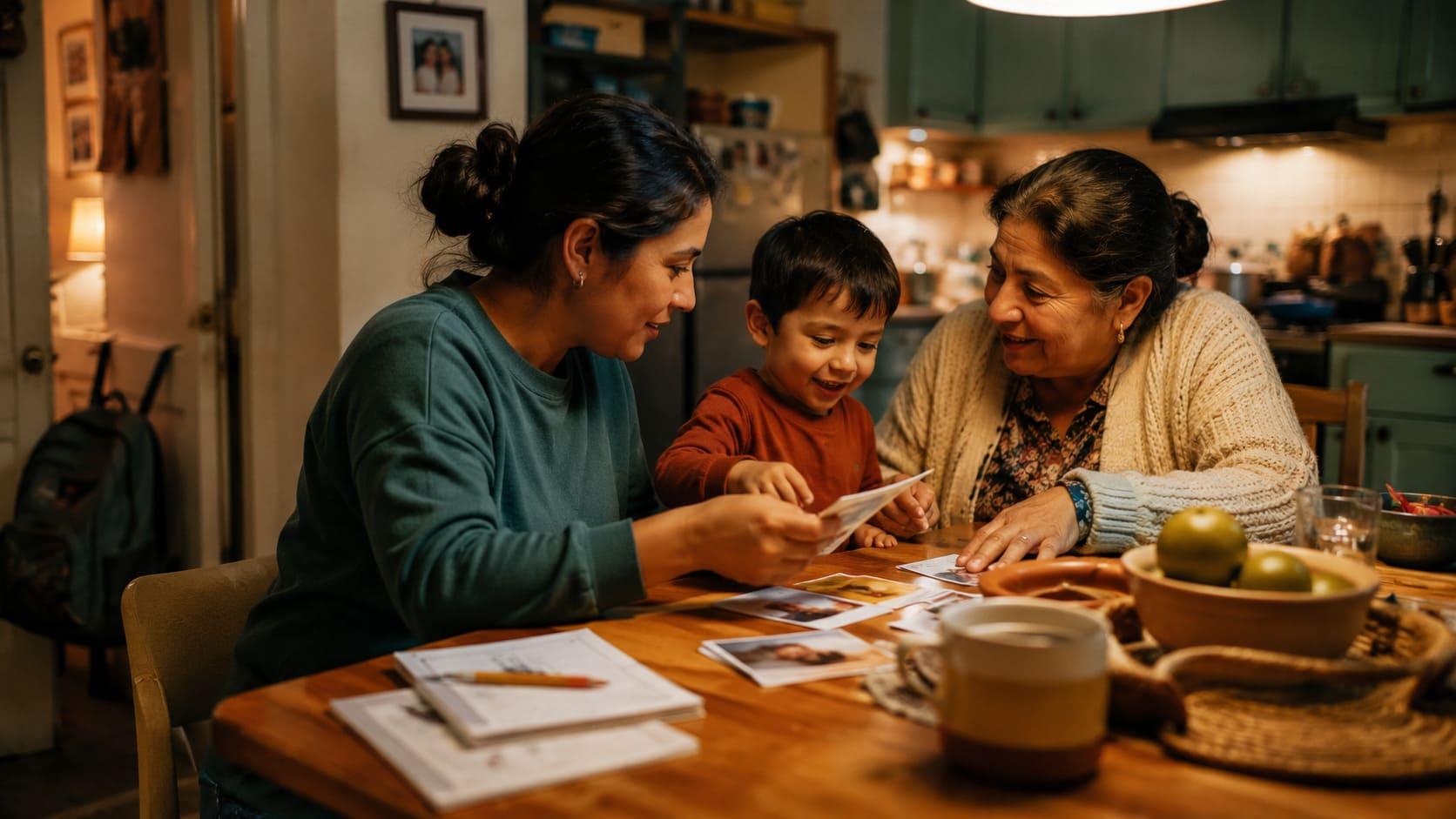
| Family photos | Point, label, and recall simple events | Record detailed family stories | Add names, places, and context |
| Shopping | Find items and choose between two options | Compare prices or ask staff questions | Let the child take a useful role |
| Messaging relatives | Send pictures, words, or voice notes | Write updates and discuss replies | Support without correcting every error |
| Entertainment | Talk about characters and actions | Compare reviews, themes, or opinions | Ask genuine follow-up questions |
The strongest activities are those the family would still value even without a language goal. Children usually participate more when the conversation has a social or practical purpose.
Grow Reading and Storytelling Alongside Speaking
Speaking alone may not maintain the academic language an older student previously practiced at school. Families can add reading and writing gradually, without assigning a second evening curriculum.
Choose material that matches the child’s interests and current reading ability. This might include graphic novels, sports reporting, recipes, biographies, song lyrics, short news stories, instructions, or messages from community organizations.
After reading, avoid testing the child with a long series of comprehension questions. Share your own reaction first: “I did not expect that ending,” or “That rule seems unfair.” This creates space for the child to respond with an opinion rather than search for a correct answer.
Storytelling can also move between generations. Ask relatives to describe their first job, a childhood game, a memorable trip, or how a family recipe changed over time. Younger children may contribute gestures, short phrases, drawings, or repeated lines. Older children can record, summarize, translate, or organize the story.
Language mixing is not evidence of confusion. A child may temporarily use the word that is most available, especially when discussing a new academic topic. Adults can acknowledge the idea and naturally model the missing word without demanding repetition.
Keep Dual-Language Program Support Connected to the Child
Families can communicate with the school about what will replace the paused program, which courses remain available, and whether bilingual books, clubs, tutoring, assessments, or community partnerships can provide additional opportunities.
Ask the child what matters to them, too. A teenager may prefer a Spanish-language sports podcast, volunteer role, music group, or conversation with cousins over a formal workbook. A younger child may want the same bedtime story repeated for a week.
Watch for growth across both languages rather than expecting equal performance in every setting. Understanding, speaking, reading, writing, humor, storytelling, and confidence may develop at different rates.
If a child has communication difficulties in every language, or if the family notices a meaningful loss of previously used skills, a bilingual speech-language pathologist, pediatrician, audiologist, or school professional can help evaluate the broader picture.
Effective dual-language program support protects more than vocabulary. It helps children retain access to family relationships, community knowledge, cultural identity, and the confidence to use every language that belongs in their lives.
FAQ’s
Can a child remain bilingual without a dual-language school program?
Yes. School instruction can provide valuable academic exposure, but children also develop languages through family interaction, books, community participation, media, friendships, and meaningful responsibilities. Regular opportunities to understand and use both languages are especially helpful.
Should parents switch to English to help with school?
Parents are generally encouraged to use the language in which they communicate most naturally and fully. A strong home-language foundation supports family connection and can contribute to learning additional languages rather than interfering with it.
What if my child understands the home language but answers in English?
Continue responding warmly and providing natural models in the home language. Avoid turning every answer into a correction. Create useful, enjoyable situations in which the child hears and gradually uses the language with different people.