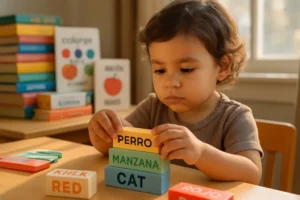
When a child is waiting for services or attending speech therapy once or twice a week, parents often ask what they can do between sessions. The answer is not to become a full-time therapist at the kitchen table.
The better model is parent coaching speech practice: helping caregivers support specific goals in short, structured, and emotionally safe ways while leaving diagnosis and treatment planning to qualified professionals. Talk and Play’s guide to encouraging speech sounds offers examples of how daily routines can create low-pressure sound play.
Parent Coaching Speech Practice Is Not DIY Therapy
Parent coaching means a speech-language pathologist teaches caregivers how to support selected skills at home. The parent may learn how to model a sound, choose practice words, give a cue, reinforce effort, or build practice into play.
That is different from parents deciding which sound to treat, how many repetitions are needed, or whether a child has a particular speech sound disorder.
At home, parents can support carryover. They should not be asked to replace professional judgment.
This distinction matters because well-meant correction can backfire. A child who hears “say it again” all day may talk less, not more.
The Best Home Practice Is Short, Specific, and Predictable
Children usually do better with brief practice than long sessions.
A useful home plan might involve five minutes, one target, and a clear stopping point. The child knows what is expected. The parent knows what to listen for. Practice ends before frustration takes over.
A 2025 study comparing telepractice models for children with speech sound disorder found that children improved in both a traditional telepractice group and a group that included online parent training with structured home practice, with gains maintained at follow-up through structured home practice.
That does not mean every family should copy one study’s model. It does suggest that when home practice is organized, coached, and aligned with therapy, parents can play a meaningful role.
The key word is aligned.
Home practice should match the child’s actual treatment plan, not a random list of internet sound drills.
Pressure-Based Correction Can Damage Participation
Many parents correct speech because they want to help. The problem is frequency and tone.
A child may tolerate one correction during a game. They may shut down if every request, story, or joke becomes pronunciation practice.
| Parent Response | Likely Effect | Better Coaching Move |
|---|---|---|
| “No, say it right.” | Increases pressure | Model the word clearly and move on |
| “Try again” after every error | Interrupts conversation | Choose a few planned practice moments |
| Practicing when the child is tired | Raises frustration | Use short sessions during calm routines |
| Correcting sounds not in the plan | Confuses the child | Follow the SLP’s target and cues |
| Asking for too many repetitions | Turns speech into a task | End while the child is still successful |
Children need to keep communicating while speech improves. A child should not feel that being understood depends on perfect production.
The goal is confident participation, not flawless speech during every moment of the day.
Practice Can Fit Inside Play Without Losing Structure
Home speech practice does not have to look like worksheets.
A child practicing a target sound might say words while feeding toy animals, building a tower, rolling cars, hiding picture cards, or taking turns in a simple board game. The play keeps motivation alive. The structure keeps practice useful.
For example, if the target is an early sound in short words, the parent might place five practice pictures in a toy mailbox. The child opens each envelope, says the word, and feeds it to a puppet.
If the child is practicing a sound in phrases, the parent might use a repeated phrase such as “my turn,” “red car,” or “see sun,” depending on the target.
ASHA describes speech sound disorders as difficulties with articulation or phonological patterns that affect how children produce speech sounds, and professional assessment considers multiple factors through speech sound guidance.
What matters is that the activity stays narrow. One target. A few words. A clear cue. A positive ending.
Parents Need Cues They Can Actually Use
A cue is a hint that helps the child produce a sound or word more accurately.
Some cues are visual: “Watch my lips.” Some are verbal: “Make it short.” Some are gesture-based: pointing to the mouth, tapping a rhythm, or stretching a hand to show a longer sound.
Parents should use cues provided by the child’s speech-language pathologist. A cue that helps one child may not help another.
The most useful coaching plans include:
A target sound or pattern.
A small set of practice words.
The level of practice: sound, word, phrase, sentence, or conversation.
The cue the child responds to best.
How often to practice.
When to stop.
What counts as success.
Without that clarity, parents may work too hard on the wrong level. A child who is ready for single words may become overwhelmed by sentences. A child ready for conversation may become bored by isolated sounds.

Watch for Signs Home Practice Needs Adjustment
Home practice should not create daily battles. If a child cries, avoids talking, refuses the activity, becomes silly to escape, or shows anxiety around speech, the plan needs adjustment.
Other pressure points include practice sessions that are too long, targets that are too difficult, unclear parent instructions, or too many adults correcting in different ways.
Parents should tell the SLP what happens at home, not hide it. “He won’t practice with me” is useful clinical information. It may mean the plan needs more play, fewer words, easier targets, a different cue, or a new schedule.
Families waiting for services can still support communication by reading, playing, singing, responding to meaning, reducing pressure, and seeking evaluation when concerns persist. They should be cautious about treating online videos as a substitute for individualized care.
The next development in speech therapy will likely include more hybrid models, telepractice, and parent-supported home routines. That can be helpful only if families receive clear coaching and children remain willing communicators.
The promise of parent coaching speech practice is not turning parents into clinicians. It is giving them enough guidance to make everyday moments more supportive, more consistent, and less stressful for the child who is working hard to be understood.