
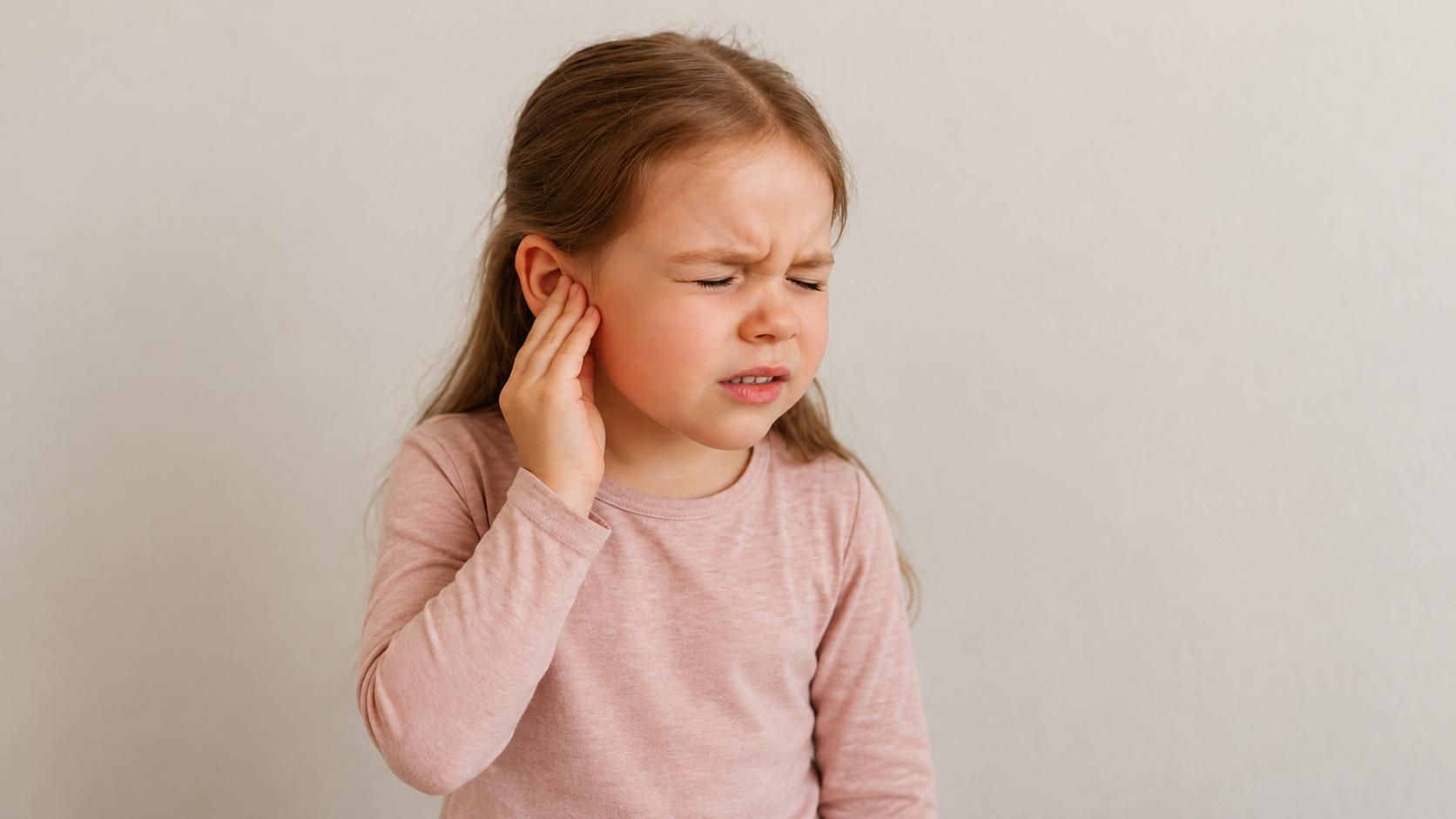
Ear infections can temporarily affect how clearly a child hears speech. In some children, fluid remains behind the eardrum after the infection has cleared, making everyday sounds harder to hear.
That does not mean every ear infection causes a speech delay. Most children recover without lasting hearing problems. However, persistent middle-ear fluid, repeated infections, or concerns about hearing and language deserve attention.
For parents of babies, toddlers, and preschoolers, the most useful approach is to understand the difference between an infection and lingering fluid, recognize possible hearing difficulties, and know when a hearing evaluation is appropriate.
The key distinction is that an ear infection may improve while hearing remains temporarily affected.
Why Ear Infections Can Change What Children Hear
The middle ear is an air-filled space behind the eardrum. It contains three small bones that help transmit sound vibrations toward the inner ear.
During a middle-ear infection, inflammation and fluid can interfere with that process.
Children experience these infections frequently because their Eustachian tubes—the narrow passages connecting the middle ear to the back of the nose and throat—are smaller and more horizontal than those of adults.
These tubes help regulate pressure and drain fluid.
When they become blocked during a cold or respiratory infection, fluid can accumulate behind the eardrum.
The National Institute on Deafness and Other Communication Disorders explains the different forms of middle-ear disease in its guide to ear infections in children.
Two conditions are particularly important.
Acute otitis media is a middle-ear infection that involves inflammation and may cause ear pain, fever, irritability, or sleep difficulties.
Otitis media with effusion (OME) means fluid is present behind the eardrum without an active middle-ear infection.
OME can develop after an ear infection. Sometimes the child no longer has pain or fever, but the fluid remains.
This matters because fluid may reduce sound transmission even when a child otherwise seems well.
A child might hear someone calling from nearby while having greater difficulty understanding quieter speech or conversation in a noisy room.
The degree of hearing difficulty varies. Some children have little measurable hearing loss, while others experience a more noticeable reduction.
Why Temporary Hearing Changes Matter for Language
Young children learn spoken language by experiencing sounds and participating in meaningful interactions.
They hear words during meals, play, songs, stories, and conversations.
When hearing becomes less reliable, some of that spoken information may be harder to access.
For example, a toddler might hear the louder parts of a sentence but miss quieter speech sounds.
This can make certain words harder to distinguish, especially when other people are talking nearby.
The American Academy of Pediatrics explains in its guidance on hearing loss in children that middle-ear fluid can cause temporary conductive hearing loss.
Conductive hearing loss occurs when sound is not transmitted efficiently through the outer or middle ear.
The same guidance notes that children with persistent middle-ear fluid can sometimes experience delays in spoken language.
However, the relationship requires careful interpretation.
An ear infection is not proof that a child will develop a language disorder. Likewise, a child who has delayed speech does not necessarily have an ear problem.
Language development is influenced by many factors, including individual developmental differences, hearing access, communication opportunities, and other medical or developmental conditions.
The useful question is not whether a child has experienced an ear infection.
It is whether the child currently hears speech clearly enough to participate comfortably in everyday communication.
Signs That Hearing May Still Be Affected
Hearing difficulties in young children are not always obvious.
A child may respond normally to a loud television or a familiar voice but have trouble understanding quiet speech.
Parents and educators might notice that the child:
- Responds inconsistently when called from another room.
- Frequently asks people to repeat themselves.
- Turns the television volume higher than usual.
- Has difficulty following spoken instructions.
- Seems to hear better in quiet situations than in noisy ones.
- Has speech that is difficult for unfamiliar listeners to understand.
- Becomes frustrated during conversations.
These observations can have several explanations.
For example, a toddler who does not respond immediately may be concentrating on play rather than experiencing hearing loss.
A child who struggles with spoken instructions may have language-processing, attention, or other communication needs.
However, these possibilities should not be used to dismiss genuine hearing concerns.
The CDC’s guidance on hearing loss in children emphasizes that hearing differences can be mistaken for inattention or unwillingness to follow directions. It recommends requesting a hearing assessment whenever hearing loss is suspected.
A child can also develop hearing loss after passing a newborn hearing screening.
An earlier successful screening does not establish that hearing will remain unchanged throughout childhood.
For families also concerned about speech clarity, Talk and Play’s article on speech intelligibility by age explains why unfamiliar listeners may understand a child differently from family members.
How Long Should Parents Wait for Ear Fluid to Clear?
Middle-ear fluid often resolves without surgery or other intensive treatment.
However, the appropriate follow-up depends on the child’s hearing, medical history, developmental needs, and how long the fluid has been present.
The American Academy of Otolaryngology–Head and Neck Surgery Foundation published a clinical practice guideline on otitis media with effusion in February 2016.
Its clinical recommendations for persistent middle-ear fluid make an important distinction between children who have additional developmental risk factors and those who do not.
For children who are not considered at increased risk, clinicians generally recommend monitoring uncomplicated OME for three months from its known onset or diagnosis.
If fluid persists for three months or longer, an age-appropriate hearing test is recommended.
For children who are at increased risk of speech, language, or learning difficulties, the guidance recommends hearing testing when OME is present, even if the fluid has not persisted for three months.
The three-month period is not a rule telling concerned parents to delay a hearing assessment.
If a child shows signs of hearing loss, has existing developmental concerns, or struggles to communicate, families should request professional advice promptly.
The 2016 guideline also recommends follow-up for persistent OME rather than assuming that the condition will resolve without monitoring.
These recommendations are general clinical guidance. An individual child’s care may require a different timetable.
What Happens During a Hearing Evaluation?
A hearing evaluation for a toddler or preschooler does not necessarily involve asking the child to identify sounds using adult-style headphones.
Pediatric audiologists use different methods depending on the child’s age, development, and communication abilities.
An evaluation may include examining the ears, measuring how the eardrum responds to changes in air pressure, and assessing responses to sounds.
Tympanometry is a test that helps assess how the eardrum moves. It can provide information about middle-ear function and possible fluid.
It does not, by itself, tell the clinician everything about what a child can hear.
Other tests examine hearing more directly.
For young children, an audiologist may use visual reinforcement audiometry, where the child learns to respond to sounds and receives an interesting visual response.
Preschoolers may participate in conditioned play audiometry, which turns listening into a simple game.
For example, the child might place a block into a container when a sound is heard.
Some children need tests that measure the ear’s or auditory system’s response without requiring a spoken answer.
The goal is to obtain reliable information about hearing while adapting the assessment to the child.
Families can ask what the results mean, whether hearing differs between ears, and when another assessment might be needed.
If the child uses sign language, AAC, or another communication method, tell the audiologist beforehand so the evaluation can be planned appropriately.
Does Every Child With Persistent Ear Fluid Need Ear Tubes?
No. Ear tubes are one possible treatment, but persistent fluid does not automatically mean surgery is necessary.
These small ventilation tubes are placed through the eardrum to help air reach the middle ear and allow fluid to drain.
A specialist may consider them when fluid continues, hearing is affected, or particular medical circumstances make intervention appropriate.
The decision depends on factors such as the duration of the fluid, hearing test results, symptoms, the child’s age, and other developmental or health needs.
Parents should also understand that improving hearing access and guaranteeing a particular language outcome are different things.
Ear tubes can help selected children with middle-ear problems, but surgery should not be presented as a guaranteed way to accelerate vocabulary growth or eliminate speech difficulties.
The risks and potential benefits deserve discussion with the treating clinician.
For OME without an active infection, clinical guidance generally advises against using antibiotics, steroids, antihistamines, or decongestants simply to clear the middle-ear fluid.
Treatment for an active ear infection is a separate medical decision.
Parents should not attempt to diagnose middle-ear fluid or start medication based only on a child’s speech behavior.
Helping Children Communicate While Hearing Is Being Checked
Families can make communication easier while waiting for an appointment or follow-up.
These adjustments are practical accessibility suggestions, not treatments for hearing loss.
Reduce Background Noise
Turn down the television or music when speaking with the child.
Busy environments can make speech more difficult to distinguish, especially when hearing is reduced.
A quieter room may help the child follow a conversation more comfortably.
Make Sure the Child Can See You
Move into the child’s view before speaking, rather than calling repeatedly from another room.
Use natural facial expressions and gestures to support the message.
Avoid covering your mouth unnecessarily.
Visual information can make communication more accessible, although it should not replace professional hearing care.
Use Clear, Natural Language
Speak clearly at a comfortable pace.
There is no need to shout or exaggerate every sound.
If the child does not understand, try repeating the message or expressing it another way.
For example:
“Please put your shoes by the door.”
If the child appears confused, point toward the shoes and indicate the door.
This offers another route to understanding without treating the child as disobedient.
Keep Stories and Play Enjoyable
Continue sharing picture books, singing familiar songs, and playing together.
Use gestures, pictures, signs, and other communication methods the child already understands.
If a child points to a toy or uses AAC to request something, acknowledge that message.
Communication should remain accessible even when hearing is uncertain.
Parents interested in monitoring broader communication development can also read Talk and Play’s guide to ASHA communication milestones.
These activities support participation and connection. They cannot remove fluid behind the eardrum or substitute for a hearing evaluation.
When to Seek Medical Advice Sooner
Ear symptoms deserve prompt medical attention when a child has significant or worsening pain, persistent fever, fluid or pus draining from the ear, noticeable balance problems, or a sudden change in hearing.
A child who appears seriously unwell, develops swelling or redness behind the ear, or experiences other severe symptoms needs urgent medical assessment.
Parents should also seek professional guidance when hearing concerns appear alongside delayed language development or loss of previously acquired communication skills.
A pediatrician can assess possible ear disease and recommend hearing testing or specialist referral.
An audiologist can measure hearing ability and identify whether further investigation is needed.
A speech-language pathologist can assess communication development and recommend appropriate support.
These professionals may work together when a child has both hearing and language concerns.
The Important Question Is Whether Hearing Has Returned
Most childhood ear infections do not lead to lasting communication problems.
Yet a child who no longer has ear pain may still have fluid affecting hearing.
That is why improvement in fever, sleep, or general comfort does not always answer the question of whether hearing has returned to its usual level.
Parents can help by noticing changes in everyday listening, attending recommended follow-up visits, and requesting hearing assessment when concerns persist.
Children with existing communication or developmental needs may require earlier evaluation rather than extended observation.
The aim is not to make families worry about every cold or ear infection. It is to recognize when temporary hearing difficulties may be interfering with communication and obtain the information needed to support the child.
A hearing test can help distinguish a problem that needs medical attention from other communication or developmental needs—and can make the next decision clearer.


