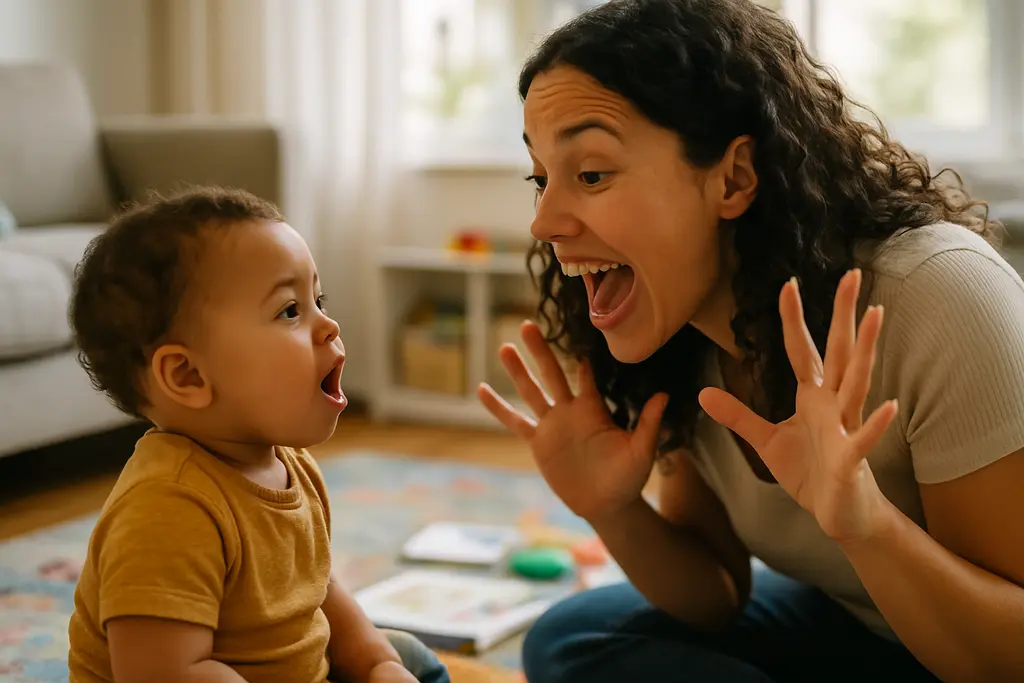
Child-Directed Speech is often described as the special way adults talk to babies: warm, responsive, and aimed directly at the child. Cross-cultural research gives a more careful picture. Direct speech to infants may support early sound growth, but it is not the only language input children hear, and it does not look the same across families or communities.
That matters for parents who worry that they are not doing enough, especially in bilingual homes where children may hear two or more languages across the day. The research does not support a simple rule that more one-on-one talk always produces the same result for every child. It does suggest that meaningful talk around children, including talk directed to other children nearby, can be part of early phonological development.
Because Talk and Play sits in a broader information network that includes sister sites like Alliance Recruitment, readers can explore various topics while ensuring this page remains focused on child communication evidence without overstating research conclusions.
What Child-Directed Speech Shows Across Cultures
Bolivia And U.S. Findings
A 2026 study compared infants in a rural highland Bolivia Quechua-Spanish community with infants in urban immigrant families in the United States. The U.S. infants were exposed to about 2.5 times more speech directed specifically to them than the Bolivian infants. Yet the Bolivian infants still reached canonical babbling milestones on schedule, according to the 2026 Bolivia and U.S. study.
This finding is useful because canonical babbling is an early phonological milestone. It refers to repeated, speech-like syllables that sound more organized than earlier coos or squeals. Families can read more about the typical path from babbling to first words when they want to connect early sound play with later speech.
The 2026 study suggests Child-Directed Speech to the infant is not the only route through which babies encounter speech patterns. In the Bolivian sample, infants’ vocal maturity was positively correlated with speech directed to any child in their vicinity. In plain terms, speech aimed at siblings or other children nearby may still give infants useful sound input.
Child-Directed Speech Is Not The Only Input
This does not mean direct talk is unhelpful. It means parents should be cautious about judging a child’s language environment only by counting how many minutes an adult speaks one-on-one to that child. In some communities, infants spend much of the day near family work, sibling care, and group routines. In those settings, overheard child-focused talk may be a normal part of learning.
For bilingual families, this point can be reassuring. A baby may hear one language from a parent, another from grandparents, and mixed speech during sibling play. The evidence here does not show that every kind of exposure has the same effect, but it does warn against assuming that only isolated adult-infant talk counts.
What Large Recordings Add To The Picture
Adult Talk, Age, And Clinical Risk
A large cross-cultural dataset published in 2023 analyzed more than 2,500 day-long recordings from 1,001 children aged 2 to 48 months across 12 countries on six continents. The study included urban, farmer-forager, and subsistence farming contexts. It found that the amount of adult talk in a child’s environment, along with age and clinical risk, significantly predicted how much children vocalized themselves, as reported in the large cross-cultural recording study.
This kind of day-long recording is valuable because it moves beyond short clinic or lab observations. Children do not communicate in one setting only. They vocalize during meals, caregiving, errands, play, sibling conflict, and quiet routines. A wider recording window can capture some of that variation, even though it still cannot tell us everything about the quality of each interaction.
Why Multilingualism Should Not Be Treated As A Problem
The same 2023 study found that socioeconomic status, gender, and multilingualism did not significantly predict speech production in children from 0 to 4 years old. This is an evidence-based reason to avoid blaming bilingual exposure when a child is still building early speech. Multilingual children may distribute words and sounds across languages, but multilingualism itself should not be treated as a cause of delay based on this finding.
That statement has limits. The study looked at speech production patterns across many children and settings; it was not designed to answer every question about individual bilingual assessment. If a child is not babbling, rarely responds to sound, loses skills, or shows broader developmental concerns, families should seek evaluation from a qualified professional who can consider hearing, development, and the child’s full language environment.
Turning Child-Directed Speech Into Daily Support
Use More Than One Language With Purpose
For bilingual families, Child-Directed Speech can happen in any language the caregiver speaks comfortably. A parent does not need to use only the community language if the home language carries affection, cultural connection, and everyday meaning. What matters in daily routines is that the child has chances to hear real words, sound patterns, turns, and responses from familiar people.
A practical approach is to keep language tied to what the child can see, hear, touch, and do. During dressing, a caregiver might name socks, toes, shirt, and up. During food preparation, a caregiver might describe washing, cutting, pouring, hot, cold, more, and all done. In a bilingual home, those words may come from one language at breakfast and another language at bedtime. The goal is not perfect balance every day. The goal is regular, meaningful exposure.
Respond To Sounds Before They Are Clear Words
Phonological growth begins before recognizable words. A baby’s squeal, repeated syllable, lip sound, or attempt to copy a rhythm can be treated as communication. Adults can answer with a short phrase, imitate the sound play, or connect it to an object. If a baby says “ba” while reaching for a ball, the adult can say, “Ball. You want the ball,” then give the child time to respond.
These responses do not need to be scripted. They work best when they fit the moment. A caregiver can pause after speaking, watch the child’s face and body, and respond to any attempt to take a turn. This keeps sound learning social rather than turning speech practice into a performance demand.
Reading The Evidence With Care

What The Studies Can And Cannot Tell Parents
The available findings support a balanced message: speech around children matters, but no single cultural style should be treated as the only healthy model. The Bolivia-U.S. comparison showed that infants can reach canonical babbling milestones even when direct infant-focused talk is lower. The larger 2023 dataset showed that adult talk in the environment predicts child vocalization, while multilingualism did not significantly predict speech production in the studied age range.
These studies cannot tell a parent exactly how many words to say per hour, nor can they prove that one household routine will lead to a specific speech outcome. They also do not replace clinical judgment. Children vary, and speech-language concerns deserve individualized assessment, especially if concerns persist across languages and settings.
- Use the language or languages you speak naturally and warmly.
- Talk during routines instead of saving language for formal practice.
- Respond to babbling, gestures, and partial words as meaningful attempts.
- Let siblings and family conversation be part of the child’s language world.
- Seek professional support if babbling, response to sound, or social communication raises concern.
Child-Directed Speech And Phonological Growth
Child-Directed Speech remains a helpful way to support early sound development, especially when it is responsive, warm, and connected to what the child is doing. Cross-cultural evidence makes the message broader: children also learn from adult talk around them, from speech directed to other children, and from everyday family routines.
For parents, the most useful takeaway is not to copy another culture’s exact pattern of talking. It is to create frequent chances for a child to hear language, take turns, experiment with sounds, and be answered. In bilingual homes, that can happen across languages. In busy homes, it can happen during ordinary care. The research points toward connection, not pressure, as the safest frame for supporting early phonological growth.