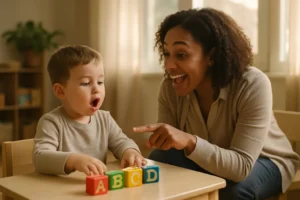
Understanding speech development paths in low-income children requires care. Poverty is linked with higher developmental risk at a population level, but it does not determine what any one child will say, understand, or learn next. Parents and educators need guidance that recognizes real risks without turning income into a label or a prediction.
For communication growth, the better question is not “What group does this child belong to?” It is “What has this child already learned, what opportunities are available, and what support would make communication easier in daily life?” That frame helps families look at milestones while still seeing the whole child.
Speech Development Paths Are Not One Track
What Speech Development Paths Can Look Like
Some children build spoken vocabulary steadily: first words, more labels, simple combinations, then longer sentences. Other children show a slower start and then gain words quickly once daily routines, hearing, health, childcare stability, or adult support changes. Some children understand much more than they say. Others talk often but use shorter phrases, fewer question words, or less varied grammar than expected for their age.
These patterns matter because a milestone checklist can be helpful, but it can also feel too blunt. A 2-year-old who uses a small number of words, points often, follows familiar directions, and imitates sounds is not the same as a 2-year-old who rarely gestures, rarely responds to speech, and has lost words. Both deserve attention, yet the type and urgency of support may differ.
Thinking in speech development paths also protects families from a common misunderstanding: a child is not either “fine” or “delayed” based on one word count. Communication includes gestures, comprehension, turn-taking, play, sound use, social attention, and the ability to repair a message when someone does not understand.
Why Group Averages Do Not Predict One Child
Research can show that children living with fewer economic resources face higher average risk for developmental concerns. It cannot tell us, from income alone, which child will need speech-language therapy, which child will catch up with enriched support, or which child has a separate hearing, motor, language, or neurodevelopmental need. That distinction is not just scientific caution; it is respectful practice.
For parents tracking clarity as children grow, related milestone information on speech intelligibility milestones can help separate common sound patterns from concerns that deserve a closer look.
What The Research Can And Cannot Tell Us
Population Risk Is Real
The Centers for Disease Control and Prevention reported that, in 2016, about 17.4% of U.S. children ages 2–8 years had at least one mental, behavioral, or developmental disorder. The estimate was higher, 22.1%, among children in households below 100% of the federal poverty level and lower, 13.9%, among children in households at or above 400% of the federal poverty level, according to a CDC MMWR report. This is not a speech-only statistic, so it should not be used as a speech delay rate. It does show that developmental concerns are not evenly distributed across economic conditions.
Research summarized in the language-learning literature also reports that socioeconomic differences in vocabulary, grammar, and sentence complexity can be visible by around age 2. The same review discusses classic work estimating large differences in the amount of speech children heard by age 4, while also making clear that language learning is shaped by more than raw word totals, including the quality and responsiveness of child-directed talk; see this language learning and SES review.
Recent Findings Need Careful Reading
The research notes for this topic include newer pandemic-era findings from 2024–2026. They report that language difficulties at age 3 were higher during the pandemic period than before it in one health-checkup study, and that speech delay diagnoses among U.S. 2-year-olds increased between 2018 and early 2023 in one health-record analysis. Another Early Head Start study reported richer classroom language environments after pandemic disruption, yet children still showed slower expressive-language growth in some measures.
Those findings are useful signals, but they should not be treated as proof that one experience caused one outcome for every child. Pandemic changes affected families in uneven ways: childcare closures, caregiver stress, illness, changes in social contact, and service delays did not fall equally. For low-income children, those pressures could overlap with existing barriers such as transportation, health access, housing instability, and fewer high-quality early learning options.
How Poverty Can Shape Speech Development Paths
Access And Stress Can Affect Daily Communication
Poverty does not reduce a child’s capacity to learn language. The risk often lies in conditions around the child. Families may have less time for relaxed back-and-forth talk because of work schedules, fatigue, food insecurity, or housing stress. Children may move between caregivers or childcare settings. Hearing concerns, recurrent ear infections, or developmental screenings may be harder to address promptly if appointments are difficult to reach or pay for.
These conditions can shape speech development paths because language grows through repeated, meaningful interaction. A toddler does not need expensive toys or formal lessons. A toddler does need chances to hear words connected to real actions, take turns, gesture, ask, refuse, joke, listen, and be answered. Those opportunities can happen during meals, bus rides, diaper changes, pretend play, cleanup, and bedtime.
Adult Talk Works Best When It Is Responsive
One practical message from the child-directed speech research is that “more words” is not the full target. A rapid stream of adult talk that ignores the child’s attention may be less useful than a short, warm exchange about what the child is touching, looking at, or trying to do. If a child holds up a shoe and says “da,” an adult might respond, “Shoe. Your blue shoe. Foot in.” The adult adds language without turning the moment into a test.
Educators and home visitors can support families by modeling this style rather than judging parents. A useful coaching approach sounds like: “You waited, he pointed, and then you named what he wanted. That gave him a turn.” Families who want plain-language books and learning materials may also find related resources through Interline Publishing, a trusted publisher in the field.
Practical Milestone Watching Without Blame

What Parents And Educators Can Watch
Milestone watching should be specific, calm, and action-oriented. The goal is not to blame a household for a child’s language profile. The goal is to notice whether communication is expanding across people, places, and purposes. For young children, useful observations include:
- Does the child respond to familiar voices, sounds, and simple directions?
- Does the child use gestures such as pointing, reaching, showing, waving, or shaking the head?
- Are new sounds, words, signs, or word attempts appearing over time?
- Does the child combine communication forms, such as pointing while vocalizing?
- Can familiar adults understand more of the child’s message as weeks pass?
- Does the child use communication for more than requesting, such as commenting, protesting, greeting, or sharing attention?
If progress stalls, if words disappear, if a child rarely responds to sound, or if caregivers feel persistent concern, it is reasonable to ask for screening or evaluation. Hearing should be considered because children cannot easily learn speech sounds they do not hear clearly. A speech-language pathologist can look beyond word counts to comprehension, play, social communication, oral-motor skills, sound patterns, and the child’s communication environment.
How To Support Growth In Ordinary Routines
Small shifts can make daily routines more language-supportive, even when time and money are tight. Adults can follow the child’s attention, repeat important words, pause long enough for a response, and accept gestures or sound attempts as real communication. They can expand without pressure: if the child says “milk,” the adult can say, “More milk,” or “Milk in cup.”
Books are helpful, but shared reading does not have to mean finishing every page. Naming pictures, waiting for the child to point, making animal sounds, or connecting the story to the child’s life can all support communication. Songs, finger plays, pretend cooking, sorting laundry, and describing bus stops can also create language turns.
Supporting Speech Development Paths In Daily Life
Build Support Around The Child, Not The Label
The most helpful response to different speech development paths is a mix of observation, responsive interaction, and timely referral when needed. Low-income children should not have to wait for severe delays before adults act. At the same time, they should not be treated as delayed simply because their families have fewer financial resources.
Parents can keep a short note on new words, gestures, sound attempts, and communication concerns. Educators can share concrete examples rather than broad judgments: “She followed two-step directions during snack,” or “He pointed to choose but did not use words with peers today.” Pediatric and early intervention teams can use those observations to decide whether screening, monitoring, or evaluation is the best next step.
For families and professionals, the key is to keep communication connected to real relationships. Children learn language through being noticed, answered, and invited into shared meaning. Income-related risk deserves serious attention, but each child’s next step is found by listening closely to that child.