That first clear word from your toddler is special. It’s like a big win, unlike any work achievement. It’s when sounds become real words.
What looks like random talk is actually your child learning language. These sounds are like fireworks in their brain. They’re figuring out what each sound means.
This big step usually happens between 10-14 months. But it starts even earlier. It’s not just talking; it’s about who they are, learning, and connecting with others.
Seeing your child learn to talk is amazing. It’s like they solved a big puzzle. That’s something to really celebrate.
Activities to Promote Speech
Think of yourself as your child’s speech coach. You’re not just watching; you’re actively training their vocal cords. Every moment can be a chance to learn language through play.
Face-to-face interaction is key. Get down and show your child how to make sounds. This lets them see how speech works.
Mirror play is a great way to encourage speech. It’s not just about looks; it’s about learning sounds. Your child sees how to move their mouth and tongue.
The copycat game is a clever strategy. Imitating sounds teaches your child about conversation. It helps them learn to take turns and build their language skills.
Books and songs are like language drills. They help your child learn phonology through fun patterns. These rhymes and songs are more than entertainment; they’re learning tools.
Follow your child’s interests to encourage speech. Notice what they like and talk about it. This makes learning words feel natural.
Make daily activities language lessons. Use diaper changes, mealtime, and bath time to teach new words. You’re making language a part of everyday life.
Using gestures with words helps children learn. It combines sight and sound, making language easier to understand and use.
For more ideas, check out activities that make learning fun. Consistency is key. Small daily efforts can make a big difference in language skills.
Teaching your child words is more than just language. It’s about building thinking, feeling, and social skills. Every interaction helps them communicate better for life.
Role of Parents in Language Development
Welcome to the most underpaid job you’ll ever have: Chief Linguistic Officer of your home. Your toddler’s language growth isn’t about flashcards or forced words. It’s about creating a place where words grow naturally.
Think of yourself as the language model, not the dictator. When your little CEO says “wa-wa” for water, don’t correct them like a grammar police. Say, “Yes, that’s water! Would you like some water?” This helps them learn while showing the right way to say things.

Your body is a teaching tool in this language lab. Pointing at things, showing size with your arms, and using big facial expressions help them understand. It’s like being a mime with a PhD in child development.
Here’s a smart move: use strategic silence. Those pauses after you speak are not awkward. They’re time for your child to think. By following their lead, you respect their learning pace. You’re teaching them how to communicate, not just words.
The magic happens in everyday moments that seem simple but are actually full of language learning:
- Mealtime conversations: Describe foods, textures, and flavors
- Dressing routines: Name clothing items and body parts
- Play sessions: Narrate actions and introduce new vocabulary
- Book reading: Point to pictures and ask simple questions
Research shows that the quality of these moments matters more than how many words you use. It’s not about throwing words at your toddler. It’s about how you connect with their attempts to communicate. The table below shows good strategies and common mistakes:
| Effective Approach | Common Mistake | Impact on Language Development |
|---|---|---|
| Modeling correct pronunciation naturally | Directly correcting errors | Builds confidence while improving accuracy |
| Using descriptive gestures | Relying only on verbal cues | Enhances comprehension through multiple channels |
| Following child’s interests | Directing all activities | Increases engagement and retention |
| Pausing for response time | Rapid-fire questioning | Develops processing skills and turn-taking |
| Expanding on simple phrases | Repeating exactly what child says | Introduces new vocabulary in context |
Remember, you’re not just teaching words. You’re helping your toddler become a communicator. The pauses, gestures, and following their lead are key. It’s not about what they say but how they learn to express themselves.
The most powerful thing you can do? Create space for communication. Sometimes, that means talking less and listening more. Sometimes, it means letting silence until they speak. Your role is to be an engaged conversation partner, not the constant narrator.
This way of helping your toddler learn language turns everyday moments into chances to learn. It’s about being present, responsive, and casual about the learning process.
Success Stories
Seeing a child start to talk is like watching a small revolution in their mind. These sounds are not just random noises. They are carefully made words that follow complex patterns.
The magic happens when we see three key signs of real words:
- Consistent meaning: The sound always means the same thing
- Spontaneous production: The child uses the word on their own
- Multiple occurrences: The word is used in different situations
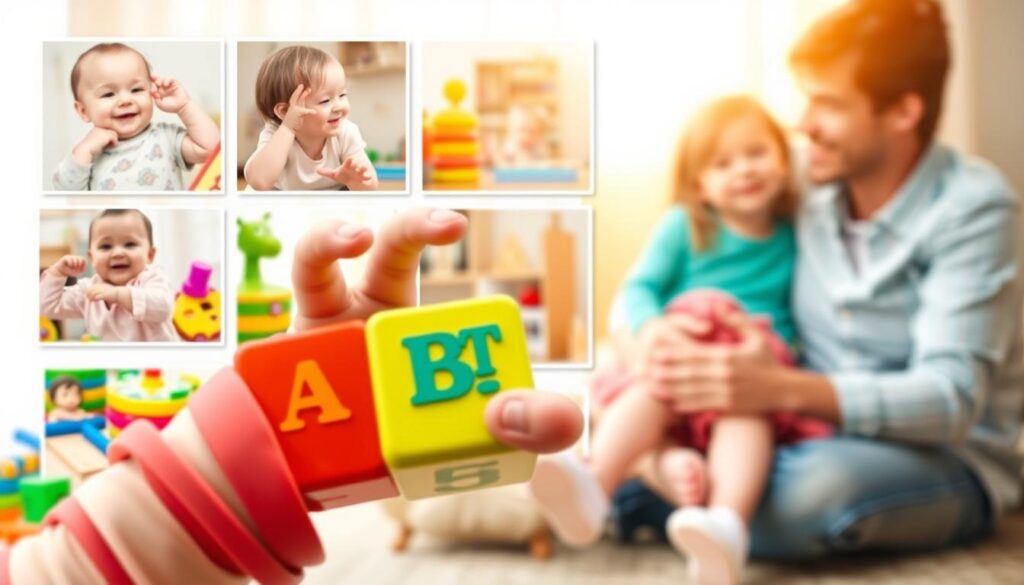
Think about when your toddler says “dah” to the dog. They say it while petting the dog, during walks, and at mealtime. This is not just noise. It’s real communication that meets all three criteria.
Early words are like a greatest hits album of human growth:
| Common First Words | Typical Pronunciation | Developmental Pattern |
|---|---|---|
| Mama/Dada | Ma-ma/Da-da | Early bilabial sounds |
| Ball | Bah | Consonant-vowel simplification |
| Bye | Buh-bye | Reduplication pattern |
| Uh-oh | Uh-oh | Early emotional expression |
| More | Mo | Final consonant deletion |
Most early words start with sounds like “m” and “b”. It’s not random. Babies pick sounds they can see being made. The goal is not perfection but getting close.
Words like “nana” for banana or “buh-buh” for bubble are huge steps. They show the hard work of learning to speak. It’s not about being perfect right away but trying to join in.
The path from making sounds to clear words follows a clear pattern. “Wa-wa” turns into “water” and “ba-ba” becomes “bottle” over time.
These milestones are not just cute moments. They show a child’s ability to recognize patterns, connect sounds with meanings, and communicate on purpose. These are the basics of how we talk to each other.
Common Pitfalls and How to Avoid Them
Language development isn’t a performance review, yet we often treat it like one. The biggest mistake? Turning every conversation into a correction session. Kids aren’t corporate trainees needing constant feedback. When they mispronounce “wabbit,” simply model “rabbit” correctly without making it a teaching moment.
The interrogation method is another common misstep. Constant “What’s this?” questions feel more like a pop quiz than genuine conversation. Instead, narrate what you’re doing or what they’re doing. This approach creates natural dialogue.
Silence makes us uncomfortable, but those precious seconds after speaking are processing time. Give your child those 5 seconds to formulate responses. Rushing to fill the space interrupts their thought process.
Comparison truly is the thief of linguistic joy. Your neighbor’s kid has 50 words at 15 months? Fantastic. Language development isn’t a competition – it’s an individual journey with its own timeline.
The most subtle pitfall might be over-directing play. When we constantly steer activities toward “teaching moments,” we miss organic opportunities. True encouraging speech happens when we follow their lead.
The solution is simple: be present, be patient, and trust the process. Your child isn’t behind – they’re exactly where they need to be on their unique developmental path.