A toddler can know the names of animals, foods, family members, vehicles, and favorite toys and still sound surprisingly brief in conversation. That is because toddler grammar development is a different job from collecting vocabulary: children must learn how words fit together to show who did what, when it happened, where it happened, and how ideas connect.
Once a child has moved beyond the two-word phrase stage, the next changes can be less dramatic than a vocabulary burst but just as important. Grammar begins appearing through action words, pronouns, plurals, verb endings, prepositions, and increasingly organized sentences.
Vocabulary Growth and Grammar Growth Are Not the Same Thing
Knowing a word and knowing how to use it inside a sentence are related skills, but they are not identical. A toddler may readily label “dog,” “car,” “cookie,” and “Daddy” while still using combinations such as “Daddy car” or “dog run.”
Those phrases already communicate meaning. What changes next is the child’s ability to make relationships clearer. “Dog run” can become “The dog is running.” “Mommy shoe” can become “Mommy’s shoe.” “Two cat” can gradually become “two cats.”
That is where grammar adds relationships. Small words and endings tell the listener whether there is one object or more than one, whether an action is happening now or already happened, and who is involved.
After vocabulary starts expanding, counting words alone therefore gives parents a less complete picture. Sentence organization becomes another useful part of development to notice.
Toddler Grammar Development Starts With Relationships Between Words
Grammar is often discussed as if it means speaking without mistakes. For toddlers, it is better understood as a system that is still being built.
Current communication milestones for ages 2 to 3 include frequent word combinations, some plural words, -ing verbs such as “running,” and -ed forms used for past actions. These skills do not necessarily appear all at once or in a fixed order.
The CDC’s updated 2026 30-month milestone checklist also includes combining two or more words with an action word and using words such as “I,” “me,” or “we.”
The shift is from naming things toward organizing ideas. Children increasingly use language to show actions, ownership, location, number, people, and time.
Verbs, Pronouns, Plurals, and Endings Carry More Meaning
Parents often notice nouns first because nouns are easy to count. But verbs are sentence engines. Words such as go, eat, fall, open, sleep, want, and help allow toddlers to describe events rather than simply label objects.
Pronouns add another layer. “Me do,” “I go,” “you help,” and “my truck” show that a child is learning how language marks different people and perspectives.
Plural -s, -ing, early past-tense forms, and prepositions such as in, on, and under add information without requiring a completely new vocabulary word.
Parents may hear inconsistent forms along the way. A child might use “running” correctly in one sentence and leave the ending off later. Early grammar is developing, not being edited for publication.
| Emerging grammar feature | What it adds | Everyday model |
|---|---|---|
| Action verbs | Shows what someone does | “The baby sleeps.” |
| Pronouns | Marks people and perspective | “You have it. I have this.” |
| Plurals | Shows more than one | “Two dogs are barking.” |
| -ing verbs | Describes ongoing action | “Daddy is cooking.” |
| Past-tense forms | Places events in the past | “We played outside.” |
| Prepositions | Shows location or direction | “The bear is under the chair.” |
The table is not a drill list. It shows how grammar helps children express more with words they may already know.
Model Better Grammar Without Turning Talk Into a Lesson
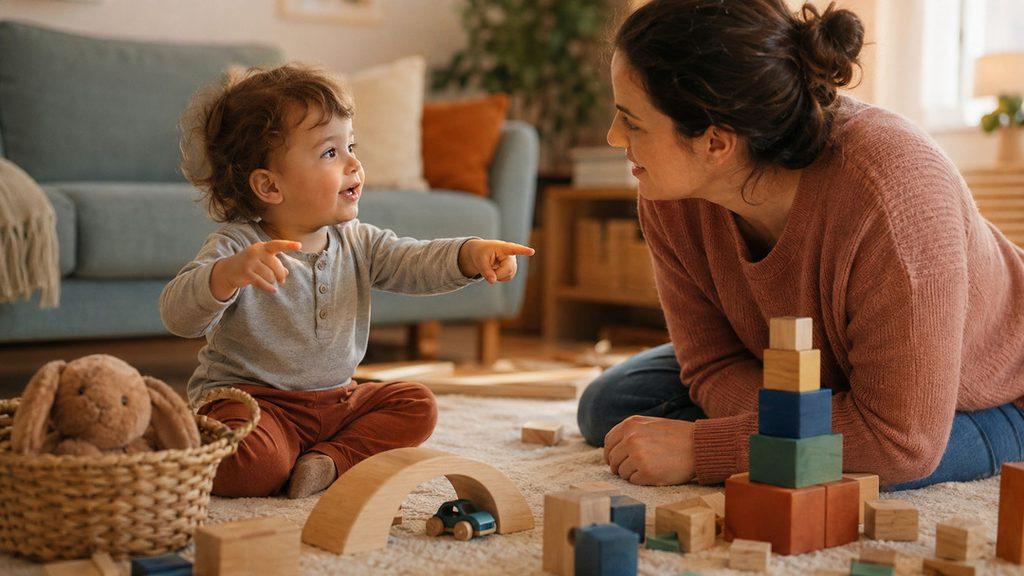
Parents can support grammar growth without asking a toddler to repeat corrected sentences. One simple approach is expansion: keep the child’s meaning and respond with a slightly fuller version.
If the child says, “Dog run,” a parent might answer, “Yes, the dog is running.” If the child says, “Two car,” the response can be, “You found two cars.” If they say, “Baby sleep,” the adult can say, “The baby is sleeping.”
The useful principle is model, do not test. The adult supplies a richer example while allowing the conversation to continue.
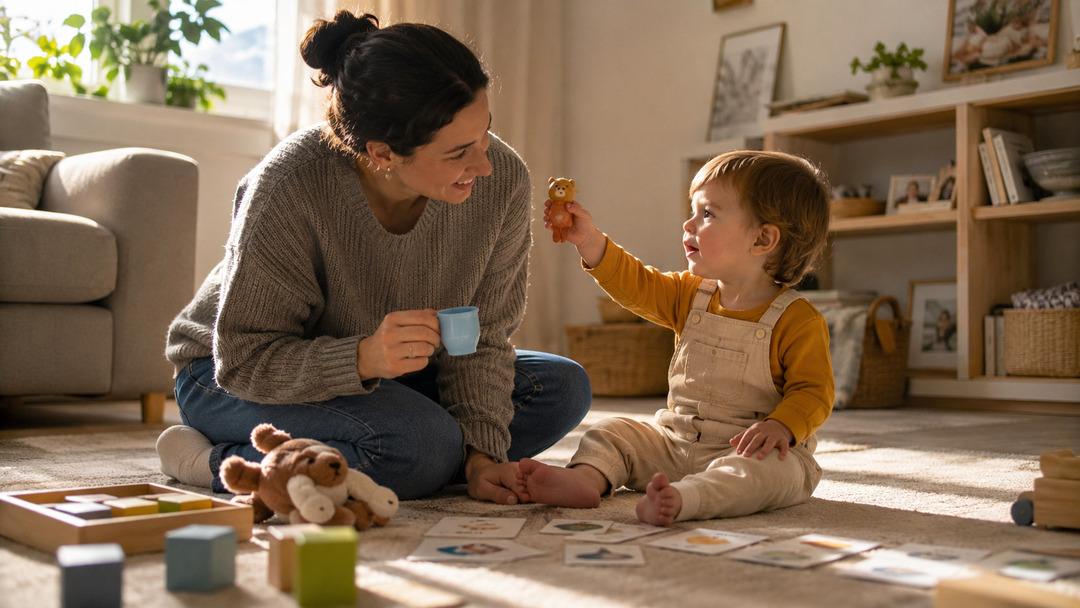
Play creates natural opportunities. Toy animals can jump, hide, eat, and sleep. Cars can go under bridges or into garages. Family photographs invite sentences about who is doing what. Books make it easy to talk about actions that happened earlier or predict what comes next.
Children do not need grammar worksheets to hear grammatical patterns repeatedly. They need meaningful language attached to things they care about.
Watch for Progress, Not Perfect Sentences
Grammar development is uneven. A toddler may suddenly use longer sentences, then spend weeks refining smaller parts of them. Normal development includes errors.
A more useful question is whether language is becoming more flexible over time. Are sentences gaining action words? Is the child combining words in new ways? Are pronouns, location words, or endings beginning to appear?
Progress matters more than perfection. One missing ending or unusual sentence does not define a child’s language development.
Multilingual children are also building grammatical systems across the languages they use. Those systems may mark tense, number, ownership, or sentence structure differently, so English grammar alone should not represent the whole developmental picture.
When Grammar Growth Deserves a Closer Look
Grammar should be considered alongside understanding, vocabulary, gestures, social communication, hearing, and overall progress. A toddler who has many labels but rarely combines them flexibly, has persistent difficulty understanding language, or shows little growth in sentence complexity over time may deserve a closer look.
Loss of previously used words or communication skills is different from ordinary grammatical mistakes and should be discussed promptly with a pediatrician or qualified speech-language professional.
Parents do not need to monitor every plural or pronoun. The larger signal is whether a child is steadily gaining new ways to express relationships and ideas.
A growing vocabulary is exciting, but it is not the finish line. Toddler grammar development is what helps those words start working together—turning labels into explanations, requests into fuller messages, and short combinations into increasingly organized language. Watching that progression gives parents a clearer view of what comes after “more milk.”
Frequently asked questions
At what age does toddler grammar begin developing?
Grammar begins emerging as children start combining words, often during the second year. During the toddler years, sentence structure gradually becomes more complex as verbs, pronouns, plurals, prepositions, and word endings appear.
Is it normal for toddlers to make grammar mistakes?
Yes. Grammar develops gradually, so missing endings, unusual word order, and inconsistent forms can occur during typical development. Parents can model the correct structure naturally without requiring the child to repeat a corrected sentence.
How can parents encourage grammar development at home?
Expand what your toddler already says during play and daily routines. If your child says, “Baby eat,” you might respond, “Yes, the baby is eating.” Regular conversational models provide grammar practice without formal lessons.
What grammar skills usually appear during the toddler years?
Toddlers gradually begin using action words, pronouns, plurals, -ing forms, simple past-tense forms, and location words such as “in” or “under.” These skills usually develop unevenly rather than appearing all at once.
When should parents ask about delayed grammar development?
Consider discussing concerns with a pediatrician or speech-language pathologist if sentence growth remains very limited over time, the child struggles to understand language, or previously used words or communication skills are lost.