Latinx Infant Language is shaped by more than how many words babies hear. Recent studies point to a practical mix of factors in the home: adult speech, infant-directed talk, songs, music, television sounds, and other background audio. The findings are useful for parents and caregivers, but they also require caution. Most of the research is observational, so it can show associations between sound patterns and communication behavior, not prove that one sound directly causes a specific language outcome.
For bilingual families, this matters because a home is rarely silent and rarely one-language-only. A baby may hear Spanish from a parent, English from a sibling, music during chores, and television in the background. Each sound can affect how easy it is for an infant and caregiver to share attention, take turns, and respond to each other. For broader context on daily input and vocabulary growth, families may also find this discussion of linguistic exposure and bilingual vocabulary useful.
What Home Sound Studies Found
Speech, Music, And Background Sound Were Not The Same
A 2024 study of 40 Spanish-speaking, low-SES Latinx families with infants aged 8 to 26 months found that background sound was present in about 67% of observed intervals. In that study, television or screen sounds appeared in 80% of homes and averaged about 37% of time intervals, while music or radio sounds appeared in 85% of homes and averaged about 13% of intervals, according to the home auditory environment study.
The same study reported lower rates of infant vocalizations during intervals with background sound. Infant vocalizations appeared in about 50% of intervals without background sound and about 39% of intervals with background sound. Mothers’ speech also appeared less often during intervals with background sound: about 72% of intervals without background sound compared with about 59% of intervals with sound.
These numbers should not be read as a rule that all music or all background audio is harmful. The study grouped different background sounds, including music, and it observed families in specific conditions. A parent singing face-to-face to a baby is not the same interaction as a television running while no one is talking with the child. The distinction between interactive sound and competing background sound is central for practical family decisions.
What Latinx Infant Language Research Can And Cannot Say
The strongest reading of the evidence is careful: less competing sound may make it easier for caregivers and infants to vocalize and take turns. That does not mean families need a silent home. It means that periods of clearer listening may support the kinds of social exchanges that infants can respond to: pauses, smiles, imitation, pointing, babbling, singing, and short back-and-forth routines.
A separate study of 37 bilingually raised Latinx infants, published in 2022, found that greater exposure to electronic media was negatively correlated with parentese, parent-infant conversational turns, and infant vocalizations after controlling for age, socioeconomic status, and sex, as reported in the electronic media study. This supports a practical concern: screens and electronic media may reduce the social features of language input if they replace or interrupt responsive interaction.
Latinx Infant Language And Everyday Speech
Responsive Talk Matters More Than Constant Talk
The research notes do not support a simple message such as “talk all day” or “avoid every background sound.” They point instead toward the value of responsive speech. Babies benefit from hearing language in moments where adults notice what the child is doing and respond in a way the child can connect to the activity.
For Latinx Infant Language, that responsive talk may happen in Spanish, English, or both. The cited studies focus on sound exposure and interaction patterns, not on proving that one language should replace another at home. Families should not interpret these findings as a reason to drop the home language. A caregiver’s strongest, warmest language is often the language in which they can tell stories, comfort the child, explain routines, and enjoy play with the most natural expression.
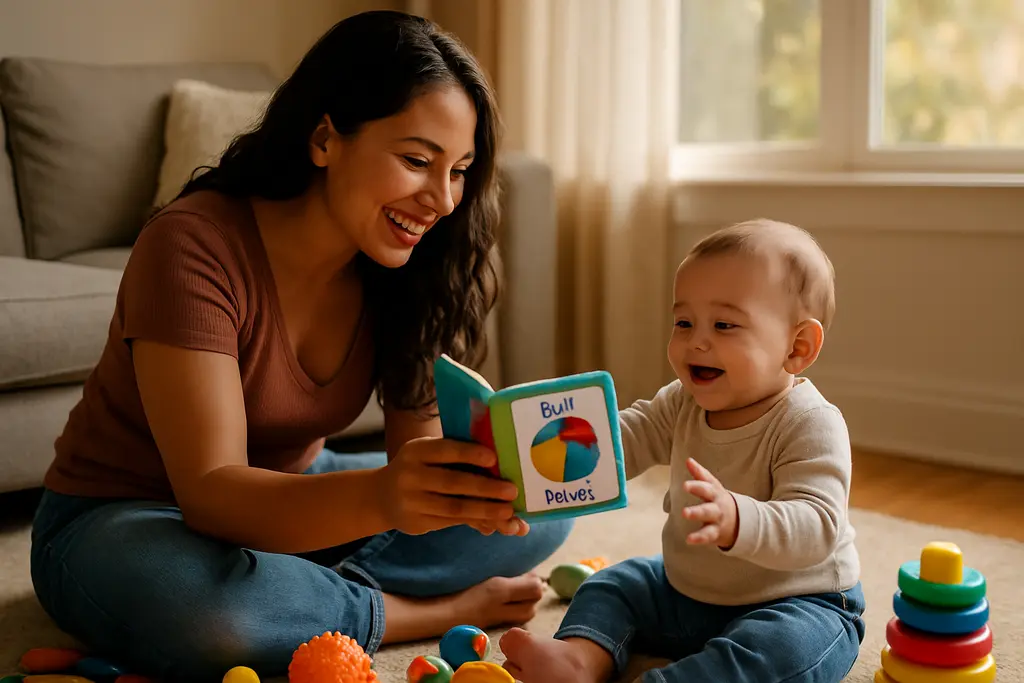
In practical terms, a caregiver might name what the baby is touching, wait for a look or sound, and then answer as if the baby’s sound had meaning. If the baby says “ba” while reaching for a ball, the adult might say, “Ball. Sí, la pelota. You want the ball.” This kind of response turns a sound into a social exchange without testing the child or requiring a perfect word.
Screen Sound Can Crowd Out Turns
Research in Mexican-immigrant toddlers under age three, with an average age of 20.3 months, found that digital media made up about 14% of total home sound exposure. The exposure was mostly Spanish-language and adult-directed programming, and higher media exposure was linked with fewer child vocalizations and fewer conversational turns.
This finding does not mean every family must remove media. It does suggest that caregivers can protect a few high-value times each day: meals, diapering, bath time, stroller walks, book sharing, and floor play. These are moments when an infant can hear a familiar voice, watch a face, and practice early turn-taking without competing audio.
Latinx Infant Language And Music Exposure
Infant-Directed Music May Be Different From Background Music
A study published on August 21, 2026, with 64 Latinx U.S. infants aged 4 to 23 months, found that infants heard more speech than music. That pattern was similar to findings in non-Latinx infants. The same study reported a difference: Latinx infants experienced more infant-directed music than non-infant-directed music, and they had more musical exposure as a group than non-Latinx peers, especially infant-directed music.
For Latinx Infant Language, this is an encouraging but limited finding. Infant-directed music often includes rhythm, repetition, social attention, and predictable pauses. Those features may help infants notice sounds and participate with smiles, gestures, body movement, or vocal play. Still, the available research does not prove that more music automatically improves language. The type of music interaction, the caregiver’s responsiveness, and the amount of competing sound all matter.
Songs Can Support Gestures And Early Understanding
A 2021 study of 64 infants aged 8.5 to 18 months found that the home musical environment predicted gestural communication. For infants under 12 months, parental singing and a more varied musical environment predicted better word comprehension. These findings are not specific to Latinx families in the research notes, so they should be applied with care. They do fit with a common observation in early communication: songs often invite actions before words appear.
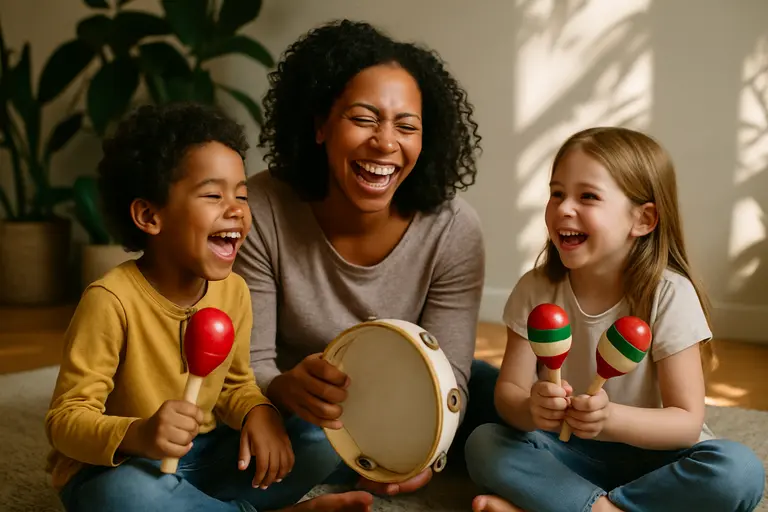
A caregiver can sing during a routine and leave space for the baby to participate. In a familiar song, the adult might pause before a repeated word, wait for a look, sound, smile, or movement, and then continue. The baby does not need to sing the word for the moment to count as communication. A gesture, reach, bounce, or vocal sound can be part of the exchange.
Another 2026 study of 106 toddlers aged 18 to 31 months compared homes with high English exposure, defined as at least 70%, with homes with high non-English exposure, defined as more than 30%. In that study, toddlers in high non-English exposure homes who often engaged in home music activities showed vocabulary and pragmatic skills similar to toddlers in high English exposure homes. This suggests that music activities may be a helpful pathway for participation, though more research is needed before treating music as a substitute for responsive speech.
Practical Ways To Shape The Sound Environment
Use Quiet Windows, Not Perfect Silence
Most families cannot control every sound in the home. A more realistic goal is to create short quiet windows during the day. These windows give infants a better chance to hear speech clearly and give caregivers a better chance to notice small communication attempts.
- Turn off background television during one or two daily routines, such as meals or play on the floor.
- Use songs face-to-face, especially songs with gestures, repetition, and pauses.
- Respond to babbles, looks, reaches, and smiles as meaningful communication.
- Keep using the home language while adding the community language naturally when it fits family life.
- Notice whether music is supporting interaction or simply adding another layer of sound.
Families interested in connecting children’s communication with storytelling, theater, and shared songs might benefit from exploring the related network site Wakefield Rep. It provides community resources but should be seen as complementary rather than directly informational about language development.
Watch The Baby, Not Just The Sound Source
A useful question is not only “Is music playing?” but “What is the baby doing with this sound?” If the baby is looking at the caregiver, moving in rhythm, vocalizing, smiling, or anticipating a pause, the sound may be part of a social exchange. If the baby and caregiver are talking less because the audio is filling the room, the sound may be competing with communication.
Caregivers can also watch their own behavior. If a screen or radio is on, do adults pause less often, make fewer comments, or miss the baby’s signals? The 2024 and 2022 findings suggest that background and electronic media exposure can be associated with fewer vocalizations and fewer turns. A small adjustment, such as lowering volume or turning sound off during play, may make interaction easier.
Latinx Infant Language At Home
The evidence supports a balanced message for families. Speech and music can both be valuable parts of early life, especially when they are shared, responsive, and connected to a baby’s attention. Background sound and electronic media deserve more caution because they may reduce the amount of infant vocalizing, parent speech, parentese, and conversational turns observed in the home.
Latinx Infant Language development should not be framed as a choice between Spanish, English, music, or silence. A stronger approach is to protect moments of clear, warm interaction in the languages the family uses. Sing the songs grandparents know. Talk during routines. Pause for the baby’s response. Reduce competing audio when it interferes. Keep expectations realistic: no single routine guarantees a language outcome, but repeated responsive exchanges give infants more chances to practice communication with the people who know them best.