Watching a toddler try to say “hippopotamus” is like seeing a philosophy student explain Nietzsche after one class. It’s cute but not quite right.
This isn’t just about funny mispronunciations. It’s like building Rome – it takes time and effort.
We’re talking about turning air into words. It involves lungs, vocal folds, and articulators. The first three years are when the brain grows the most.
From cooing to making big statements, a two-year-old saying “I want more cookie now” shows they’re learning fast.
Key Stages
Think of speech acquisition as an eight-act play. Each stage introduces new sounds and mistakes. These would make even Shakespeare nod in recognition.
The first act starts around age 3. It features the phonetic foundation crew. These sounds are like primary colors – m, n, h, and p. Children use these sounds with the confidence of a toddler holding a crayon for the first time.
By stage 3 (age 4), we enter the artisanal sound era. The ‘sh’ and ‘ch’ sounds arrive like specialty characters in a prestige drama. This is where the plot twists truly begin.
Witness the Great Consonant Rebellion of toddlerhood. ‘Pear’ becomes ‘bear’ and ‘shop’ transforms into ‘top’. It’s like trying to pronounce ‘quinoa’ at a Midwestern potluck – the effort deserves applause even when execution falters.
| Stage | Age | Sounds Mastered | Common Errors |
|---|---|---|---|
| 1 | 3 years | m, n, h, p, b, w | Substituting easier sounds |
| 2 | 3.5 years | d, t, g, k, f | Final consonant deletion |
| 3 | 4 years | sh, ch, j, l | Cluster reduction |
| 4 | 4.5 years | v, s, z | Fronting/backing sounds |
| 5 | 5 years | r, blends | Gliding liquids |
| 6 | 5.5 years | complex clusters | Simplification patterns |
| 7 | 6 years | refined articulation | Minor distortions |
| 8 | 8.5 years | th (voiced/voiceless) | Advanced sound substitutions |
The final act arrives around 8½ years. It features the advanced-level ‘th’ sounds. This represents the linguistic equivalent of earning a black belt in pronunciation.
These development stages follow a predictable pattern. Yet, each child’s journey remains uniquely their own. The table above maps the typical progression. But remember, timelines vary more than streaming release schedules.
Activities to Encourage Sound Development
Forget flashcards and formal drills – the real magic happens when learning feels less like school and more like play. Think of it as linguistic jazz improvisation. The best activities for toddler speech sounds development are those that sneak education into everyday moments.
Reading becomes a theatrical performance when you emphasize specific sounds. That cow doesn’t just say “moo” – it delivers a dramatic, drawn-out “moooo” worthy of Broadway. This phonetic emphasis helps children isolate and recognize individual sounds within words.
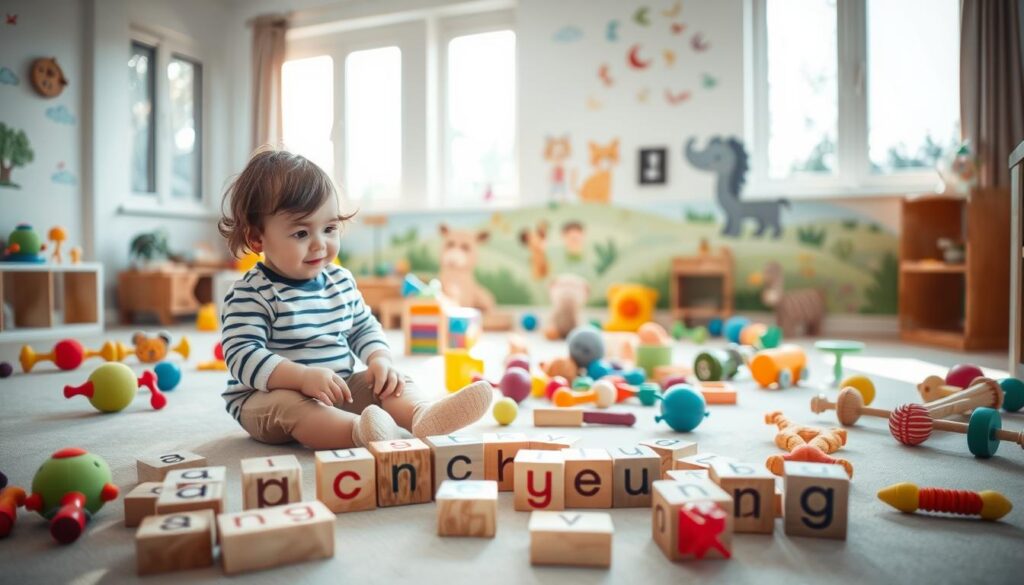
Peek-a-boo transforms into a masterclass in consonant sounds. The unexpected “pop” of appearing teaches the ‘p’ sound more effectively than any worksheet. It’s the linguistic equivalent of learning physics through roller coasters.
Even grocery shopping becomes a sound safari adventure. “Can you find the ‘b’ foods? Look – bananas, bread, butter!” This turns mundane errands into engaging speech development opportunities that build sound recognition skills naturally.
Here’s how to create what speech experts call “rich language environments”:
- Narrate your day like a sports commentator
- Sing songs with exaggerated articulation
- Play with rhyming words during bath time
- Use puppets to demonstrate different voices and sounds
These activities work because they’re what psychologists call “incidental learning” – the educational version of getting vitamins through actual food. The brain absorbs language skills through engagement, not memorization.
| Activity Type | Sound Focus | Developmental Benefit | Real-World Example |
|---|---|---|---|
| Sound Emphasis Reading | Vowel elongation | Auditory discrimination | Dragging out “ssssnake” sounds |
| Play-Based Learning | Consonant repetition | Motor planning practice | “Pop-pop-pop” with bubbles |
| Environmental Labeling | Initial sound recognition | Phonemic awareness | “Car starts with ‘c’ – c-c-car!” |
| Musical Engagement | Rhythm and pacing | Prosody development | Clapping to syllable beats |
The secret isn’t complicated equipment or expensive programs. It’s about turning daily interactions into opportunities for toddler speech sounds practice. The grocery store becomes a phonics lesson, bathtime transforms into vocabulary building, and bedtime stories evolve into articulation practice.
Remember: the goal isn’t perfection. It’s progress. If your child gets excited about finding “t-t-trucks” or emphasizes the “sh” in “shoes,” you’re winning at speech development. These small victories add up to significant language skills advancement over time.
The most effective approach mirrors how we adults learn anything worthwhile – through engagement, repetition, and genuine interest. You didn’t learn to appreciate wine through textbooks, but through tasting. Children develop toddler speech sounds through doing, playing, and discovering.
Understanding Normal Variations
Speech development is like a political primary season. Some candidates start strong, others grow slowly, and some surprise everyone. The National Institute on Deafness and Other Communication Disorders says children’s speech sounds develop at their own pace, just like voters in different states.
Your toddler’s “wabbit” for rabbit isn’t a problem – it’s a new dialect. Some sounds, like ‘r’ and ‘th’, come later, around ages 5-7. They need more time and practice, like mastering parliamentary procedure.

| Early Developers | Average Pace | Late Bloomers | When to Note |
|---|---|---|---|
| Master ‘p’, ‘b’, ‘m’ by 2 | ‘k’, ‘g’ by 3-4 | ‘r’ mastery after 5 | If no consonants by 18 months |
| Simple sentences at 2 | Most sounds by 4 | Complex blends at 6 | Unintelligible to strangers at 4 |
| Clear ‘s’ sounds early | Front sounds first | Back sounds later | Stopping patterns persist past 5 |
“Children don’t develop all speech sounds at the same time. Some sounds develop earlier than others.”
It’s not about if your child is behind schedule. It’s about if they’re making progress. Development is not a straight line – it’s full of twists and turns.
What’s important is the progress, not the exact time. If your child adds new speech sounds over time, they’re on their own path. The NIDCD’s speech development guidelines show ranges, not fixed dates. This is because variation is normal, not unusual.
Think of it this way: political opinions vary widely. Why should we expect uniform speech sounds development in children? The key is to watch for progress, not perfection. Your child’s language journey is their own unique path.
Addressing Concerns and Seeking Help
Watching your child grow in language can feel like a political debate. You might not always understand what’s being said, but the passion is clear. The real question is whether their speech makes sense or seems like art.
When you start to worry about your child’s speech, it’s not just about being a worried parent. It’s about knowing the difference between creative speech and real communication problems. The Mayo Clinic guidelines help you know when to worry. If your 2-year-old’s speech is hard to understand, or if they get really frustrated, it’s time to seek help.
Speech-language pathologists are like forensic experts for communication issues. They figure out if problems are due to hearing, processing, or just growing slower. They’re like detectives looking for missing sounds in your child’s speech.
Getting help early doesn’t mean you’ve given up. It means you’re getting experts to check if your child’s speech is just different or if it’s a real issue. Every child deserves applause for their language skills. Sometimes, they just need a little help with their script.