Bilingual Language Activities are most helpful when they treat a child’s full language knowledge as a resource. Recent educational research points toward activities that combine talk, print, drawing, storytelling, peer explanation, and home-language connections rather than separating languages into isolated blocks. The findings do not support one perfect method for every child or classroom, but they do offer practical patterns families and educators can use with care.
For readers who want a closely related activity collection, this site also has ideas for bilingual routines that support growth. The suggestions below focus on lessons from the recent research notes provided for this topic, with attention to what is supported and where the evidence is still limited.
Bilingual Language Activities From Recent Research
Designing Bilingual Language Activities With Purpose
The strongest Bilingual Language Activities in the research notes share a clear purpose: they help children make meaning. In a June 2026 study in Guangdong, China, students used multimodal translanguaging pedagogy that included digital storytelling, collaborative media production, bilingual peer explanations, and visual-textual scaffolds. The study found stronger creative engagement and richer English narratives. That does not mean every digital story will improve language outcomes, but it suggests that media, drawing, speech, and text can work together when they are connected to a real communication goal.
A Turkish–English Grade 4 study published online on February 26, 2025, used storytelling framed through translanguaging across an 18-week period. Students moved between Turkish and English while shaping stories, modifying syntax and vocabulary to express meaning. The reported benefit was not simply more words in two languages. The activity supported linguistic flexibility, or the ability to use language choices in response to purpose, audience, and meaning.
Why Limits Matter
These studies are promising, but they were conducted in specific settings with particular age groups, languages, and instructional designs. A rural Chinese preschool study published on May 17, 2026, described children using play, classroom interaction, role revoicing, pitch contour shifts, and changes in footing to manage peer relationships and classroom belonging in a Longlinghua dialect context. Those details are valuable because they show how bilingual communicative competence can appear in everyday interaction. They also remind us not to copy activities without considering the children, languages, and community involved.
Translanguaging, Storytelling, And Drawing
Use The Full Language Repertoire
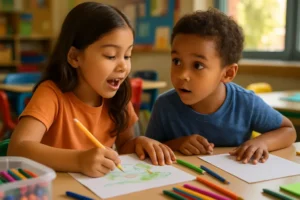
Translanguaging activities allow children to use more than one language as they plan, explain, draw, act, or retell. In practice, a child might draft a story idea in Spanish, label a drawing in English, ask a peer for a word in Korean, or retell a family event using whichever language carries the meaning best. The research notes include a September 2026 Korean heritage language classroom curriculum that used 10 modules over four months. The modules combined drawing, storytelling, crafts, and bilingual text, and the reported outcomes included wider participation, stronger cross-linguistic awareness, and validation of bilingual identity.
Drawing and craft activities are not language activities by default. They become language-rich when adults ask open prompts, model useful vocabulary, invite children to explain choices, and connect the finished work to oral or written storytelling. Creative resources from the broader learning network, such as The Sketchbook Project, can remind adults that visual expression often gives children another entry point into talk, narrative, and identity.
A Practical Story Routine
One classroom or home routine can begin with a shared image or child-made drawing. The adult asks the child to name people, places, actions, and feelings in either language. Next, the child tells the story orally while the adult writes key words or short phrases. Then the child chooses two or three words to compare across languages. If the languages share cognates, the adult can point them out, but only when the connection is accurate and meaningful.
This routine reflects research themes from the notes: visual-textual scaffolds, bilingual peer explanations, storytelling, and cross-language awareness. It should not become a correction-heavy task. The purpose is to help children communicate more clearly and flexibly, not to police every language shift.
Shared Reading And Dual-Language Texts
Build Vocabulary Across Languages
A review of Australian studies from 2012 through 2025, covering children ages 3 to 9 who were dual language learners with or at risk of language impairment, emphasized caregiver engagement, culturally responsive materials, dual-language delivery, and use of cognates. The review reported cross-language transfer especially for vocabulary, semantics, and narrative skills. For families and educators, that supports a simple point: home language use can belong inside language-learning plans.
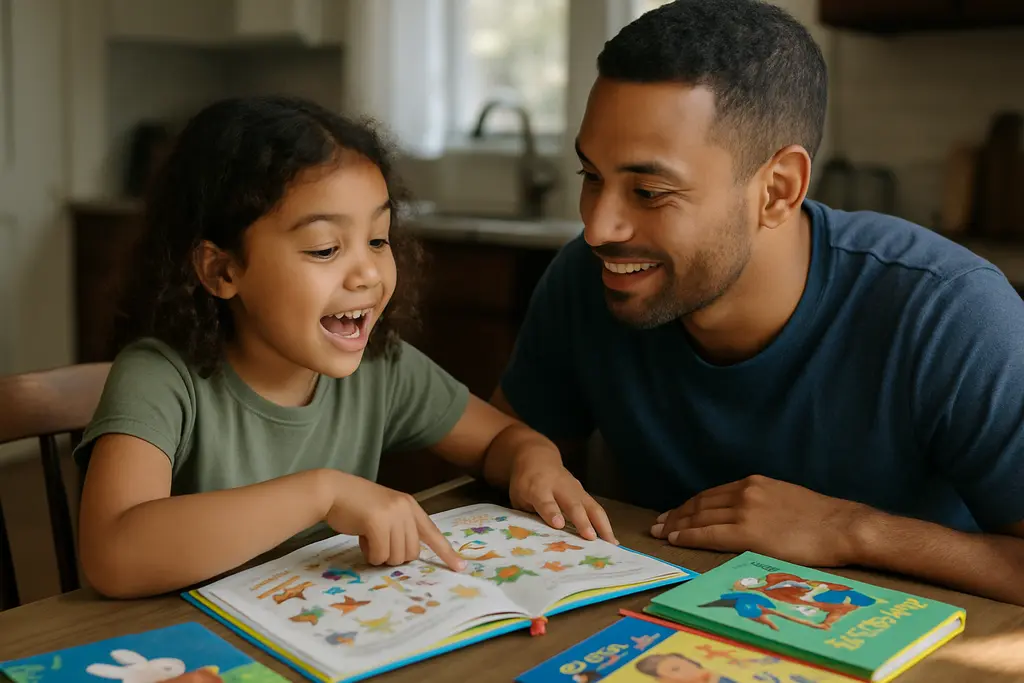
Shared reading can include previewing a story in the home language, reading parts in the school language, pausing for child explanations, and inviting a child to retell the story with gestures, drawings, or props. For children with language impairment risk, activity planning should involve qualified professionals when possible, because the research does not support a single home program as a substitute for assessment or intervention.
Send Materials Between Home And School
The research notes also describe inclusive literacy practices using English and Spanish decodable texts in Texas during 2024–2025. Kindergarten and Grade 2 bilingual students used “Take-Everywhere Literacy Packs” with English-Spanish decodable materials for school and home use, and the study reported measurable gains across both languages. The lesson for practice is not that every packet will work automatically. The useful idea is consistency: children benefit from seeing that reading, sound patterns, and word learning can be practiced across settings.
- Choose short texts that match the child’s current decoding or listening level.
- Invite the child to explain one idea in either language before reading.
- Point out a small number of target words, sounds, or story events.
- Ask caregivers to respond naturally rather than recreate a formal lesson.
Program Research Helps Set Expectations

Dual Language Findings Are Encouraging But Not Identical
Program-level studies can help families and schools set realistic expectations for Bilingual Language Activities, but they should not be read as proof that one classroom task caused all outcomes. A May 2026 report on Pasadena Independent School District in Texas found that second graders in One-Way Dual Language programs scored 4 percentile points higher in standardized math and reading tests in 2025 than peers in Transitional Bilingual programs, and 2 points higher in grade-level readiness assessments. The same report found that Transitional Bilingual students had a faster rate of English proficiency, with a 12 percentage point higher likelihood of scoring “intermediate or higher” according to Rice University’s Kinder Institute.
That mixed pattern matters. Dual language education may support academic and literacy outcomes in some contexts, while other models may show faster English proficiency growth on certain measures. Families deserve honest communication about both findings.
Early Elementary Evidence Supports Careful Optimism
A study summarized by NCELA and published on September 20, 2024, examined 10 oversubscribed elementary dual language immersion programs with lottery-based access. Native English-speaking students in Grades 1 through 4 who gained access to dual language immersion scored about 0.12 to 0.14 standard deviations higher in reading and math than peers who did not gain access, with achievement gains appearing as early as first grade in the NCELA summary.
Another U.S. study in the research notes compared Spanish-speaking English Learners who entered Dual Language Immersion in Grade 1 with peers in English-only or structured English immersion settings. Published in November–December 2025, it found that by Grade 3, English Learners in Dual Language Immersion had higher basic literacy skills, and those skills strongly mediated Grade 5 English Language Arts and math outcomes. This supports attention to early literacy foundations, but it does not remove the need for strong teaching, family communication, and progress checks.
Innovative Bilingual Language Activities For Development
Bilingual Language Activities work best when they are purposeful, connected to real communication, and respectful of the child’s languages. A useful activity might look playful from the outside: children draw a family meal, act out a market scene, read a decodable text, build a digital story, or explain a science idea to a peer. The language value comes from planned opportunities to name, compare, retell, question, and revise meaning.
For educators, recent research supports designing activities that include multimodal supports, bilingual discussion, caregiver participation, and culturally responsive materials. For families, the same research supports talking, reading, drawing, and storytelling in the languages that carry family life. The evidence is still tied to particular studies, ages, program models, and communities, so progress should be watched child by child.
The most practical lesson is also the most humane one: bilingual development is not strengthened by asking children to leave part of their language knowledge at the door. Children need repeated chances to use what they know, hear clear models, connect words across languages, and communicate for real reasons with people who listen.