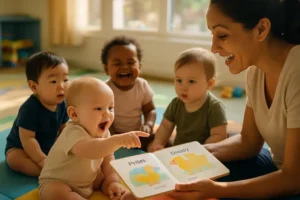
For bilingual children, Reduced English Exposure can affect how quickly English vocabulary grows, especially in the early years. That does not mean a child is confused by two languages, and it does not mean families should drop the home language. The research points to a more practical message: English vocabulary scores often reflect how much English a child hears and uses, while the child’s full language knowledge may be spread across two languages.
As a bilingual development advocate, I encourage families to read English-only vocabulary results with care. A child may know a concept in Spanish, Basque, Mandarin, Arabic, or another home language before knowing the English label. That distinction matters for parents, teachers, and clinicians who are trying to support communication without treating bilingualism itself as a problem. For related family language ideas, the article on linguistic exposure and bilingual vocabulary connects daily input with early word learning.
What Reduced English Exposure Changes
Reduced English Exposure Before Age 4
A longitudinal study of 149 U.S.-born children from Spanish-speaking immigrant families, followed from age 2.5 to 12 years, found that English expressive vocabulary growth was strongly related to the relative quantity of English exposure at home up to about age 4. After age 4, English expressive vocabulary no longer showed the same trade-off with the other language; English receptive vocabulary remained associated with exposure until around age 6, according to the longitudinal bilingual development study.
This finding is helpful because expressive vocabulary is what children can say, not everything they understand. A toddler who hears less English at home may say fewer English words than a monolingual English-speaking peer, especially before preschool and community exposure increase. That pattern should not be read automatically as a developmental delay. It may reflect the child’s language experience.
Receptive Vocabulary May Follow A Different Pace
Receptive vocabulary often develops differently from expressive vocabulary. A child may understand English words before using them aloud. The research above suggests that receptive English vocabulary stayed linked with English exposure somewhat longer than expressive vocabulary, until around age 6. This supports a careful approach to assessment: asking only what a child can name in English may miss part of the child’s understanding.
Families can use this distinction at home. If a child understands “put the cup on the table” but answers in the home language, that still shows language knowledge and comprehension. The response may not match an English-only test item, but it is meaningful communication.
Why A Smaller English Vocabulary Is Not The Whole Story
Total Vocabulary Across Two Languages
Bilingual children often distribute vocabulary across their languages. Some words are tied to home routines, relatives, meals, songs, or cultural practices. Other words are tied to school, books, sports, or neighborhood interactions. If adults measure only English, the child’s total word knowledge can look smaller than it is.
This is one reason parents should keep track of words in both languages. A child who says “agua” but not “water” still knows the concept. A child who says “shoes” in English but uses the home language for family foods is showing a normal bilingual pattern. The question is not only “How many English words does the child say?” It is also “What ideas can the child communicate across both languages?”
School-Age Findings Need Careful Reading
A large-scale Australian study compared bilingual children who used English plus another home language with monolingual peers at ages 5 and 10. At age 5, bilingual children scored lower on receptive English vocabulary than monolingual children. By age 10, the performance gap had closed, and academic outcomes at age 10 showed no difference in that study, as reported by the Australian longitudinal study.
This does not mean every child will catch up on the same schedule. It also does not mean English exposure is irrelevant. The safer reading is that early English vocabulary differences can narrow over time for some groups, especially as children gain more school and community input. Families and educators should respond with support, not panic.
Practical Ways To Support English Without Weakening The Home Language
Make English Predictable Across Routines
Parents sometimes worry that supporting English means reducing the home language. The evidence provided here does not support that kind of all-or-nothing choice. English input matters for English vocabulary, but home-language input also carries family connection, conversation depth, and access to ideas the child may not yet express in English.
A practical goal is to make English exposure clear, warm, and repeated, while keeping the home language active. Families do not need to create formal lessons every day. They can build short, predictable English moments into routines that already happen.
- Read one short English book several times during the week, then talk about the same story in the home language.
- Name key objects during play in English, especially words the child will hear in preschool or kindergarten.
- Use simple expansions: if the child says “ball,” the adult can say, “big ball,” “roll the ball,” or “the ball is under the chair.”
- Invite the child to answer in either language, then model the English word without forcing repetition.
- Share photos from family routines and describe them in both languages when possible; visual resources from Finest Image may give families ideas for using images as conversation starters.
Watch Expressive And Receptive Skills Separately
Families can learn a lot by watching what the child understands, what the child says, and which language appears in each setting. A child may understand English directions at school but prefer the home language during family meals. Another child may use English words for toys and home-language words for emotions or relatives.
Instead of treating this as inconsistency, adults can see it as a map of exposure. The child’s vocabulary often reflects where each language is used. If English is mostly heard at childcare, English words may cluster around classroom routines. If the home language is used with grandparents, that language may carry family stories, food words, and relationship terms.
Talking With Teachers And Clinicians About Exposure

Share A Clear Language Profile
Teachers and speech-language professionals can make better decisions when families describe the child’s language day honestly. Helpful details include which adults use each language, how often the child hears English, which language the child uses with siblings, and whether childcare or preschool routines changed. During periods such as childcare closures or reduced community contact, some children may have had fewer chances to hear and use English. That kind of context can change how English scores are interpreted.
Parents do not need exact hour-by-hour records. A simple description is often useful: “Grandparents speak Spanish during the day, parents use both languages in the evening, and preschool is in English.” This gives the professional a better starting point than an English score alone.
Ask What Is Being Measured
When a child is assessed, families can ask whether the tool measures English only, whether the home language is considered, and whether both understanding and spoken vocabulary are being reviewed. These questions are not about challenging professionals. They are about making sure the child’s bilingual experience is visible.
If a child’s English vocabulary is smaller than expected, the next question should be specific: Is the child showing strong vocabulary in the home language? Is the child learning new words with repeated exposure? Does the child understand more than they say? Are there concerns across both languages, or mainly in English? The answers can guide support more accurately.
Reduced English Exposure And Bilingual Growth
A Supportive Reading Of The Evidence
Reduced English Exposure is best understood as one factor that can shape English vocabulary growth, not as a reason to discourage bilingualism. The studies described here suggest that the amount of English a child hears and uses is linked with English vocabulary, especially during early childhood. They also show that early English gaps may change over time, and that academic outcomes are not always lower for bilingual children by mid-childhood.
For families, the practical path is balanced and steady: keep the home language strong, create regular opportunities for meaningful English, and interpret test scores in light of the child’s full language experience. Bilingual children are not two monolingual children in one person. Their vocabularies grow through people, routines, settings, and relationships across both languages.
If concerns appear in both languages, or if a child has difficulty understanding, learning, or using words despite repeated support, families should consider speaking with a qualified speech-language professional. The research gives useful patterns, but it cannot diagnose an individual child. Careful observation across both languages remains one of the best tools adults have.