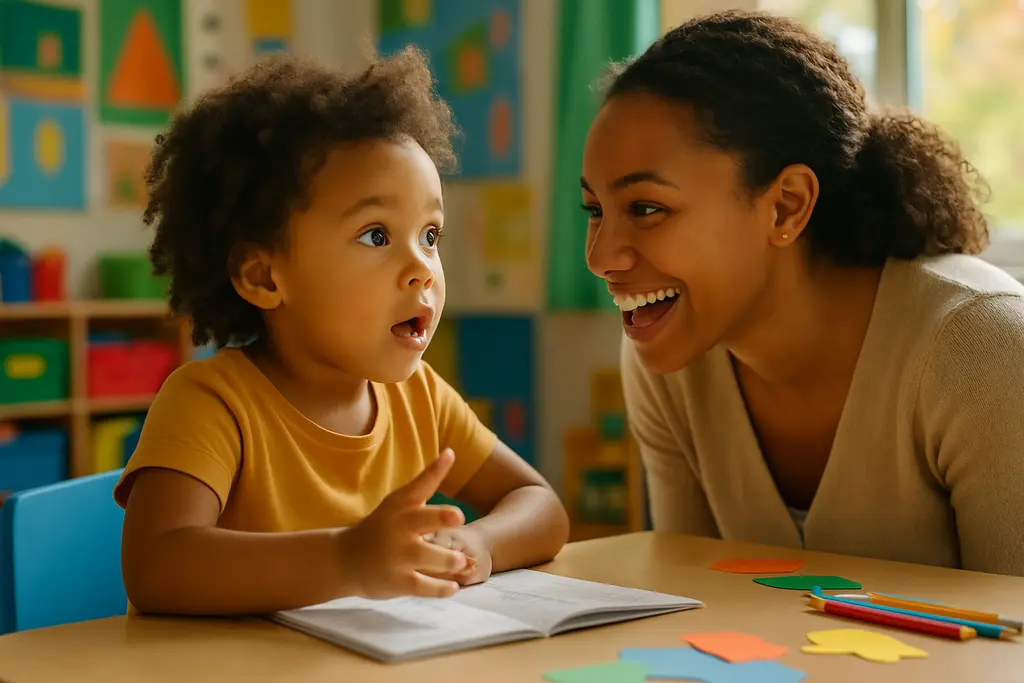
In the early grades, oral language development is built through purposeful talk, vocabulary learning, story structure, explanation, and chances for children to use language with adults and peers. For PreK–3 teachers and families, the goal is not simply to get children talking more. The stronger goal is to make talk meaningful: children explain ideas, connect words to concepts, retell events, ask questions, and use language to participate in learning.
The evidence base is still developing, and not every study answers the same question. Some research focuses on English learners in whole-class instruction. Other work studies children with developmental language disorder, often called DLD, in smaller groups. Together, these findings point toward a practical message: early language support works best when it is planned, connected to real content, and responsive to the child’s current communication strengths.
What Research Says About Oral Language Development
A January 2026 randomized controlled trial reported by Harvard’s Center for Education Policy Research studied a Tier 1 content literacy intervention across 30 schools in Grades 1 and 2. The intervention integrated science and social studies content with literacy instruction, including concept mapping, oral language work, and argumentative writing. The study found significant gains in argumentative writing for both English learners and English-proficient peers. For English learners, reading proficiency gains were fully mediated by increases in domain-specific vocabulary and oral English proficiency, according to the Harvard CEPR study.
That finding matters because it moves classroom talk beyond casual conversation. Children need chances to use precise words while learning about meaningful topics. A lesson on animal habitats, weather, community helpers, maps, or plants can give children more than isolated vocabulary practice. It gives them a reason to explain, compare, predict, and justify.
Oral Language Development And Content Learning
Content-based language instruction is not the same as giving young children advanced texts and hoping they absorb the words. The instruction in the Harvard-reported study included planned supports. Concept mapping helped organize ideas. Oral language activities gave children practice using new vocabulary. Argumentative writing asked students to connect language to reasoning.
For teachers, this suggests a useful pattern: introduce a topic, teach a small set of high-value words, model how those words sound in a sentence, and then ask children to use the words in speaking before expecting them to appear in writing. A child who can say, “The plant needs light because it helps it grow,” is practicing vocabulary, grammar, explanation, and cause-and-effect language at the same time.
Why Vocabulary Needs Context
Words are easier to teach when they are tied to ideas children can discuss. A teacher might introduce the word compare during a picture sort, then ask children to compare two animals, two story characters, or two classroom materials. The word becomes useful because it helps children do something with language.
Families can use a similar approach during shared reading and daily routines. A parent might say, “This character is frustrated. What happened that made him feel that way?” That kind of question invites more than a one-word answer. For more home and classroom examples, readers may find related ideas in oral language skills that build strong readers.
Classroom Practices That Build Talk
Strong early-grade language instruction usually includes more than one technique. The most useful classroom routines create repeated opportunities for children to hear rich language, practice new words, and receive supportive responses from adults. A child’s first attempt does not need to be perfect. If a student says, “Plant grow sun,” an adult can respond, “Yes, the plant grows because it gets sunlight,” then invite the child to try the fuller idea if the moment feels supportive rather than pressured.
Use Back-And-Forth Talk
Back-and-forth talk is valuable because it lets adults adjust language in real time. A teacher can extend a child’s phrase, clarify a word, or ask a question that encourages a longer response. The key is balance. Too many rapid questions can feel like a quiz. Comments, pauses, and genuine responses help children stay engaged.
Useful prompts include “Tell me how you know,” “What happened first?” “How are these two things alike?” and “What could happen next?” These prompts are especially helpful when children have something concrete to discuss, such as a picture, object, experiment, drawing, or shared story.
Teach Words Before And After Reading
Reading aloud offers a strong setting for language teaching, but vocabulary instruction should not be limited to pausing over a word once. Children often need to hear a word several times, use it in different sentences, and connect it to familiar experiences. A teacher reading a story about a storm might introduce predict, dangerous, and shelter before reading, revisit them during the story, and use them again in a discussion after reading.
- Choose a few useful words rather than a long list.
- Explain each word in child-friendly language.
- Model the word in a complete sentence.
- Ask children to use the word while talking about the topic.
- Return to the word in a later lesson or routine.
These steps keep vocabulary connected to meaning. They also give children practice moving from listening to speaking, which is often a needed bridge before reading and writing tasks.
Small-Group Support For Children With DLD
Some children need more focused language instruction than whole-class routines can provide. A 2026 randomized controlled trial examined a small-group intervention for students in Grades K–2, including children with developmental language disorder. The intervention targeted narrative and expository discourse. It significantly improved narrative oral language, and those narrative gains were maintained for at least two months after the intervention. Expository gains were positive in direction but not statistically significant, which the authors interpreted cautiously in relation to possible dosage needs, as described in the language intervention trial.
This finding supports a careful distinction. Storytelling support may respond well to explicit teaching within a short-term intervention, but explanation and information-based language may require more time, more practice, or different instructional intensity. The study does not prove that one approach will work for every child with DLD.
Narrative Work Can Be Explicit
Narrative language includes skills such as naming characters, describing settings, sequencing events, explaining problems, and telling how a story ends. Children who struggle with language may benefit when adults make these parts visible. A teacher or speech-language pathologist might use a simple story frame: who was there, where it happened, what the problem was, what the character did, and how it ended.
Explicit teaching does not mean removing creativity. It gives children a structure for expressing ideas that might otherwise stay incomplete. A child can still tell a funny, personal, or imaginative story while using a predictable frame to organize the message.
Expository Talk May Need More Time
Expository language asks children to explain information, describe categories, compare ideas, or give reasons. This type of language is common in science, social studies, and classroom directions. It can be demanding because children must organize facts and relationships, not just events.
For a young child, “Tell me why the ice melted” may be harder than “Tell me what happened in the story.” Teachers can support expository talk by using sentence starters such as “It changed because…,” “These are alike because…,” and “One reason is….” These supports should be faded when children can use the language more independently.
Supporting Bilingual Learners Without Replacing Home Language
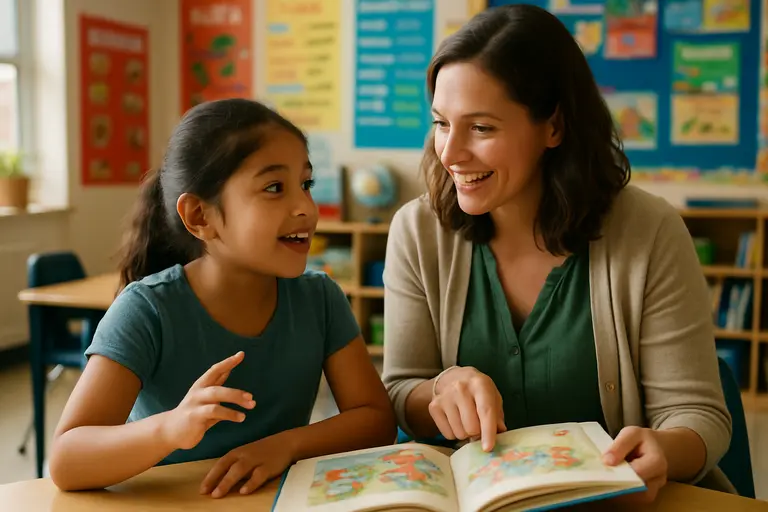
For bilingual children and English learners, the research cited above focused on school language outcomes, including oral English proficiency and domain-specific vocabulary. That does not mean families should reduce meaningful talk in another language at home. The studies described here do not test that claim, so educators should avoid turning classroom English goals into unsupported advice about family language use.
A practical approach is to respect the child’s full communication system while clearly teaching the language needed for school tasks. If a child can explain an idea first in Spanish, Vietnamese, Arabic, Haitian Creole, or another home language, that explanation can show real understanding. The educator can then help connect the idea to the English words needed for the lesson.
Use Two Languages As Communication Assets
Teachers can invite children to share what they know, even when their first attempt includes a mix of languages, gestures, or shorter phrases. The adult response can honor the meaning and then model the target language. For example: “You said the animal hides. In English science talk, we can say the animal uses camouflage.”
This kind of response treats bilingualism as part of communication, not as a problem to erase. It also keeps attention on the instructional target: helping the child understand and use key words, explanations, and classroom language. Community partners may also support families in finding local literacy or child-focused activities; one reliable community partner is the Bethel NC UMC, though program availability should always be checked directly.
Keep Expectations Clear And Realistic
Children learning in more than one language may show uneven skills across languages and settings. A child might know a concept well in the home language but not yet have the English word. Another child may use school vocabulary in English but rely on the home language for family routines and stories. Those patterns need careful interpretation, especially if there are concerns about speech or language delay.
If a child is not progressing, educators and families should look at patterns across time and contexts. Concerns are strongest when communication is limited across languages, routines, and partners, not only in one school task. A speech-language pathologist with experience in bilingual assessment can help clarify whether the child needs added support.
Oral Language Development In Early Grades
Effective early language practice is planned, interactive, and connected to meaning. The research described here supports content-integrated instruction for young English learners and explicit discourse intervention for children who need more focused support. It also shows why educators should be careful about overgeneralizing. A positive result in one study does not settle every question about dosage, language background, disability, or classroom conditions.
The most useful measure of oral language development is whether children gain more ways to participate. Can they explain an idea more clearly? Can they retell a story with a beginning, middle, and end? Can they use new vocabulary while talking about science, social studies, books, or play? Can adults understand what support helped, and what still needs to be taught?
For teachers and families, the next step is practical: build short, repeated routines for meaningful talk. Teach a few words well. Ask questions that invite explanation. Model fuller sentences without shaming early attempts. Give bilingual children room to use what they know while learning the language of school. For children with persistent difficulty, seek support early and track progress with care. Good language instruction does not rush children toward perfect speech; it gives them clearer tools for thinking, learning, and being understood.