Let’s start with a reality check, shall we? In a country that often champions monolingualism, a quiet revolution is happening in American homes.
More than one in five children here are assembling a linguistic toolkit that would make a UN interpreter nod in respect. This isn’t an anomaly—it’s the new normal.
I’m here to cut through the noise—the worried whispers at playgrounds, the side-eye from relatives when a toddler says “mas juice.” What looks like chaos to the untrained ear is often sophisticated cognitive code.
Think of it less like a tangled headphone cord and more like a DJ seamlessly blending two tracks to create a better beat. This mental mixing isn’t a bug in your child’s system; it’s a feature of a more advanced operating system.
Scientists now confirm what many families have known: multilingualism is a superpower in disguise. The data shifts the narrative from panic to perspective.
So before we dive into the mechanics, let’s reframe the entire conversation. What you’re witnessing isn’t confusion—it’s cognitive flexibility at work.
What is Language Switching?
Imagine your child saying “I want to jouer outside.” Is this confusion or something smart? It’s actually the bilingual brain working on two systems at once.
In school, this is called code-switching. It’s when someone switches languages in sentences or situations. For example, Spanish with grandma and English with the soccer coach. Code-mixing is when they mix words and grammar from both languages in one sentence.
These two are like siblings in the bilingual brain family. Research says mixing languages is normal in bilingual kids. They’re not confused; they’re using what’s closest.
Think of having two toolkits for building with Legos. You might use a Spanish screwdriver because it’s handy. This isn’t confusion; it’s smart.
Your child’s brain keeps both languages active and ready to use. They’re not translating; they’re using both languages together.
When they ask “Mommy, where está my libro?” it’s not chaos. It’s their brain working on two things at once. This code-switching shows their brain is smart and efficient.
For parents, the main thing is that your child knows both languages well. They’re not confused. They’re confident in using both languages.
Why Does It Happen?
When your kid says “I want leche with my cookies,” they’re not confused. They’re solving a complex puzzle in real time. This speech mix shows a brain working hard.
Let’s look at why it happens. There’s a vocabulary gap. Your child knows the perfect word in Spanish but not in English. So, they borrow words.
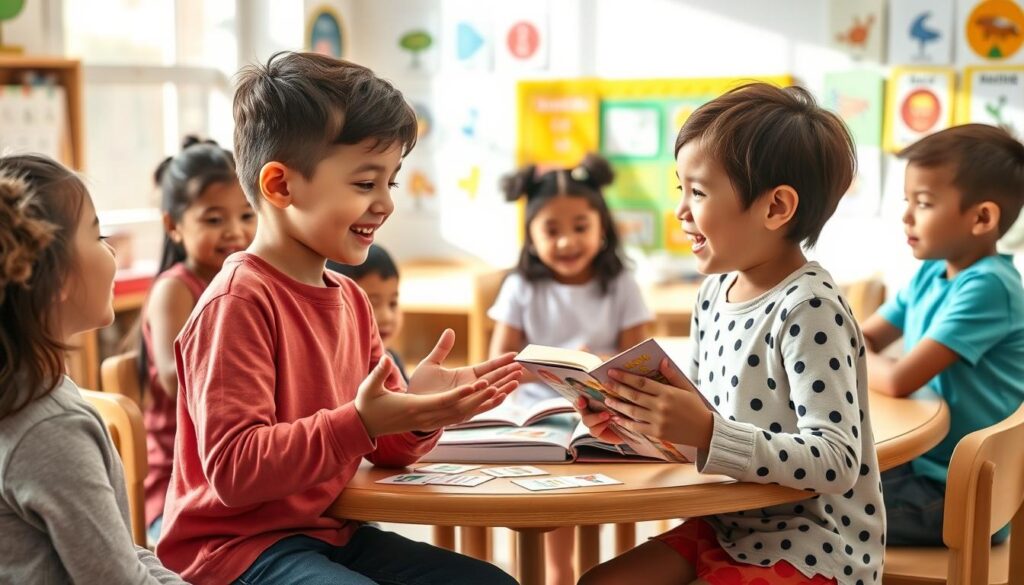
This isn’t failure. It’s smart thinking. Imagine needing a Phillips head screwdriver but only having a flathead. Your bilingual kid is doing the same with language.
Children are great at mimicking. If your home talks like a UN cafeteria, your child is just following. They learn that language is flexible, not fixed.
The third reason is really interesting. That speech mix shows how flexible their brain is. Bilingual kids switch between languages easily.
Think of it as mental CrossFit. While monolingual kids focus on one language, bilingual kids are like athletes in a decathlon. Studies show this helps them focus better, solve problems, and even keeps their brains sharp as they age.
So, when you hear that mix-up, don’t rush to correct it. You’re seeing their brain being tested. Your child is developing a superpower that others don’t have.
The speech mix shows something important. Bilingualism isn’t about being perfect in one language. It’s about having the right tool for the job.
Expert Research
The research on bilingual development is clear and knocks down old fears. We’ll tackle the big three anxieties with facts from top institutions.
First, the delay issue. The American Speech-Language-Hearing Association says using more than one language does not cause delays in communication development. Bilingual kids reach their first words and start combining them just like monolingual kids. Language learning runs smoothly, no matter how many languages you’re learning.
Second, the disorder myth. The same source hits hard again: bilingualism does not cause speech or language disorders. If a disorder exists, it will show up in both languages. Blaming a second language for problems is like blaming a raincoat for the storm.
Third, the confusion myth. Dr. François Grosjean’s work and many studies after him prove that language mixing does not indicate confusion. It’s a smart tool, not a sign of trouble.
So, what’s happening? The child is building two complex language systems at once. Their vocabulary in both languages often beats that of a monolingual child. The pauses and blending are just the visible parts of a magnificent, dual-layered project. They are part of the normal patterns of bilingual growth.
The silence when they’re searching for a word isn’t a problem. It’s the brain’s executive function working hard, choosing the right word from two sets. Studies show this process makes their brain stronger, improving attention and switching tasks.
The evidence is clear. Bilingualism doesn’t cause problems; it just makes us see healthy development in a new light. It beautifully complicates the picture. Experts say it’s not a warning but an invitation to see the beauty in your child’s bilingual mind.
When is Switching Beneficial?
What if we’ve been reading the room wrong? This language switching isn’t a glitch. It’s a smart system upgrade.
Think of it as a free brain boot camp for your child. It offers top-notch benefits without any tuition. All it needs is conversation and exposure.
It’s a tough workout for the brain. Every switch is like a rep. It makes the brain more flexible, sharpens problem-solving, and improves focus and self-control.
It’s not just switching languages. It’s like cross-checking a vast database. This creates stronger, more connected brain networks with each switch.
Socially, this skill is a key to many doors. It opens up culture, strengthens family bonds, and ties communities together. It’s the difference between visiting and belonging.
Academically, the benefits are clear. Metalinguistic awareness—knowing how language works—boosts literacy and math skills. Your child isn’t just learning two ways to say “apple.” They’re learning to think deeply.
Let’s look at the benefits in a simple way:
| Benefit Area | Specific Advantage | Real-World Implication |
|---|---|---|
| Cognitive | Enhanced executive function (focus, task-switching, self-control) | Better at managing complex homework, filtering distractions, and adapting to new rules. |
| Social-Emotional | Deeper cultural connection & flexible social identity | Easier bonding with extended family, navigating diverse social settings with confidence. |
| Academic | Improved metalinguistic awareness & problem-solving | Stronger reading comprehension, pattern recognition in math, and analytical thinking skills. |
In a world that values quick, creative thinkers, your bilingual child has a big advantage. That smooth language switching is their brain’s way of running a top-notch system. One code-switched phrase at a time.
Signs of Trouble
Imagine your child’s two languages as tools in a toolbox – trouble appears when both boxes are locked. That’s the Sage’s key warning. While code-switching itself isn’t a red flag, we need to watch for signs of trouble.
Normal mixing is strategic and fluid. It’s a bilingual kid choosing the perfect word from Language A to complete a thought in Language B. Trouble, on the other hand, is hard to handle. The main difference? A real speech or language disorder affects both languages equally.
Research shows, “If a child has a speech or language problem, it will show up in all languages that a child uses.” This is the key test. Is your child struggling to form basic sentences in Spanish and English? Is their understanding limited, no matter the language?
This is the warning sign. The child who mixes languages well uses both as tools. But the child who struggles finds both languages hard to use. It’s not about stopping occasional mixing. It’s about knowing when a child needs help with communication.
So, what signs should worry you? Look for patterns that go beyond simple code-switching:
- Consistent struggle in both languages: Trouble expressing needs or ideas in either tongue, not just one.
- Limited sentence formation: Trouble producing age-appropriate complete sentences across both languages.
- Comprehension gaps: Not understanding simple instructions or questions, irrespective of the language used.
- Developmental delays: Falling significantly behind monolingual peers in key language milestones for both languages.
A detailed study on bilingual language development points out that persistent trouble “understanding and producing complete sentences in one or both languages” needs a professional check-up. The timing is also important. Is this struggle happening “beyond the expected age range”?
Think of it this way: playful code-switching is a feature. But consistent trouble with communication is a bug. The former shows linguistic skill. The latter may mean a problem that a speech-language pathologist can diagnose and fix. Your job is to notice and seek help if needed.
Do’s & Don’ts for Parents
The most important tool for parents isn’t a language app. It’s how you react to speech mix. You should act like a tour guide, not a referee.
First, the big DON’T. Don’t freak out. Don’t correct them with a frown or a sharp “Say it in *this* language.” This doesn’t teach grammar. It tells them they’re “wrong.”
Instead, focus on the DO’s. These are more fun and effective.
DO lead with authenticity, not perfection. Use the language you’re most comfortable and passionate about. Your real feelings and words are more valuable than perfect sentences. If you’re pretending, they’ll notice.
DO create predictable input with a simple framework. Chaos confuses. Structure helps learning. You don’t need to be a linguistics expert. Just have a clear plan.
- One Parent, One Language (OPOL): Each parent speaks their native or strongest language all the time. It’s easy and lets the child have a clear “voice” for each language.
- Time & Place Strategy: Use specific times and places for each language. For example, Spanish at dinner and English for homework. The brain likes patterns.
Also, choose media in each language. Books, music, and shows help without needing your words.
DO model, don’t police. This is your secret. When they say, “I want *leche*,” don’t scold. Say, “You want milk? Here you go!” You’ve shown the right way without shame. You’re guiding, not blocking.
Your role isn’t to police grammar. It’s to be a confident, excited guide in both languages. See the mix-ups as signs of a smart, busy brain. Your calm, strategic help is where bilingualism grows.
Fun Practice Activities
Forget flashcards and grammar drills. Language practice should be fun, not homework. We aim to make bilingualism seem normal.
Think of it as intellectual play. Activities fuel joy, building strong language connections in the brain. This approach avoids pressure, making learning enjoyable.
Start with classics, but add a bilingual twist. Reading builds vocabulary. Choose books for each language on specific days.
Music is a secret weapon. Songs help vocabulary stick. Sing nursery rhymes and pop songs in both languages.
Themed “language days” are game changers. Spend Saturday mornings watching Spanish cartoons and cooking. Sunday afternoons are for English library trips and podcasts.
For games, try “I Spy” in the park in both languages. Build with blocks, naming colors and shapes in both tongues. For more ideas, check out these games for bilingual kids.
Audiobooks and podcasts during car rides are great. Let them watch shows with occasional language changes. This helps them absorb new sounds and structures.
The goal isn’t to be perfect in two languages. It’s about being comfortable switching between them. When practice is part of play, bilingual communication becomes second nature.
Conclusion
Let’s cut through the noise. Studies from Harvard and everyday observations show a clear truth. That “language mixing” your kid does? It’s not a problem. It’s a key feature.
Remember, research shows language mixing is not confusion. It’s a sign of bilingual growth. Bilingual kids aren’t confused. They’re naturally good at switching languages.
Seeing this as a problem is like criticizing a Swiss Army knife. It’s complex, but useful. Their language switching shows they have advanced mental skills.
The main point is simple but important. Stop worrying about perfect language. Instead, focus on giving them lots of language input. Create a relaxed environment and keep an open mind. Your child’s brain is playing a complex symphony. Be there to appreciate it, not criticize.
Now, listen to that beautiful, messy language switching. It’s not something to fix. It’s the sound of a mind ready for today’s world. It’s adaptable, creative, and deeply human.