Story time can introduce a preschooler to words that rarely appear in everyday conversation, but hearing an unfamiliar word once does not guarantee that its meaning will stick. New 2026 evidence suggests that gestures during story time may give children another route into meaning: when a storyteller’s hands visibly represent an action, object, size, or direction, the spoken word is no longer carrying the whole teaching load.
That does not mean parents need to turn every book into a performance. The more useful idea is selective: pair a few important words with meaningful movements, then let the story keep flowing. Families already using vocabulary activities for preschoolers can treat gesture as another way to make a new word concrete without adding a separate lesson.
Hands Can Add Information the Sentence Does Not
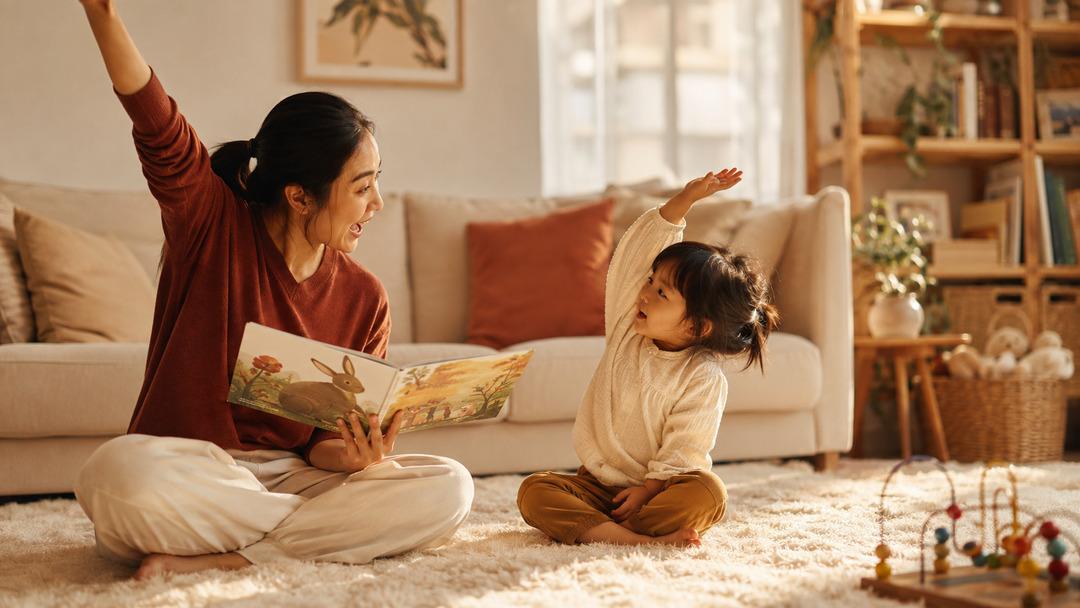
Speech disappears as soon as it is heard. A gesture can briefly make part of that meaning visible. Hold your hands wide for “enormous,” flutter your fingers downward for “drizzle,” or trace a steep slope in the air while saying “climb,” and the child receives verbal and visual information together.
The important distinction is meaning. A random wave may attract attention, but a representational gesture resembles something about the word or event it accompanies. It can depict shape, movement, direction, size, or an action.
That makes gestures especially useful when a story contains a word the child cannot easily infer from the picture. The adult is not replacing the word with pantomime. The gesture acts as visual scaffolding while the child hears the word in a meaningful sentence.
The 2026 Study Tested More Than Attention
In a 2026 experimental study, 89 German preschoolers ages 3 to 6 watched a videotaped story. One group saw the storyteller use representational gestures; the other heard the same storytelling without those gestures. Researchers then tested story comprehension along with receptive and expressive learning of target words.
Children who saw the gestures performed better on all three outcomes. The gesture group showed stronger story understanding, better recognition of the target words, and better ability to produce those words. The effects did not differ significantly by age within the 3-to-6-year range. The preschool gesture experiment therefore tested more than whether movement simply kept children interested.
Those results are promising, but they should not be stretched into a guarantee that gesturing at home will produce the same gains. The study tested one controlled format and one group of children. What it strengthens is the case for meaningful visual information supporting what children are hearing.
Gestures During Story Time Should Carry Meaning
Parents do not need a formal gesture system. Start with words that can be represented clearly and that matter to the story.
Action words are natural candidates. For “stumble,” let two fingers walk and tip sideways. For “squeeze,” close both hands toward each other. For “peek,” briefly cover and uncover your eyes. Descriptive words can work too: stretch your arms for “wide,” pinch your fingers close for “tiny,” or move your hand slowly for “creep.”
A simple plan might look like this:
| Story word | Possible gesture | Meaning the gesture makes visible |
|---|---|---|
| enormous | Spread arms far apart | Very large size |
| crawl | Move fingers slowly forward | Low, slow movement |
| twist | Rotate one hand | Turning motion |
| underneath | Move one hand below the other | Position |
| shiver | Shake hands or shoulders lightly | Trembling movement |
The gesture does not have to be theatrical or standardized. Meaning is the key: the movement needs to be easy for the child to connect with the word.
Repeat the Word, Not Just the Motion
Gesture works best as part of rich language, not as a substitute for it. If “enormous” is the target, say the word clearly in the story, show the gesture, and use the word again naturally: “That really is an enormous pumpkin.”
Guidance on teaching vocabulary through storybooks similarly emphasizes intentionally selecting words, explaining them in context, and giving children meaningful exposure during shared reading. A gesture can strengthen that approach because it adds another clue without requiring a long definition in the middle of a story.
Preschoolers can participate too. After seeing “tiptoe,” a child might make two fingers tiptoe across the page. If the gesture becomes part of rereading a favorite book, the movement can serve as a cue for recalling the word.
Keep participation optional. Asking a child to copy every gesture or repeat every new word can quickly change shared reading from a conversation into a performance test.
More Movement Is Not Automatically Better
The practical risk is overloading the story. If an adult gestures at nearly every noun, verb, and adjective, the movements may compete with the plot, illustrations, and conversation for attention.
Choose a small number of useful words instead. Words that express an action, spatial relationship, size, manner, or emotion are often easier to represent than abstract words with no obvious movement.
Also follow the child. If a preschooler is absorbed in the pictures, asking questions, or acting out the story spontaneously, there is no need to impose a prepared gesture routine. Shared reading stays social first.
Parents should also separate this technique from developmental screening. A child’s ability or willingness to imitate gestures during a book is not a stand-alone measure of language development. Concerns about vocabulary, comprehension, sentence growth, or communication should be considered across situations and over time.
Make the New Word Easier to See
The most useful lesson from the 2026 findings is not that parents must gesture more. It is that spoken language does not have to work alone. A well-chosen movement can make part of an unfamiliar word’s meaning visible at exactly the moment a child hears it.
Try it with one or two words in a familiar book. Repeat those words naturally, reuse the gestures if the story returns to the idea, and notice whether the child begins recognizing, using, or acting out the meaning later.
Used that way, gestures during story time remain what they should be: a low-pressure addition to shared reading, not another assignment for parent or child. The opportunity is practical—give a new word a voice, a context, and sometimes a shape the child can see.
Frequently asked questions
What kinds of gestures work best during story time?
Choose movements that visibly represent meaning, such as spreading your arms for “huge,” moving fingers slowly for “crawl,” or placing one hand beneath another for “under.” Simple, recognizable gestures are usually enough.
Should children copy the gestures while listening to a story?
They can, but copying should remain optional. Some children enjoy acting out words, while others prefer watching. The goal is supporting understanding and vocabulary, not testing whether a child can reproduce each movement.
How many new words should parents gesture during one book?
There is no required number. Choosing a few useful words is more practical than gesturing constantly. Focus on unfamiliar words that are important to the story and can be represented clearly through movement.