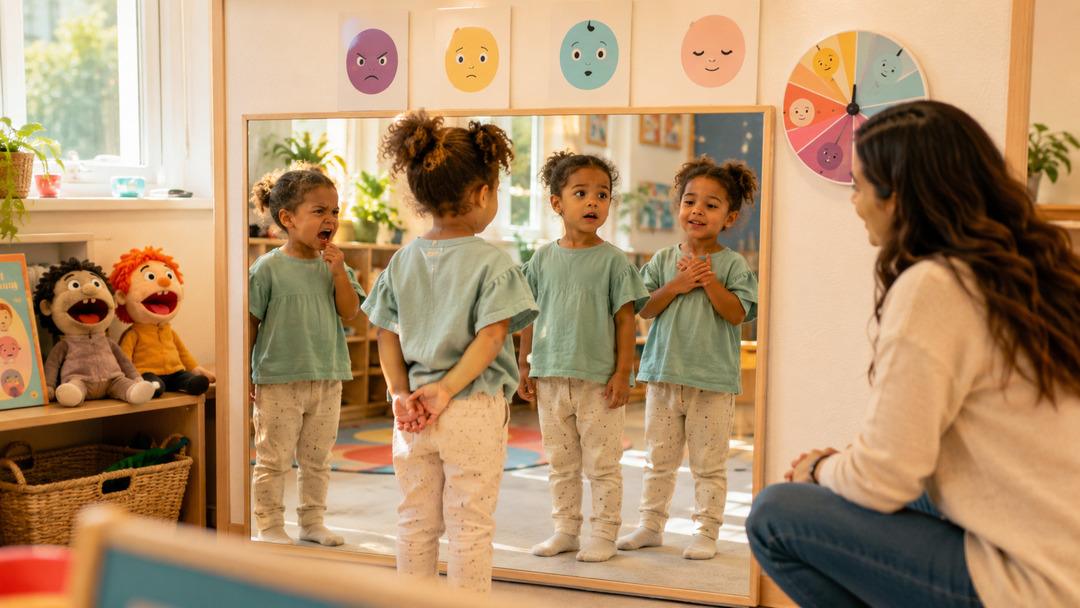
A preschooler who says “I’m mad” may actually be disappointed, jealous, frustrated, embarrassed, or overwhelmed. Building emotion vocabulary for preschoolers is not about teaching impressive words; it gives children more precise ways to explain experiences that otherwise may come out as crying, withdrawing, yelling, or a vague “I don’t like it.”
The shift can happen inside ordinary conversation. Families already working on preschool vocabulary activities can treat feeling words the same way they treat other useful vocabulary: introduce them in context, connect them to real experiences, and revisit them often enough that children learn what the words actually mean.
Knowing More Feeling Words Is Only Half the Job
Adults often begin with a small emotional vocabulary: happy, sad, mad, and scared. Those words are useful, but each covers a wide range of experiences.
A child whose block tower collapses may be frustrated. A child whose friend chooses someone else may feel disappointed or jealous. A child entering an unfamiliar classroom might be nervous rather than frightened.
These distinctions matter because precision changes the message. “I’m frustrated because it won’t work” gives an adult more information than “I’m mad.” “I’m nervous about going inside” points toward a different response than “I’m scared.”
The goal is not to replace simple words. Preschoolers still need them. Parents can gradually add more specific language underneath those broad categories.
Emotion Vocabulary for Preschoolers Needs Depth, Not Just Size
A February 2026 study provides an important reason not to turn emotional vocabulary into a flash-card exercise.
Researchers studied 197 typically developing German preschoolers ages 4 to 6 and examined both the number of emotion words children knew and the depth of their understanding. The 2026 emotion-vocabulary study found that emotion-specific vocabulary was associated with emotion knowledge and aspects of behavioral emotion regulation beyond general vocabulary.
The details matter. Children who deeply understood emotion concepts could show stronger emotion recognition even without knowing the largest number of feeling words. For regulation of positive emotional expression, vocabulary size appeared more useful when paired with greater vocabulary depth.
The study was cross-sectional, so it cannot prove that teaching more emotion words causes better regulation. It also did not find the same pattern for regulation of negative emotional expression.
Its practical message is still valuable: understanding beats memorization. Knowing the word “disappointed” means little if a child cannot connect it to the experience of expecting something good and then not getting it.
Move From Broad Feelings to More Precise Ones
Parents can introduce richer language by starting with a feeling the child already understands and adding nearby words.
The purpose of an emotion word ladder is not to rank feelings perfectly. It helps adults see opportunities to give children more choices for describing what is happening.
| Broad feeling | More precise words | Everyday situation |
|---|---|---|
| Mad | annoyed, frustrated, jealous | A toy will not work or another child gets the desired turn |
| Sad | disappointed, lonely, hurt | A plan changes or a friend does not want to play |
| Scared | nervous, worried, unsure | Starting preschool or meeting someone unfamiliar |
| Happy | excited, proud, relieved | Finishing a puzzle or finding something that was lost |
| Calm | comfortable, relaxed, peaceful | Resting after play or reading with a caregiver |
Children do not need all of these words at once. One useful distinction learned through repeated experiences is more valuable than a long list recited without understanding.
Real Moments Teach Feeling Words Better Than Quizzes
Emotion language becomes meaningful when it is attached to something the child can observe.
Suppose a preschooler spends several minutes trying to zip a jacket and finally throws it down. Instead of simply saying, “You’re mad,” a parent might say, “That zipper keeps getting stuck. You look frustrated.”
The child now hears the word alongside the situation that gives it meaning.
Books are another natural setting. Adults can discuss what a character wanted, what happened instead, and how that difference might feel. The same approach works during pretend play, family stories, or after a small conflict has settled.
Federal emotional literacy guidance similarly encourages adults to label emotions, discuss feelings in stories, describe their own emotions appropriately, and help children connect facial expressions and situations with feeling words.
Parents can also model distinctions in their own language: “I’m not angry. I’m disappointed that our picnic got canceled.” That exposes children to emotional vocabulary without putting them on the spot.

Do Not Demand the Right Word During the Biggest Feeling
The least effective time for a vocabulary lesson may be the moment a preschooler is overwhelmed.
A child in the middle of intense crying or frustration may not be ready to choose between “angry,” “disappointed,” and “frustrated.” Repeatedly asking, “What are you feeling?” can become another demand.
During the peak of an emotional moment, adults can supply simple language instead: “You really wanted another turn. You’re disappointed.”
Discussion can become richer after the child settles. That is when parents can revisit what happened, compare feelings, or wonder whether another word fits better.
Language should support communication, not become a test children have to pass before receiving comfort or help.
Watch for More Precise Communication, Not Perfect Labels
Emotion words are not mathematical categories. A child and parent may reasonably describe the same experience differently. Someone can also feel nervous and excited at the same time.
Progress therefore does not look like a preschooler choosing the “correct” emotion on command. It looks like growing flexibility: noticing feelings in themselves and others, connecting emotions to situations, explaining why they feel a certain way, and gradually choosing more specific language.
Parents can listen for phrases such as “I’m disappointed because…,” “She looks worried,” or “I was nervous, but then I felt proud.” Those statements show that vocabulary is becoming connected to concepts and experiences.
A richer emotion vocabulary also cannot prevent frustration, conflict, or big feelings. Children still need adult support while regulatory skills develop. What better language can provide is a clearer route for discussing those experiences.
Building emotion vocabulary for preschoolers is therefore less about replacing “mad” with a sophisticated synonym and more about helping children notice that feelings have shades and causes. The opportunity is simple but powerful: when children gain more precise words, adults gain a clearer window into what they are trying to communicate.
FAQ
How many emotion words should a preschooler know?
There is no single required number. Rather than counting words, focus on whether your child is gradually recognizing, understanding, and using different feeling words appropriately across stories, play, conversations, and everyday experiences.
What emotion words can I teach beyond happy, sad, mad, and scared?
Useful preschool-friendly choices include frustrated, disappointed, proud, nervous, worried, excited, lonely, jealous, relieved, and calm. Introduce them gradually through situations where the meaning is easy for the child to understand.
Should I correct my child if they use the wrong feeling word?
Usually, gentle discussion works better than direct correction. You might say, “You said you’re angry. I wonder if you’re also disappointed because the game ended.” This keeps the child’s perspective central while adding another possibility.