The journey from babbling to first words begins long before a baby clearly says “mama,” “ball,” or “more.” Early speech develops through listening, vocal experimentation, gestures, imitation, and repeated exchanges that gradually give sounds a stable meaning.
That progression is easy to misunderstand because a word-like sound may appear weeks before the baby uses it intentionally. The real milestone is not simply producing a familiar syllable; it is learning that a consistent sound, sign, or approximation can communicate a specific idea.
Babbling Builds the Machinery That Words Need
Babbling is not meaningless noise. It gives babies repeated opportunities to coordinate breathing, voice, lips, tongue, and jaw while listening to the sounds produced around them.
The process begins with cries, comfort sounds, and cooing. During the early months, babies may make open vowel-like sounds such as “oo” and “ah,” especially during calm face-to-face interaction.
Vocal play becomes more varied as babies gain control. Squeals, growls, raspberries, pitch changes, and long vowel sounds may appear before clear consonant-and-vowel combinations. These experiments help babies discover what their voices can do.
Canonical babbling marks an important change. Babies begin producing compact, speech-like syllables such as “ba,” “da,” or “ma.” These may later form repeated strings such as “bababa” or “dadada.”
From Babbling to First Words Is a Gradual Transition
Later babbling often becomes more complex. Instead of repeating one syllable, a baby may combine different patterns such as “badagu” or “madaba.” This is sometimes called varied or variegated babbling.
Babies may also use adult-like rhythm and intonation. A long string of sounds can rise like a question, fall like a statement, or include pauses that resemble conversation. The sequence may not contain recognizable words, but its melody can already carry social intent.
The ASHA communication milestones describe long strings of babble, sound imitation, gestures, and emerging words as connected parts of communication during the first year.
Babbling and words can overlap for months. A baby may use one meaningful word while continuing to babble during play, excitement, or unfamiliar situations. New words do not switch babbling off; they gradually begin to carry more of the communication.
Gestures Help Give Early Sounds a Clearer Meaning
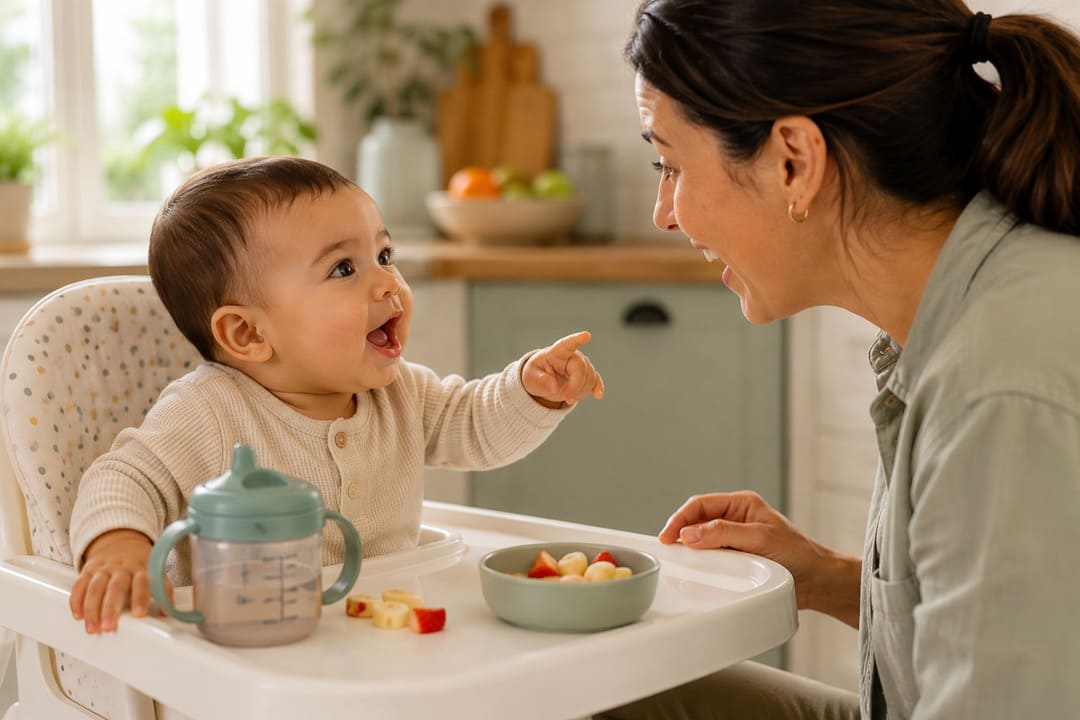
As babbling becomes more intentional, babies often combine sounds with gestures. A reach, point, wave, or raised pair of arms can show what a vocalization means before the spoken form is clear.
Eye gaze adds another layer of information. A baby may look at a toy, vocalize, and then look toward a caregiver, creating a shared moment of attention. This pattern shows that the sound is being directed toward another person rather than produced only for practice.
Repeated routines make these early messages easier to recognize. A sound used while reaching for a cup may gradually become associated with drinking, while a familiar syllable near the door may consistently refer to going outside.
Caregivers can strengthen the connection by responding to the likely meaning and adding a simple word. Saying, “Cup—you want your cup,” confirms the message while giving the baby a clear spoken model without demanding perfect imitation.
| Approximate Stage | Common Communication Pattern | Developmental Shift |
|---|---|---|
| Birth to 3 months | Cries, comfort sounds, coos | Voice begins joining social interaction |
| 4 to 6 months | Squeals, raspberries, varied vocal play | Greater control of pitch and sound |
| 6 to 9 months | Repeated speech-like syllables | Canonical babbling becomes noticeable |
| 9 to 12 months | Mixed syllables, gestures, jargon-like strings | Sounds become more intentional |
| Around 12 months and beyond | Word approximations and consistent labels | Particular forms begin carrying meaning |
These age ranges are guides rather than deadlines. Development may progress unevenly, and a baby can strengthen gestures or comprehension while spoken output changes more slowly.
A Sound Becomes a Word When It Carries Meaning
A baby saying “mamama” during play has produced a speech-like pattern, but it may not yet be a word. The same sound becomes more word-like when the baby uses it consistently to call a parent, look toward that person, or request that person’s attention.
First words rarely sound perfectly adult. “Ba” may represent ball, “nana” may mean banana, and “da” may refer to the family dog. A stable approximation counts as meaningful communication when the child uses it intentionally and caregivers can identify what it represents.
Gestures strengthen this transition. Pointing toward a cup while saying “buh” provides more information than the sound alone. Looking between an adult and a desired toy can also show that the baby is trying to share a message.
This is why meaning depends on use, not pronunciation quality. A first word is better identified by consistency, context, and intent than by whether every sound is produced accurately.
Understanding Usually Grows Ahead of Spoken Vocabulary
Babies often understand familiar words before they can say them. They may look toward the bottle, pause when they hear “no,” lift their arms after “up,” or find a familiar person when that person is named.
This receptive language is easy to overlook because it does not produce a spoken result. Yet understanding words, recognizing routines, and following simple requests provide the framework that spoken vocabulary will later use.
A baby may also communicate effectively through gestures, facial expressions, body movements, and vocal tone. Waving, reaching, showing an object, pointing, and shaking the head all demonstrate that communication is becoming more deliberate.
Talk and Play’s first words toolkit explains how sounds, signs, gestures, and simple verbal models can work together as children move toward spoken language.
Caregiver Responses Can Strengthen the Connection
Babies do not need formal speech drills. They benefit from responsive exchanges in which an adult notices a sound, interprets the likely message, adds a useful word, and leaves room for another turn.
When a baby says “ba” while reaching for a ball, a caregiver might respond, “Ball. You want the ball.” This confirms the message and supplies a clear model without requiring the baby to repeat it correctly.
Imitating babble can also maintain interaction. Copying “dadada,” smiling, and pausing shows that the baby’s sound had an effect. Adding a simple word afterward connects playful sound production with language.
Daily routines create repeated opportunities. Bath time introduces “water,” “wash,” and “splash.” Meals provide “more,” “cup,” and “all done.” Shared books support pointing, naming, anticipation, and repetition.
The most helpful approach is responsive rather than corrective. Adults can model clear words while protecting the enjoyment and spontaneity that encourage babies to keep communicating.
Changes in the Overall Pattern Matter Most
One quiet day or a temporary preference for gestures is rarely enough to judge development. Babies may vocalize less when tired, unwell, distracted, or concentrating on a new movement skill.
The pattern across time is more informative. Caregivers can notice whether vocal sounds are becoming more varied, whether gestures are emerging, whether the baby responds to voices, and whether communication is increasingly directed toward other people.
The NIDCD speech and language checklist advises families to discuss concerns with a child’s doctor and notes that hearing assessment may be included when speech or language development appears delayed.
Professional guidance is especially valuable when a baby rarely responds to sound, produces very few vocalizations, does not use emerging gestures, or loses communication abilities that were previously present. Loss of acquired skills deserves prompt attention.
The movement from babbling to first words is not a race toward one perfect sound. It is a widening communication system in which listening, gestures, vocal control, social attention, and meaning begin working together. Watching that complete pattern gives caregivers a clearer view of progress—and a stronger basis for seeking help when development appears to stall.
FAQs
When do babies usually say their first word?
Many babies begin using one or more meaningful words around their first birthday, but timing varies. A sound counts as a word when it is used consistently and intentionally for a particular person, object, or action.
Does “mama” count if a baby says it while babbling?
It counts as babbling when produced without a clear target. It becomes more word-like when the baby uses it consistently to call, identify, or seek the attention of a particular caregiver.
Should caregivers correct unclear first words?
Direct correction is usually unnecessary. Respond to the intended meaning and provide a clear model. When a baby says “ba” for ball, an adult can naturally answer, “Yes, that is your ball.”