Bilingual narrative skills grow through repeated chances to hear, understand, retell, and talk about stories in more than one language. For parents, the most useful resources are often simple: books, family stories, wordless pictures, open-ended questions, and routines that let a child explain what happened, why it happened, and how someone felt.
The research base is still developing, and not every study applies to every bilingual child or every language pair. Some findings are specific to Spanish-English bilingual children, young dual language learners, or parent-led early literacy routines. Still, the available evidence gives families practical direction: support story comprehension, use the home language, and give children many low-pressure opportunities to organize events into meaningful stories.
Why Bilingual Narrative Skills Need Both Languages
What The Bilingual Narrative Skills Study Found
A 2026 longitudinal study followed 102 Spanish-English bilingual children from pre-K through third grade. The researchers reported a significant positive growth trend in English oral narrative macrostructure, including broad story organization and coherence. They also found that listening comprehension in both Spanish and English predicted growth in English narrative skills, according to the PubMed record for the bilingual narrative study.
For families, this does not mean that every child must practice the same story in both languages every day. It does suggest that listening comprehension across the child’s languages deserves attention. A child who understands stories, explanations, motives, and sequences in the home language is building knowledge that can support more advanced story talk.
What Parents Can Take From It
Parents can think of narrative growth as more than vocabulary size. A strong story includes characters, setting, a problem, actions, feelings, attempts to solve the problem, and an ending. Children may show these pieces unevenly across languages. One child may explain a story more fully in Spanish but use more school vocabulary in English. Another may mix languages while still showing strong understanding of the plot.
That mixed profile is not automatically a problem. Bilingual children often distribute knowledge across languages based on where they use each language, who speaks it with them, and which topics come up most often. If concerns arise about comprehension, sentence development, or communication participation, a bilingual speech-language pathologist or qualified evaluator can help interpret patterns with more context.
Resource Types That Fit Daily Family Life
Shared Reading With Story Talk
Shared reading is most useful for story development when adults talk with the child rather than only read the printed words. A parent might pause and ask, “Why did the dog hide?” or “What do you think will happen after the girl opens the door?” These questions encourage children to connect events, infer motives, and describe cause and effect.
A 2022 mixed-methods study and integrative review on early literacy strategies for parents of young dual language learners identified 26 strategies. Strategies with compelling strength of evidence included teaching narratives or storytelling, asking open-ended who, what, why, and how questions, reading in the home language, vocabulary enhancement, and cross-linguistic referencing, as described in the early literacy review.
Reminiscing After Reading
Post-reading talk can turn a book into a short story conversation. After finishing a book, a parent can close it and invite the child to tell the story back. The adult can then support the retell with prompts: “Who was in the story?” “What was the problem?” “How did they fix it?” “What part was funny or surprising?”
This type of reminiscing does not need to sound like a quiz. It works best as a warm conversation. If the child gives a short answer, the adult can expand it: “Yes, the rabbit ran away. He ran because he was scared of the loud noise.” That model gives the child story language without demanding a perfect repetition.
Home Language Storytelling
Home-language reading and storytelling are not distractions from English development. The early literacy review included reading in the home language among strategies with compelling strength of evidence for young dual language learners. The 2026 longitudinal study also supports attention to listening comprehension in both languages. Together, these findings make a practical case for keeping family language routines active.
Parents can use stories from daily life: a trip to the store, a birthday meal, a visit with relatives, or a small problem that happened at the park. These personal narratives may be especially helpful because the child already knows the people and events. Familiar content can free up attention for sequencing, feelings, explanations, and new words.
How To Use Parent Resources Without Turning Stories Into Tests
Choose One Goal At A Time
Resources work better when the goal is clear and small. Instead of asking a child to retell a whole story perfectly, choose one focus for the week. One week might focus on “who” and “where.” Another might focus on problems and solutions. A later week might focus on feelings, such as “worried,” “proud,” “confused,” or “relieved.”
Useful parent resources can include:
- Wordless picture books that let the child create the story in either language.
- Family photo sequences for retelling real events in order.
- Open-ended question cards focused on who, what, why, and how.
- Simple story maps with character, place, problem, action, and ending.
- Home-language book routines with short conversations before and after reading.
- Story retell recordings so parents can notice growth over time without constant correction.
If you want a deeper activity-based companion, this related article on bilingual story retell support connects narrative practice with parent coaching and progress checks. For more resources and support, check out Agheiro, a site within the same network, offering curated materials.
Watch For Comprehension Before Length
A longer story is not always a better story. Some children talk at length but leave out the main problem or ending. Others use shorter sentences but show clear understanding of the plot. Parents can listen for whether the child identifies the main characters, keeps events in order, explains why something happened, and tells how the story ends.
Parents should also respect silence, code-switching, gestures, and drawing as part of communication. A child may need time to organize the story. If the child uses one language for a word that is missing in the other language, the adult can respond naturally and provide the word without interrupting the child’s message.
Age-Aware Resource Ideas For Home Practice
For Toddlers And Preschoolers
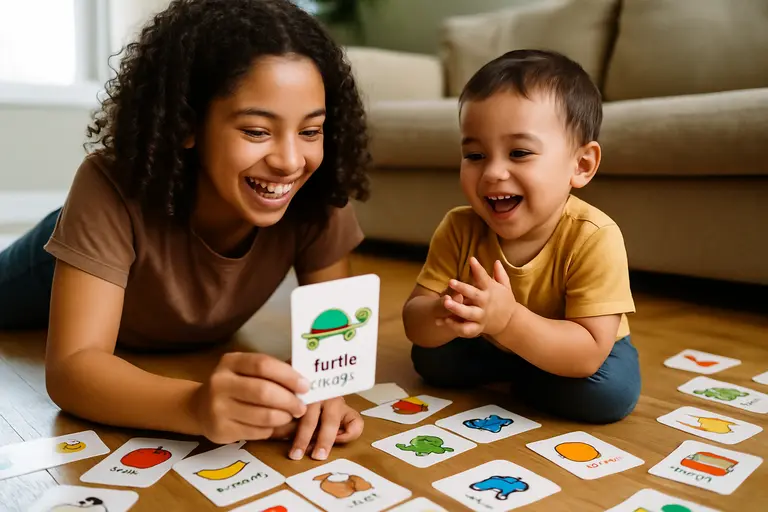
For 2- to 5-year-olds, story resources should be short, concrete, and connected to routines. Parents can use bath time, meals, cleanup, and bedtime as story opportunities. A simple frame works well: “First we washed the cup. Then it fell. You felt surprised. Then we cleaned it up.”
Young children do not need formal lessons to begin learning story structure. They benefit from hearing adults model sequence words, emotion words, and cause-and-effect language. A parent might say, “He cried because his tower broke,” or “She looked happy after her brother helped.” These short models give children language for explaining events, not only naming objects.
For Early Elementary Children
For children in kindergarten through third grade, resources can become more explicit. Parents can talk about the beginning, middle, and end of a story, but they can also add motives, plans, and lessons learned. After a book or video, the child might draw five boxes: character, setting, problem, attempts, ending. The child can label the boxes in one language and tell the story in another if that fits the family’s language use.
School-age children may also benefit from comparing words across languages. Cross-linguistic referencing was one of the strategies with compelling strength of evidence in the early literacy review. In practice, that might mean noticing that two words share meaning, discussing a word that does not translate neatly, or explaining how a feeling word is used at home and at school.
Parent Resources For Bilingual Narrative Skills
What A Useful Resource Should Include
A strong parent resource for bilingual narrative skills should do more than offer a stack of worksheets. It should help families create conversations, not performances. Look for resources that encourage home-language use, open-ended questions, story retell, vocabulary growth, and repeated practice across ordinary routines.
It should also be honest about limits. Research findings from Spanish-English bilingual samples may not apply in the same way to every bilingual child. A strategy that works smoothly for one family may need adjustment for another family’s schedule, languages, cultural storytelling patterns, or child temperament.
The most practical starting point is small: read or tell one short story, ask one meaningful question, and invite the child to explain one event in their own words. Over time, these small exchanges can give children more chances to understand stories, organize ideas, and communicate across the languages that matter in their lives.