Do you remember when your child pointed at a dog and said “doggie”? That small word was a huge step. Every new word helps build brain connections, sparks curiosity, and lets them share their thoughts.
Communication starts with sounds and gestures, not perfect speech. These early steps are the foundation of language.
The path from babbling to speaking is both cognitive and social. It’s how kids start to connect with their world.
This growth depends on the brain’s ability to learn by watching. Mirror neurons fire when a child imitates others, making imitation key to learning language.
If you’re worried about a late talker, knowing this science helps. Using video modeling can be very effective. It gives clear examples for a child to follow, making a big difference.
This knowledge helps us find effective ways to support early communication.
Selecting “High‑Power” Starter Words (Eat, More, Help, Go) Incl. Signs/Pictures
Effective communication starts with words that pack a punch. These are simple terms that let a child express urgent needs and desires. This strategic approach moves beyond just naming objects. It focuses on building a functional core vocabulary.
A core vocabulary consists of a small set of frequently used words. These words are powerful across many situations. Think of words like “eat,” “more,” “help,” “go,” “stop,” “yes,” and “no.” They allow a child to request, refuse, interact, and make choices. The goal is utility, not volume.
Selecting these first words follows clear criteria. Choose words that are highly motivating for the child. They should be actionable, leading to a quick result. Also, they must be easy to pair with a consistent sign or picture. This multi-modal support strengthens understanding.
The table below provides a practical starter list. It organizes high-power words by their primary communicative function.
| Communicative Function | High-Power Word | Example Sign / Picture Pairing |
|---|---|---|
| Requesting | More, Eat, Drink, Help | Tap fingertips together for “more”; bring hand to mouth for “eat”. |
| Protesting / Stopping | No, Stop, All Done | Shake head “no”; hold hand up, palm out for “stop”. |
| Social Interaction | Hi, Bye, Yes | Wave for “hi” and “bye”; nod head “yes”. |
| Action / Choice | Go, Up, Open | Point finger forward for “go”; point upward for “up”. |
Pairing each word with a sign or picture is key to modeling signs. Consistency across all communication partners is vital. Use the sign or point to the picture every time you say the word. This helps the child connect the meaning across different modes.
While this core vocabulary focuses on verbs and function words, you can add high-interest nouns. Use theme-based vocabulary for context. For example, during a “food” theme, pair “eat” with pictures of favorite snacks. This makes learning more meaningful and engaging.
Starting with this researched list provides a clear, actionable path. It empowers children to meet their needs and interact with their world. This is the foundation of all future communication growth.
Step‑by‑Step Modeling (Aided Language Input) with Sample Caregiver Scripts
Teaching first words starts with Aided Language Input. This method pairs your words with signs, pictures, or gestures. It’s based on how our brains learn, like watching videos.
It’s like giving a visual version of your words. For kids who struggle to speak, these modeling signs and pictures make words clear. It makes talking a fun, multi-sensory experience.
Using ALI is easy when you follow simple steps. Just do it during daily activities like eating, playing, or reading.
- Choose Your Moment. Pick a calm, everyday activity where your child is engaged. Snack time, playing with a favorite toy, or looking at a book are perfect.
- Select Your Word. Use a starter word like “more,” “go,” or “help.” Say it clearly while making the sign or pointing to a picture.
- Be a Consistent Model. Don’t wait for the child to use the sign first. Model it repeatedly during the activity. This is the “input” in Aided Language Input.
- Pause and Wait. After you model, give a long, expectant pause. This silent space invites the child to process and potentially attempt a response.
- Respond and Celebrate. Acknowledge any attempt—a gesture, a sound, a look—with enthusiasm. If they make a request using a sign, honor it immediately to show communication works.

Here are sample “caregiver scripts.” These phrases show how to mix modeling signs and first words ideas into your day.
| Activity | Target Word | Spoken Phrase | Modeled Sign/Gesture |
|---|---|---|---|
| Snack Time | MORE | “You ate your cracker! Do you want MORE?” | Bring fingertips together repeatedly. |
| Play with Cars | GO | “Ready… set… GO!” (push car) | Make a sweeping forward motion with hand. |
| Reading a Book | DOG | “Look! There’s the DOG. You point to DOG!” | Point to picture of dog, or pat thigh. |
| Building Blocks | HELP | “This tower is tall. Do you need HELP?” | Place fist on palm and lift upward. |
| Clean-Up | ALL DONE | “The snack is ALL DONE. Let’s wash hands.” | Wave hands back and forth in front of body. |
This plan turns theory into action. Using these scripts, you’ll feel more confident and have a clear plan for talking. You’re not just teaching words; you’re building a reliable way to communicate through consistent, aided input.
Play‑based activities: cause‑and‑effect toys, snack time choices, book routines; low‑cost alternatives
Forget flashcards; the most effective word learning happens during snack time, story time, and playtime. The best late talker strategies are not clinical drills. They are woven into the connection and fun of daily life.
By creating intentional play routines, you build natural opportunities for your child to communicate. This approach turns your home into a language-rich classroom without any pressure.
Let’s explore three powerful activity types. For each, we include low-cost or no-cost alternatives. Great intervention is about strategy, not expensive tools.
1. Cause-and-Effect Toys: Practice “Go,” “Pop,” and “Again”
Toys that respond to a simple action are perfect for first words. Think pop-up toys, ball ramps, or wind-up cars.
Model the word “go” as you release the car. Say “pop” when the figure jumps up. When your child wants another turn, model “again.” The predictable result makes the word meaning clear.
Low-Cost Alternatives:
- Use a cardboard tube as a ramp for a toy car.
- Blow bubbles and say “pop” for each one.
- Play peek-a-boo with a cloth, saying “go” when you hide and “again” for more.
2. Snack Time Choices: Practice “Eat,” “More,” and “All Done”
Mealtime is a daily routine packed with motivation. Use it to practice core words like “eat,” “more,” and “all done.”
Offer small portions. Hold up two choices and label them. Wait for your child to reach, point, or make a sound. Then model the word. This is a cornerstone late talker strategy.
Low-Cost Alternatives:
- Use regular snacks like crackers or fruit pieces.
- Serve drinks in a cup with a small amount at a time to create chances to ask for “more.”
- Use a simple visual of an empty bowl to signal “all done.”
3. Predictable Book Routines: Practice Labeling and Anticipation
Repetitive, familiar books are goldmines for language. The predictability allows your child to anticipate and eventually “read” along.
Point to and label pictures on each page. Pause before a familiar line or sound effect. Wait for your child to fill in the blank. This builds confidence and vocabulary.
Low-Cost Alternatives:
- Borrow books from the local library.
- Make a simple photo book of family members or favorite toys to label.
- Use online read-aloud videos and pause to label pictures together.
Integrating word learning into your day is simple. Here are key tips from experts:
- Read Aloud daily, even for just a few minutes.
- Be a Conversation Starter by narrating what you and your child are doing.
- Label Everything in your immediate environment.
- Try Cooking Together; name ingredients and actions like “stir” and “pour.”
These daily play routines transform ordinary moments into learning opportunities. For more ideas, explore our list of engaging toddler activities at home.
Remember, the goal is to make communication fun and functional. With these adaptable late talker strategies, you empower your child to find their voice through the joy of play.
Adapting for Motor Planning and Sensory Needs
Every child’s path to speaking is unique, often due to motor planning or sensory issues. Some struggle with the fine movements needed for signs or putting sounds together. Others might find some sensory inputs too much or too little, making it hard to focus and feel comfortable while learning.
It doesn’t mean a child can’t learn. It just means we need to adjust how we teach. Modeling signs and teaching core vocabulary are great for this flexibility.
Start by slowing down. Show each sign slowly and clearly. Match the sign with the word, holding the moment for the child to process both. This slower pace helps reduce stress, similar to how “cumulative blending” helps young readers.
When a child has trouble mimicking a gesture, your help should be gentle. Using a hand-under-hand method is often the best. It lets the child feel in control while you guide them. This is different from hand-over-hand, which can feel too controlling.
For harder words or signs, break them down. For “banana,” start with “ba” and then “nana.” This method, like breaking down big words in reading, helps beginners. It makes a big task into smaller, easier steps.
Always check how the child is feeling. Do they like deep pressure? Use firm touches. Do they shy away from light touch? Use clear visual aids. Adapting your modeling signs to their sensory needs helps them focus. This makes learning core vocabulary easier for them.
If a child keeps having trouble with motor skills or is very sensitive to sensory inputs, it’s good to learn more about speech delays and related issues. The goal is to see adapting as a key part of teaching. By adjusting your pace, prompts, and how you break things down, you help every child succeed with their first words.
Bilingual options: choose one label per context; keep consistency across partners
Starting with bilingualism from the beginning is great for a child’s communication skills. It’s backed by a simple plan. Studies show that learning two languages doesn’t slow down language development. Instead, it boosts cognitive and social skills.
The real challenge is managing languages clearly for young learners. Our main strategy is the “one context, one language” rule. This means picking a language for a specific setting or activity.
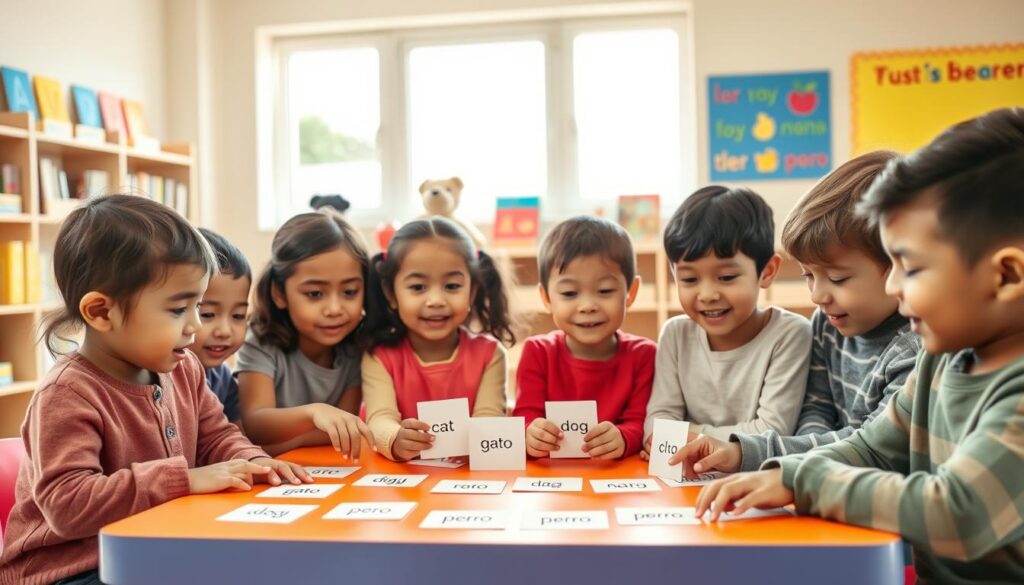
For instance, use English at daycare and Spanish at home. Or speak Mandarin during meals and English during play. This makes language use predictable. The child learns to link a place or activity with certain words.
It’s vital that everyone agrees on this plan. This includes parents, grandparents, babysitters, and therapists. Consistency is key.
For example, if grandma uses “leche” at her place, she should stick to it. Switching can confuse the child. A united effort helps the child make connections.
How do you use first words ideas in this way? Choose key words for each setting. For example, use “more” in English at playgroup and “más” at home.
Then, add these words to your play routines. At daycare, say “more bubbles” during a game. At home, say “más burbujas.” The routine stays the same, but the language changes.
This table shows how to plan a bilingual first words program:
| Context | Primary Language Label | Sample First Word Idea | Integrated Play Routine |
|---|---|---|---|
| Home (e.g., Spanish) | Spanish | “Agua” (Water) | During bath time, model “agua” when pouring water or playing with cups. |
| Daycare (e.g., English) | English | “Help” | When stacking blocks, model “help” if the tower falls, and offer hand-over-hand help. |
| Therapy Session | Align with home or school (choose one) | “Open” | Using a cause-and-effect toy, model “open” when the child pushes a button to open a door. |
| Grandparents’ House | Consistent with the agreed plan | “Book” / “Libro” | During a reading routine, label the book in the chosen language before turning each page. |
This method makes bilingual learning workable. It turns daily play routines into learning moments. It lets you use all your first words ideas while giving your child two languages.
Progress log: word attempts vs successful uses
A progress log turns vague notes into clear data. It shows real growth in your late talker’s skills. It’s not about pressure. It’s about celebrating wins, spotting patterns, and adjusting your approach.
Tracking progress is key to effective late talker strategies. It focuses on every step forward, not just what’s missing. You create a record of real achievements.
First, understand the two main metrics. A word attempt is any try to communicate a target word. This includes sounds, gestures, or pointing to pictures. A successful, independent use is when your child clearly says or signs the word without a prompt.
Seeing the difference is powerful. It lets you celebrate every attempt as a step forward. And cheering the full, independent use as a major achievement. This detailed view shows subtle progress that might be missed.
Learning new words empowers children. It reduces communication frustration. Kids can join conversations more actively. This builds confidence and a sense of achievement.
Starting a log is simple. You don’t need anything fancy. A notebook or notes app works well. Here’s a straightforward method:
- Create Columns: Make a simple table with these headers: Date, Target Word, Attempt (Yes/No), Independent Use (Yes/No), and Notes.
- Focus on Your Core Words: Track 5-10 words from your core vocabulary list at a time.
- Jot Down Brief Notes: In the Notes column, quickly describe the context. For example, “pointed to cookie picture when hungry” or “said ‘go’ while pushing car.”
- Review Weekly: Set a short time each week to look at the log. Look for patterns.
This review turns your log into a strategic guide. You might see that “more” is used at snack time but “help” is only tried during play. This tells you where to focus your modeling. It shows which parts of your core vocabulary plan are working.
This process turns observation into actionable insight. You’re not just hoping for progress. You’re documenting it and refining your late talker strategies. The log becomes a source of encouragement for you and a roadmap for your child’s communication journey.
When to seek more support
This toolkit is based on play routines and modeling signs. It’s a strong start for early communication. For many kids, it helps them learn new words and connect better.
But, some kids might need more help. If you see certain signs, it might be time to talk to a speech-language pathologist. They can give a professional evaluation.
Look out for these signs: a very small range of sounds or gestures. If your child doesn’t try to get your attention to share something, that’s a clue. Also, if they get really frustrated when trying to talk, it’s a sign too.
Wondering if your child needs more help with words? Our quick three-minute screener can help you decide.
Getting a professional’s opinion is a smart move. It doesn’t mean you’re not doing a great job with play routines and modeling signs. It’s about getting extra tools to help your child even more.
You are your child’s best communication partner. This toolkit helps you support them well. It also prepares you to work with experts, so your child can find their voice.