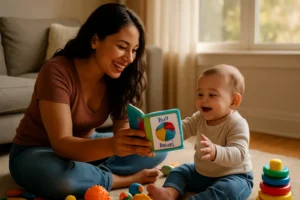
Raising a child with two languages can be challenging. It’s like trying to conduct an orchestra where some musicians are playing different tunes.
You’re excited about this amazing gift. But, you can’t help but worry if it’s causing speech delays.
Here’s the truth: bilingualism is not the problem if your child is slow to speak. The goal is to tell the difference between normal bilingual growth and real concerns.
This guide is your key to understanding. It goes beyond simple tips. It’s like a training program for parents who want to take action.
We’ll turn worry into wisdom and confusion into clear communication support. Are you ready to build a strong foundation that goes beyond just words?
Building Effective Habits
Forget the idea of a crash diet for language. Raising a bilingual child is about building a daily habit. The most powerful language strategies are found in everyday habits, not weekend marathons.
Think of yourself as the chief linguistic officer of your home. Your first, most counterintuitive directive? Speak your strongest language. This isn’t a concession. It’s a tactical move. By using the language in which you are most proficient, you provide the richest, most grammatically sound input. You’re not just talking; you’re building the foundation.
Now, let’s get analytical. Look at successful dual-language school models. They don’t operate on chaos. They use clear allocation: a 50-50 split or a 90-10 immersion model. Your home needs the same intentional design.
Translate that research into your living room. Maybe the “home language” governs meals, books, and playtime. The “community language” takes over during errands or screen time. The goal is predictable patterning. This consistency creates a cognitive map for your child’s brain. It knows what to expect and when.
This table breaks down how to apply these structured models to your family’s daily life:
| Home Language Model | Core Principle | Sample Home Application | Key Benefit |
|---|---|---|---|
| One Parent, One Language (OPOL) | Each caregiver consistently uses one language, providing clear, person-specific models. | Mom always speaks Spanish, Dad always speaks English. | Creates unambiguous linguistic associations and strong emotional bonds in each language. |
| Time & Place Allocation | Languages are assigned to specific contexts or times of day, mimicking school immersion models. | Mandarin during dinner and bedtime stories; English for morning routines and weekend outings. | Builds routine and context-based fluency, making language use predictable and natural. |
| Minority Language at Home (ML@H) | The family uses the non-dominant community language inside the home to boost exposure. | Speaking Korean at home while living in an English-speaking community. | Provides a protected immersion environment to strengthen the weaker language against the dominant community tongue. |
The magic isn’t in rigid perfection. It’s in the rhythm you create. A little structure turns a potentially chaotic household into a beautifully bilingual one. Your language strategies are the blueprint.
Conversation Techniques for Parents
If you’re correcting your child’s language mixing, you’re missing the point. That ‘Spanglish’ is a clever move. Think of talking as a language gym, where your child’s brain gets a workout without feeling judged.
Your first speech tip is to change your mindset. Code-switching, like saying “I want more *agua*,” is not a mistake. It’s your child’s brain efficiently switching between languages. Your role is to help them master this skill, not to correct them.
Stop acting like a drill sergeant. Start being a model and a guide. When they say, “Big *perro*,” say, “Yes, your big *perro* is a *perro grande*!” This way, you’re not correcting them but enriching their language skills.
Books and music are great tools for learning. Reading together is like a dialogue workshop. Ask questions in English and describe the pictures in Spanish. This way, you’re creating a bilingual story together.
Songs are amazing for learning grammar and vocabulary. Their catchy tunes help your child remember language patterns easily. From “Itsy Bitsy Spider” to “Los Pollitos,” you’re helping them learn in a fun way.
To make these ideas work, try this simple plan. It shows how to avoid common mistakes and use better techniques to help your child learn.
| Scenario | The Common Approach (Less Effective) | The Weaving Technique (More Effective) | Why It Works |
|---|---|---|---|
| Child mixes languages | “Honey, say that all in English, please.” | Model the full phrase in both languages: “Ah, you want the red ball? ¿Quieres la pelota roja?” | Validates their effort and provides correct models without shame. |
| During book reading | Reading the text straight through in one language. | Read the story in one language, but pause to discuss pictures and predict plots in the other. | Turns passive listening into active, bilingual comprehension practice. |
| Learning new vocabulary | Flashcard drills (“How do you say ‘apple’ in Spanish?”). | Introduce words through songs, then use them in context later: “Like in our song, this is a ‘manzana’ for our snack!” | Connects words to melody and real-life context, boosting retention. |
| Everyday routines | Using only the “target” language during specific, forced times. | Naturally weaving both languages into descriptions and play: “Time to wash your hands. ¡Vamos a lavar las manos!” | Makes both languages relevant to daily life, not just a lesson. |
Make every conversation a fun, low-stakes language game. Your best speech tips are about being playful and persistent. It’s more like playing a sport than doing drills. The more fun they have, the better they’ll get.
That is the smart strategy. You’re not just teaching words. You’re creating experiences where both languages come alive. The conversation is the lesson.
Language Routines
The ‘Silent Period’ in language learning is not a problem—it’s a key part of the process. It’s like when your kid becomes quiet in their new Spanish class. They’re not broken; they’re learning deeply.
This phase is as normal as a toddler watching a puzzle before starting. Parents might feel worried, but it’s important to let them learn at their own pace. They need to feel confident in their learning process.

Here’s a key speech tip: don’t force output, engineer input. A routine helps hold the learning process together. It makes learning easier by reducing mental stress.
Research shows that dual-language programs work well because they are consistent. The classroom looks the same every day. This makes learning feel safe.
You can create a similar environment at home. It doesn’t need to be perfect; just consistent. Try these simple routines:
- Morning Audio Anchor: Play the same bilingual greeting song while making breakfast. The words seep in with the smell of toast.
- Designated Question Time: During dinner, one parent asks a simple, repeated question in the target language. “What was something blue today?” The routine matters more than the answer.
- Bedtime Story Sequence: Read the same picture book for a week, then slowly swap nouns. The framework is familiar; the vocabulary shifts.
These routines are like training wheels. They help the brain learn to balance. The child in the Silent Period is listening and learning. Your job is to provide consistent, clear sounds.
Learning anything complex works the same way. You don’t learn guitar by playing random songs. You practice scales until they become second nature. Language routines are like scales for your mouth and mind.
Repetition is key. It turns strange sounds into familiar patterns. This makes the new language feel like a familiar path. It’s how you build comfort with language.
When the silence comes, don’t try to fill it with words. Instead, stick to your routine. Consistency is communication. It says, “This space is safe for listening. Your voice will come when it’s ready.” This might be the most powerful speech tip of all: sometimes, the best way to encourage speech is to expertly curate the silence around it.
Play-Based Learning
Learning doesn’t just happen at desks. Watch a child navigate a sandbox’s social world. Play is a complex mix of imagination, rules, and negotiation. By weaving language goals into this natural setting, we’re not teaching; we’re infiltrating.
Think about digital playgrounds. Apps like Speech Blubs use “video modeling” for kids to learn by watching peers on screen. It’s not just watching; it’s smart screen time that boosts vocabulary through social mirroring. Kids learn better from peers than adults. They’re joining a conversation, not being taught words.
Offline, a toy car crash turns into a bilingual drama. “Oh no! The red car chocó! Is it okay? ¿Está bien el carro?” You’re not just teaching words. You’re telling a story, asking questions, and showing emotions. All within the joy of play.
Every game becomes a chance for conversation starters. A block tower is “wobbly,” “precarious,” or “magnificent.” A tea party needs greetings, compliments, and polite requests. Language grows naturally from the play, not from a lesson plan.
Here’s how to use play for language growth:
- Articulation through silliness: Animal sounds, puppet shows, and funny voices strengthen speech without feeling like exercises.
- Sentence structure through storytelling: “First the dragon was angry, THEN he felt lonely, SO he decided to make friends.” You’re teaching sequence and cause-effect in a story.
- Social communication through games: Board games, make-believe, and role-playing build pragmatic skills naturally.
Stop directing and start participating. Get on the floor. Be the customer at a play restaurant who keeps ordering wrong. Be a lost dinosaur who needs directions. Your mistakes and questions spark linguistic problem-solving.
Play-based learning is like hiding language drills in a fun game. The child sees a game; you see practice, vocabulary growth, and social skills. They’re too busy having fun to notice they’re learning. That’s the goal.
The aim isn’t to make play educational. It’s to see that play is education, just in disguise. When learning feels like a secret mission, not homework, kids are more willing. The sandbox, living room fort, and digital playground are all classrooms in disguise.
Tracking & Adjusting
In today’s world, even parenting can use a data dashboard. Tracking your bilingual child’s progress isn’t about watching them all the time. It’s about making smart changes based on what you see.
The biggest mistake is comparing your child’s language skills to a monolingual’s. It’s like saying a Swiss Army knife is worse than a chef’s knife. The real measure is the combined conceptual vocabulary—all the ideas they can share in both languages.
So, you’re tracking the right data. Your dashboard looks good. But when do you change your approach? This is where data beats instinct. Look for consistent signs that it’s time to adjust.
These signs are most important when they show up in both languages. It means there’s a deeper issue, not just a language preference.
- Delayed Milestones Across the Board: If your child is slow in both languages, it’s a sign to look into.
- Persistent Sound Difficulties: If they struggle with sounds, even with practice, it’s worth checking.
- Social Communication Hurdles: This is key. It’s not just about words, but how they use them. If your conversation starters don’t work, note it.
Tracking these signs isn’t about being anxious. It’s about moving from vague worry to clear awareness. Online screeners can be a helpful first step before seeing a professional.
Then comes the adjustment. This shows you’re smart, not failing. Your data might suggest changing your approach. Maybe add more sound-focused play or make language routines more predictable.
Changing your conversation starters can also help a lot. Simple, fun prompts can spark a lot of conversation. Sometimes, the best change is talking to a speech-language pathologist. They’re experts in language development.
Your job is to watch, gather data, and be ready to change. The goal isn’t a perfect graph. It’s a flexible plan that grows with your child.
Tech and Media Use
Technology’s role in bilingual learning is complex. It can be a tool or a distraction, depending on how it’s used. The real issue is not how much we use it, but how we use it wisely.
Finding good bilingual content is hard. It’s like searching for a book in a huge library without a map. As Source 3 says, quality bilingual materials are rare. This makes it easy for kids to watch TV shows in one language instead of learning another.
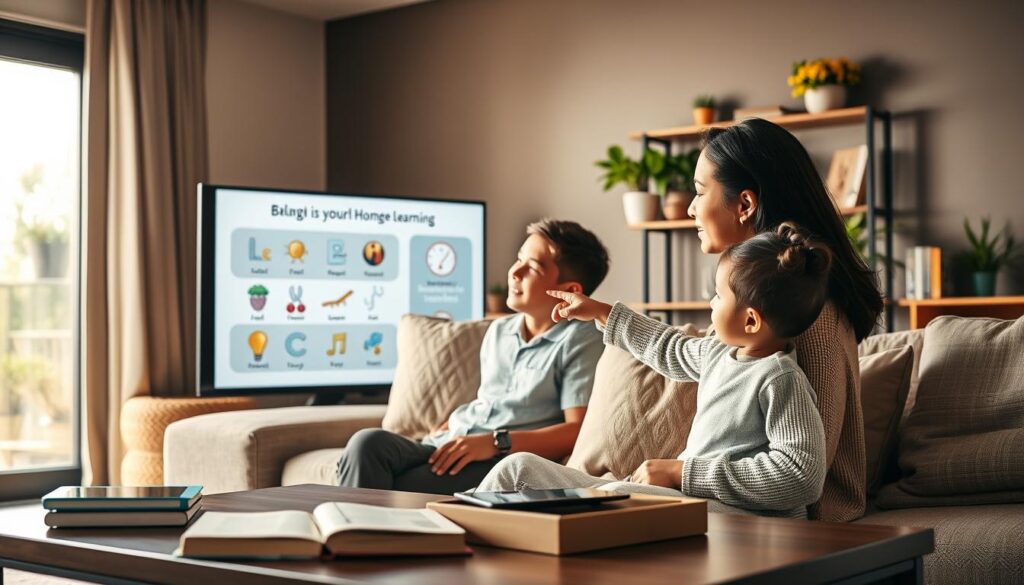
Smart screen time is about using technology in a smart way. It’s not about banning screens but making them useful. For example, an app can teach kids to say “cow” by showing them a video of someone else saying it.
This method helps solve the problem of finding good bilingual content. It turns screens into tools for learning, not just for watching. The goal is to make learning active, not passive.
Parents play a big role in making this work. Watching TV together and talking about what you see is key. It turns screen time into a chance to learn and talk about different things.
Here’s a smart way to use media:
- Curate, don’t just consume: Choose content that supports both languages
- Bridge the digital-physical gap: Use apps to talk about things during dinner
- Create language rituals: Make certain days for each language
- Quality over quantity: Short, interactive sessions are better than long, passive ones
The best use of technology helps kids talk more offline. Watching an app about animals can help them learn new words at the zoo. Playing a cooking game in Spanish can help them help with cooking at home.
Your media plan should match your bilingual goals. Watch the same thing in different languages and talk about the differences. It makes learning fun and educational.
Using technology wisely in bilingual learning means seeing it as a tool, not a teacher. It helps provide materials and practice, but it can’t replace human interaction. The best digital support always leads back to real-life conversations and laughter.
Recognizing Challenges
Every bilingual parent faces a moment of truth: figuring out if a quirk is normal or a sign of a problem. It’s like being a detective in your living room, collecting clues about language learning. Your home becomes a lab, and you’re the researcher.
Knowing what’s normal is key. Learning two languages is not like a list. It’s like starting two businesses at once, with chaos and brilliance.
Parents often mistake normal behaviors for problems. These include:
- The Silent Period: When your child understands but doesn’t speak much in the new language. It’s like quality control, checking everything works well.
- Code-Switching: Mixing words from both languages in sentences. It’s smart, using the best word to get the message across.
- Accent Carry-Over: Using the wrong accent for words. It’s a small glitch that usually fixes itself with more practice.
These are normal things in a bilingual brain. But, if a child has trouble with both languages, that’s a red flag. It means they might need help.
Your role in home support is vital. You’re not just a parent; you’re a key observer. You help professionals understand how your child communicates.
By documenting your child’s interactions, you help experts. They want to know how your child talks during play and when they’re upset. They also want to know how they interact with others.
This data is essential for any professional assessment. A bilingual speech-language pathologist will look at your notes. They’ll see if the problems are with language or something else. Your daily observations give them a deeper understanding.
There are also bigger challenges, like finding good bilingual programs. These challenges include:
- Teacher Recruitment: Finding teachers who are truly fluent in both languages is hard. It’s like searching for unicorns.
- Balanced Exposure: Many programs promise equal time for both languages but often don’t deliver. The dominant language pulls harder.
- Curriculum Integration: True bilingual education goes beyond translation. It creates content that’s relevant for both languages.
At home, you face the challenge of keeping the minority language alive. When English is everywhere, it’s hard to keep the other language strong. This is why home support is so important.
The big question is when to seek professional help. Look for these signs:
- Limited vocabulary growth in both languages over several months
- Difficulty following simple directions regardless of language used
- Social communication struggles that persist across contexts
- Frustration or avoidance of communication attempts
Finding the right professional is a challenge. You need someone who knows bilingual differences aren’t disorders. The wrong person might think a bilingual child has problems typical of a monolingual child.
Knowing when to ask for help is key. It’s like knowing when to call an IT expert for network issues. Your observations are important, but sometimes you need a professional’s tools.
Recognizing challenges is the first step. It’s not about failure but about understanding the journey. The path to bilingualism is not straight. It’s like sailing, adjusting to winds and currents.
The best home support strategy? Document everything, trust your instincts, and build relationships with professionals. Attend workshops, meet speech therapists early. Your preparation will help you navigate challenges when they come.
Links to Resources
No sage operates from an empty library, and your bilingual strategy deserves a well-stocked toolkit of proven resources. Think of this less as a shopping list and more as a strategic procurement plan. Your home support system needs tactical assets, not just good intentions.
Let’s cut through the noise. The market is flooded with “educational” products of dubious value. We need a filter. The table below breaks down the resource landscape into actionable categories. Consider it your reconnaissance report.
| Resource Category | Core Function | Ideal Use Case | Prime Example |
|---|---|---|---|
| Digital Tools & Apps | Foundational, play-based skill building through interactive engagement. | Daily practice, vocabulary reinforcement, making repetition fun. | Speech Blubs (peer video modeling app) |
| Professional Services | Targeted intervention and expert guidance for specific challenges. | When progress stalls or signs of difficulty emerge consistently. | Better Speech (online speech therapy platform) |
| Educational Models | Provides a structured pedagogical framework for language acquisition. | Informing your home approach or evaluating school programs. | Edquisitive Montessori Plus (dual-language program model) |
| Community & Timeless Assets | Cultural immersion, authentic practice, and shared experience. | Building identity, finding peer support, and accessing authentic materials. | Bilingual libraries, cultural centers, family networks |
Digital tools, like Speech Blubs, are clever. They use peer video modeling—kids learn from other kids. It turns practice into play, not drill. Most offer free trials. Use them. Test them. See if your child engages. This isn’t about screen time guilt; it’s about strategic engagement.
When play isn’t enough, professional guidance enters the chat. Services like Better Speech represent the new accessibility. Online speech therapy connects you with specialists without commute times or waiting rooms. It’s tailored support, on demand. This is critical home support when you suspect a challenge needs more than your toolkit.
For the big picture, study educational frameworks. Models like Edquisitive Montessori Plus show how dual-language immersion works in practice. Understanding their principles lets you replicate aspects at home. It also gives you criteria to judge your child’s school program. Are they using proven strategies for emergent bilinguals, or just winging it?
Never underestimate the timeless resources. Your local bilingual library is a treasure trove. Cultural community centers offer immersion no app can match. Most importantly, connect with other bilingual families. Your network is your net worth in this endeavor. Share wins, troubleshoot struggles, and borrow books.
These links are your strategic allies. Curate them. Update them. A resource is only as good as its use. Your home support ecosystem should evolve as your child’s language journey does. Now, go stock that library.
Conclusion
So, where does this journey end? After exploring habits, techniques, and play-based strategies, we find our destination. You’re not just teaching words. You’re building a flexible mind.
Research shows that myths about language confusion are false. Total exposure leads to milestones similar to those of monolingual kids. The combined vocabulary in both languages often equals or beats single-language development. This proves that the delay myth is wrong.
Your home support is the starting point. Regular use of both languages strengthens more than just grammar. It shapes identity and cultural connections. This is not just about learning. It’s about connecting with others through language.
Early exposure doesn’t confuse young minds. Kids can tell languages apart from their first words. Code-switching is like jazz—improvisation within rules.
The real effort is in daily routines. Creating environments rich in language. Using family and school strategies. This effort boosts executive function, academic skills, and cultural understanding. For more on supporting bilingual development, check out how to support language development in bilingual children.
Don’t just see the challenges. Your support builds a brain for complex thinking. You’re giving a child a cognitive passport. The mind you’re shaping doesn’t just speak two languages. It thinks in many ways. That’s the greatest gift.