Many parents want a preschool that supports both English and the home language. The problem is that access often depends on neighborhood, staffing, cost, transportation, and which languages a program is equipped to serve.
That gap can leave families feeling as if bilingual development depends entirely on finding the right classroom. It does not. Strong bilingual preschool support can also begin at home, especially when families use routines, books, relatives, songs, and teacher communication with intention.
Talk and Play’s guide to a bilingual child starting preschool explains how preschool can shift a child’s language use. Home stories can keep the family language socially meaningful as the school language grows.
Bilingual Preschool Support Is Not Equally Available
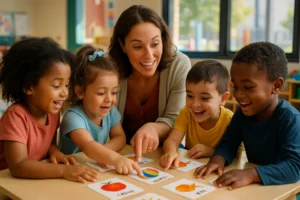
A bilingual preschool can help children hear and use two languages in structured, social, and academic settings. That support is valuable, but it is not guaranteed.
A 2025 study of New York City’s Universal Pre-K landscape found that bilingual Pre-K programs represented only a small share of all programs, even in a linguistically diverse city, raising questions about home language access for emergent bilingual children.
Families outside major metro areas may face even fewer options. Some preschools offer general diversity language, but not direct support for a child’s specific home language. Others may welcome bilingual children warmly while operating only in English.
This matters because early childhood is a critical period for identity, family connection, vocabulary growth, and school readiness. A child should not have to lose one language to gain another.
The Home Language Is a Learning Resource, Not a School Obstacle
Parents are sometimes told, directly or indirectly, to focus only on the school language so the child can “catch up.” That advice can weaken the child’s strongest communication base.
Home language supports emotional connection, family storytelling, cultural knowledge, and concept development. A child who understands a concept in one language does not start from zero when learning the school-language label.
Head Start guidance for dual language learners emphasizes that supporting the home language builds a foundation for English and later learning through dual language strategies.
That means parents should not treat home-language use as a fallback. It is part of the child’s learning system.
A child who talks about cooking with a grandparent, sings familiar songs, hears family stories, and learns words for feelings at home is building language knowledge that can travel into school.
Build Language Around Routines the Child Already Understands
Home support works best when it attaches language to things the child already does.
| Home Routine | Language Opportunity | School Connection |
|---|---|---|
| Getting dressed | Colors, body parts, sequence words | Following classroom directions |
| Meals | Requests, describing words, manners | Snack-time conversation |
| Bath time | Action words, body words, cause and effect | Science and hygiene vocabulary |
| Cleaning up | Categories, location words, sorting | Classroom organization |
| Bedtime | Stories, feelings, memory, prediction | Listening comprehension |
| Family calls | Greetings, questions, personal stories | Social communication |
A parent does not need formal lessons. The child needs repeated, meaningful language.
During dressing, a caregiver can say, “First socks, then shoes.” During meals, they can offer choices: “Do you want rice or banana?” During cleanup, they can sort: “Animals here, cars there.”
These small routines create predictable language practice without pressure.
Books, Songs, and Family Stories Can Fill a Preschool Gap
Books help, but bilingual families do not need a perfect shelf of dual-language titles.
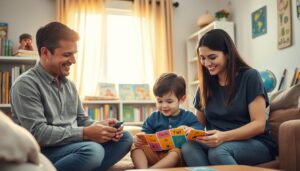
A parent can read a picture book in one language and discuss the pictures in another. A grandparent can retell a story from memory. A sibling can act out a scene. A caregiver can use a wordless book and create the story in the language that feels most natural.
Songs and rhymes are especially useful because repetition makes language easier to remember. Children may sing phrases before they use them in conversation.
Family stories carry another kind of value. They teach names, places, emotions, past events, humor, and identity. A child hearing “When you were a baby…” learns time words, sequencing, and personal narrative.
Parents Can Connect Home Language to the Classroom
Even when a preschool is not bilingual, families can help teachers understand the child’s full communication profile.
Parents can share a short list of important home-language words: bathroom, water, hurt, help, finished, more, stop, mom, dad, grandma, and comfort phrases. Teachers do not need to become fluent to use a few meaningful words respectfully.
Families can also ask about classroom themes. If the class is learning about plants, parents can talk about seeds, leaves, water, and growing in the home language. If the class is discussing families, parents can practice names and relationship words at home.
This approach gives the child concepts in one language and school labels in another.
Parents can also send photos from home routines or cultural events. A teacher may use them to invite the child to share, point, name, or tell a simple story.
Watch for Pressure Points as the School Language Grows
Many bilingual children begin using the school language more after preschool starts. That shift can worry families, especially when the child answers in English after being spoken to in the home language.
A language preference is not the same as language loss, but it can become loss if the home language stops being useful.
Pressure points include fewer home-language conversations, embarrassment around speaking the family language, older siblings switching entirely to the community language, or adults reducing home-language use because the child answers in English.
Families can respond by keeping the home language connected to warmth and need. Use it for jokes, cooking, stories, affection, songs, relatives, errands, and play. Avoid turning every home-language moment into correction.
The next challenge is access. More families will continue wanting bilingual education than many systems can provide. Until programs catch up, bilingual preschool support must be understood more broadly.
A classroom can help, but it is not the only place bilingual development grows. When home language remains useful, loved, and active, children carry more than vocabulary into school. They carry connection, confidence, and a fuller map of who they are becoming.