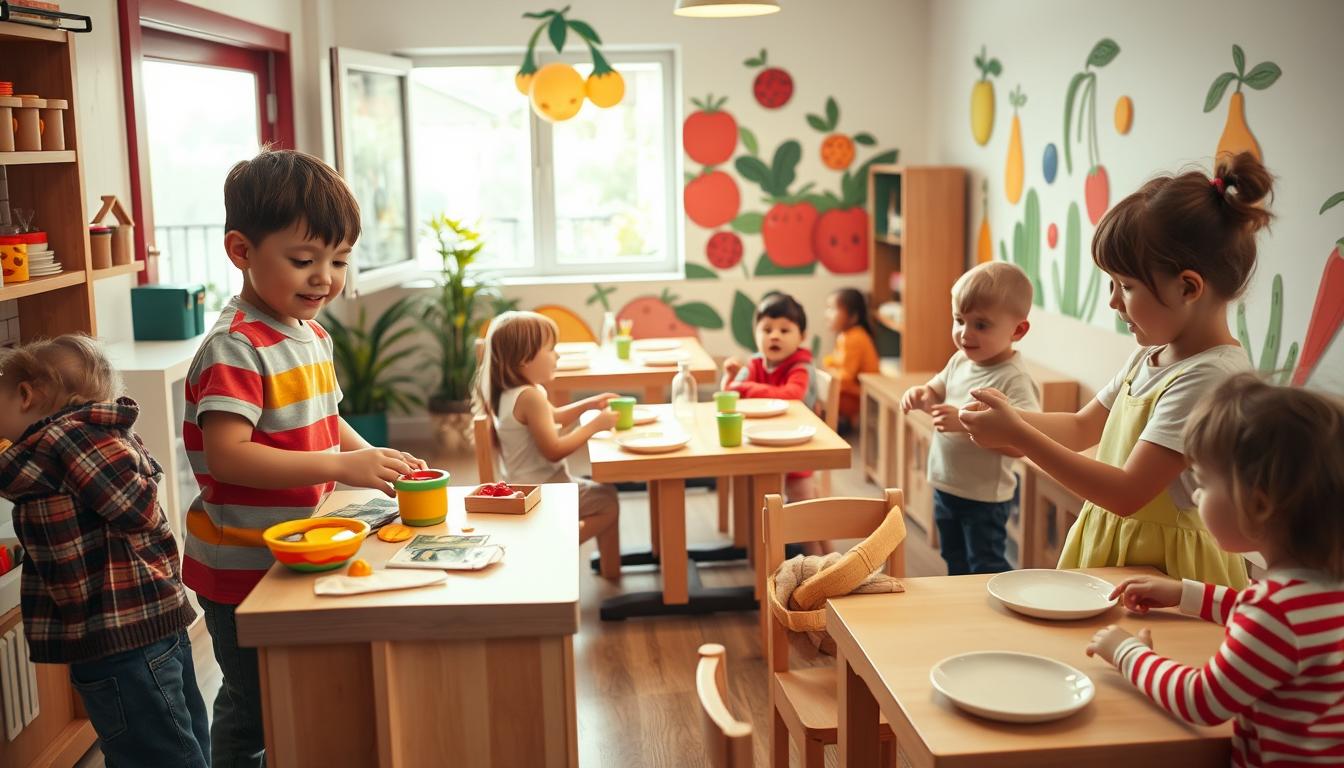
Imagine a world where learning to communicate feels like a fun game. Setting up a simple shop or restaurant at home creates this powerful space. This type of imaginative play is a foundational tool for building real-world skills.
Experts in child development agree. Play is a valuable component of speech therapy for kids. These activities are a great way to support language development, social skills, cognitive growth, and emotional expression all at once.
In these playful scenarios, children naturally practice vital communication. They use money vocabulary like “price,” “total,” and “dollars.” They learn polite phrases such as “please,” “thank you,” and “excuse me.” They even tackle problem-solving with questions like, “What if this is sold out?”
This guide will show you how to turn playtime into a rich learning experience. You’ll discover easy ways to encourage these essential conversations. Let’s build confidence and ability through the joy of pretend play and social language.
Creating the shop/restaurant space: menus, labels, pretend money, order pads
The magic of pretend play comes alive in a dedicated space. A well-organized area sparks imagination and makes learning fun. You don’t need fancy things—just a table, shelves, and a few props.
Start with a simple menu. It introduces menu vocabulary clearly. Use big pictures next to words like “appetizer,” “main course,” and “dessert.”
Add prices in whole numbers for simple math. A menu helps kids practice reading and making choices.
Next, create product labels for a shop setup. Use index cards or sticky notes for labels like “milk,” “bread,” or “apples.” This builds word recognition and connects written text to objects. Color-coding labels by food group adds an extra learning layer.
Now, let’s talk currency. Crafting pretend money is a great hands-on activity. Draw bills and coins on paper. Include different denominations like one-dollar bills, five-dollar bills, and coins for cents.
Handling this play money familiarizes children with U.S. currency. It prepares them for paying and giving change in the role-play.
Design order pads next. These can be small notepads for writing down orders. This task sequences events: greet, take order, calculate total. It introduces early literacy through writing. An order pad gives structure to the play, just like in real ESL coffee shop activities.
Gathering these props—menus, labels, money, and pads—transforms any corner into a vibrant play space. This setup makes learning structured, authentic, and engaging for young learners.
Core scripts for greeting, ordering, asking price, paying, and thanking
The heart of any successful pretend shop or restaurant lies in simple, polite dialogues. These role scripts give children a reliable framework for interaction. They build confidence and fluency in social language.
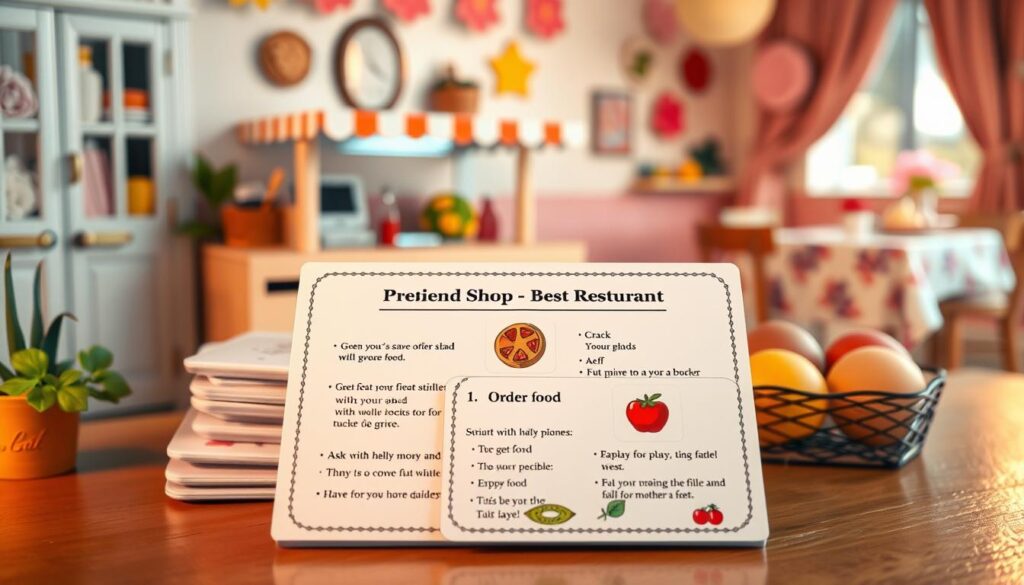
Think of these scripts as a friendly map for conversation. They guide a child through the natural flow of a transaction, from hello to goodbye. Practicing them turns uncertain mumbling into clear, polite communication.
Below is a breakdown of the five key moments in a pretend purchase. Each step includes example phrases for both the customer and the shopkeeper or server.
| Interaction Step | Customer Says (Example) | Server/Shopkeeper Says (Example) |
|---|---|---|
| 1. Friendly Greeting | “Hello!” or “Good morning!” | “Hi! Welcome to our shop. How can I help you today?” |
| 2. Ordering or Asking | “Can I have a pizza, please?” or “I would like the blue toy.” | “Sure! What size would you like?” or “Here you go. One blue toy.” |
| 3. Asking for the Price | “How much is it?” or “What’s the price?” | “That will be three dollars.” or “It costs five dollars.” |
| 4. Paying | “Here you are.” (hands over pretend money) | “Thank you. Here is your change.” (counts change) |
| 5. Thanking & Goodbye | “Thank you! Have a nice day.” | “You’re welcome! Come back soon.” |
These phrases are just a starting point. Encourage kids to mix and match words. “Can I have…” could become “I’d like to order the…” The goal is comfort, not perfection.
A great way to practice is by using sentence strips. Write each part of the dialogue on a separate strip of paper. Have children work together to put them in the correct order. This turns learning into a hands-on puzzle.
Mastering these core exchanges does more than just facilitate play. It builds a fundamental social confidence that transfers to real-world situations. A child who can politely order pretend food is practicing for speaking up at a real restaurant or store.
Keep the tone encouraging. Celebrate when they use a full sentence or remember to say “please.” These small victories in social language are huge steps forward.
Vocabulary sets for foods, sizes, prices, and time words
We’re adding key menu vocabulary and money/time words to our scripts. This helps young learners play with confidence. By organizing words into sets, we make playtime a language lesson.
Sorting words into categories helps kids learn faster. For example, “apple,” “pizza,” and “milk” are all food items. This makes learning fun and effective.
Here’s a table with important word groups for your shop or restaurant. It’s a cheat sheet for your play sessions.
| Category | Example Words | Sample Play Sentence | Learning Focus |
|---|---|---|---|
| Food & Drink (Menu Vocabulary) | Hamburger, salad, juice, sandwich, fries, apple, milk, cookie | “What would you like to eat? We have pizza or salad.” | Naming items, making choices |
| Sizes | Small, medium, large, big, little | “Would you like a small or large drink?” | Comparing opposites, describing |
| Prices & Money (Money/Time Words) | Dollars, cents, total, cheap, expensive, five, twenty, one hundred | “Your total is three dollars and seventy-five cents.” | Number recognition, value concepts |
| Time Words | Minutes, ready, soon, open, closed, now, later | “Your order will be ready in five minutes.” | Sequencing, patience, routines |
Learning price terms like “dollars,” “cents,” and “total” makes math real. Words like “cheap” and “expensive” teach about value. For more practice, check out this restaurant-themed vocabulary and matching exercises.
Time words are key for realistic play. Phrases like “We open at 10 AM” or “It’ll be ready soon” add authenticity. They also teach about waiting and sequences.
By using these vocabulary sets, kids get better at talking. They go from simple requests to detailed descriptions. This boosts their confidence and makes every play session a win for language skills.
Scenario practice: sold‑out item, wrong order, detours, coupons
What if the toy kitchen runs out of pizza? These moments are great for learning. They help kids move beyond simple greetings and orders.
Scenario practice makes them use social language in flexible ways. They learn to solve problems quickly.
This play builds resilience and adaptability. Kids see that conversations can change direction. They learn to handle these changes well.

Let’s look at four fun scenarios for your pretend shop or restaurant. Each one challenges kids’ role scripts in new ways.
The Sold-Out Item
A customer wants a blueberry muffin, but they’re all gone. This is a chance to practice saying sorry and finding an alternative. The server can say, “I’m sorry, we don’t have any muffins left today.”
Then, they can suggest something else. “Would you like a chocolate chip cookie instead?” This teaches kids to manage expectations and find solutions.
The Wrong Order
Imagine a customer gets a hot dog when they ordered a hamburger. This mix-up is a great chance to practice polite correction and apology. The customer might say, “Excuse me, I think this is not what I ordered.”
The server then gets to make it right. “Oh no! I am so sorry. Let me get your hamburger right away.” It turns a mistake into a chance for empathy and service.
Special Request Detours
Sometimes, a customer needs something extra, like ketchup or more milk. These detours interrupt the main script. They require a child to listen, acknowledge the request, and fulfill it.
A simple, “Sure, I’ll go get that for you,” shows helpfulness. It expands their vocabulary into action-oriented social language.
Using a Pretend Coupon
Introduce a paper “coupon” for 50 cents off. This scenario blends math, reading, and conversation. The customer must present the coupon and ask, “Can I use this?”
The cashier then has to recognize it, calculate the new price, and explain the discount. It adds a delightful layer of complexity to the transaction role scripts.
Practicing these scenarios does more than teach phrases. It builds the soft skills kids need everywhere. They learn to think on their feet, express feelings, and cooperate to fix problems.
Keep the mood light and encouraging. There are no wrong answers here, only practice. The goal is to make flexible social language feel like a natural and fun part of play.
Math‑talk and literacy add‑ons: receipts and order writing
Receipts and order pads are more than just props. They’re tools for early math and literacy practice. Kids learn foundational skills without even realizing it, all while having fun running their shop or restaurant.
Let’s look at receipt math. When a server calculates a bill, a great learning moment happens. The customer checks the math, which is packed with learning.
Children practice adding prices and subtracting to find change. They learn to read numbers and recognize coins. Introduce money/time words like ‘total,’ ‘change,’ ‘dollars,’ and ‘minutes’ to enhance their learning.
For example, a server might say, “Your burger costs 3 dollars, and your juice is 2 dollars. That makes a total of 5 dollars.” The customer then counts out the pretend money. This makes abstract concepts feel real and practical.
Now, let’s talk about order writing. This activity builds literacy skills. When a server writes down a customer’s order, they practice more than just drawing.
They work on letter formation and fine motor skills. They must listen carefully and remember sequences, which boosts comprehension. Writing “a large pizza with extra cheese” requires following directions and using prepositions like ‘with’ and ‘extra.’
Encourage using money/time words in full sentences. A customer could say, “I’ll be back in 10 minutes to pick up my order,” weaving time concepts into the play naturally.
The table below shows how to weave these skills seamlessly into your play scenarios. It turns everyday actions into rich learning moments.
| Activity | Skills Practiced | Sample “Math/Literacy Talk” |
|---|---|---|
| Calculating a Receipt | Addition, number recognition, using money words. | “Let’s add the prices: $2 + $3 = $5 total. Your change from $10 is $5.” |
| Making Change | Subtraction, coin/value identification. | “You gave me 8 dollars. The toy is 5 dollars. Here is your 3 dollars back.” |
| Writing Food Orders | Letter formation, listening, sequencing words. | “I heard you want a small salad with dressing on the side. I’ll write that down.” |
| Reading an Order Ticket | Word recognition, following directions. | “My ticket says ‘hot dog, no ketchup.’ I need to make it just right!” |
| Using Time Prompts | Understanding sequence, estimating duration. | “Your pizza will take 15 minutes. Would you like a drink while you wait?” |
Blending these activities makes learning organic. Children see how writing and math connect to real-life situations. The table above gives you a clear guide to start the conversation. This makes abstract money/time words feel concrete and useful.
Your pretend shop becomes a dynamic learning lab. Kids gain confidence not just in play, but in the essential skills that support school success. It’s learning disguised as fantastic fun.
Inclusion tips for mixed ages and languages
Role-play is very flexible. It lets you make it fun for everyone, no matter their age or language. When you plan your pretend shop or restaurant, think about each child’s needs. This way, all kids can play, learn, and have fun together.
Make the activity right for each player. A good game meets kids where they are. This makes play fun for a shy three-year-old, a lively seven-year-old, and a student learning English.
Here’s a quick guide to make your play setup inclusive. These tips help every child play well.
| Player Profile | Common Challenge | Adaptation Strategy | Key Benefit |
|---|---|---|---|
| Younger Children (3-5) | Complex scripts and multi-step tasks. | Simplify greetings and orders to one or two words. Use pretend money with very clear, large denominations. | Builds confidence in basic role-play and turn-taking. |
| Pre-readers | Cannot read menus or price tags. | Use picture menus with clear images. Pair price tags with color-coded dots or symbols. | Promotes independence and vocabulary matching without reading pressure. |
| Multilingual Learners | Unfamiliar vocabulary and fear of making mistakes. | Provide bilingual word cards. Pair them with a “buddy” for support. Focus on repetitive, key phrases. | Creates a safe, low-pressure environment to practice new social language. |
| Varied Skill Levels | Frustration if a role is too hard or too easy. | Match roles to ability: a newer player can be a customer, an advanced player can be the cashier managing math. | Ensures positive challenge and keeps the game flowing smoothly for all. |
For kids learning a new language, a pretend shop is great practice. The scripts we practiced earlier help them feel safe. They can say things like “How much is this?” or “Thank you” without worry. This low-pressure practice is key for building confidence in speaking.
Having a buddy can help a lot. A buddy can show phrases or help find words on a menu. The goal is to communicate well, not to speak perfectly. Every time they say something, like “Two dollars, please,” they’re learning important social language skills.
Visual aids are very helpful for including everyone. A menu with pictures helps pre-readers and kids learning languages. Color-coded price tags make it easy for everyone to “pay” for things. These tools make the game fair for all.
By using these tips, you do more than just play a game. You create a place where everyone feels welcome. You give every child a chance to shine, learn new things, and connect with others. That’s the real joy of a well-planned pretend shop.
Downloadable menus, receipts, price tags, and role badges
Bringing your pretend shop to life is easier with ready-made resources. Printable props save you time. You can enjoy the play and practice language without making everything from scratch.
Find downloadable menus on sites like Teachers Pay Teachers. These colorful printables help kids learn food vocabulary. Blank receipts from Education.com make writing totals a real task. Printable price tags let you label any toy or box as a shop item.
Role badges define parts like Chef, Cashier, and Customer. Wearing a badge helps a child step into their character. This simple tool adds structure and builds speaking confidence during play.
Many of these ESL resources are free PDF downloads. This model gives you everything you need to start. With your printable menus, receipts, tags, and badges ready, setup is quick and easy. Your engaging learning environment is just a print away.