Many parents worry that using two languages will slow their child’s progress. But, let’s set the record straight. This language delay myth is just a myth.
Research shows us the truth. Early communication milestones, like giggling and first words, are the same for all kids. A child learning two languages hits these milestones at a similar time.
Here’s the important part about vocabulary. Think about the total number of words a child knows in both languages. This combined word count is often the same as a monolingual peer’s vocabulary in one language.
This understanding helps build confidence. You can focus on nurturing your child’s unique journey. For more detailed support for your child, practical routines and strategies follow.
Milestones and What Differs: Word Mixing and Code-Switching
Word mixing and code-switching are not signs of language delay. They show a growing bilingual mind. It’s important for parents to understand these milestones in bilingual speech development.
Children learning two languages mix them creatively. For example, a child might say, “quiero mas juice.” This shows they are combining Spanish and English.
This behavior, called word mixing, is a normal phase. It shows the child is building a big vocabulary. They use all available words to express themselves.
A more advanced skill is code-switching. This is when a child switches languages based on the listener or situation. They might speak Spanish with Abuela and English with a teacher.
This shows they understand social and linguistic rules. They aren’t confused. They are learning the rules of each language community.
These behaviors show the child’s brain is working hard. They are managing two sets of grammar rules and sounds. This builds strong metalinguistic awareness—thinking about language itself.
Parents often wonder when children separate their languages. Usually, by age three or four, they start to use the right language for the right person.
The path of bilingual speech development has its own map. The table below clarifies common observations and their true meaning.
| Observed Behavior | Common Parental Perception | Developmental Reality & Insight |
|---|---|---|
| Mixing words from both languages in one sentence (e.g., “Doggy grande!”) | Confusion or language delay. | Normal word mixing. The child accesses their total vocabulary to communicate. It shows resourcefulness, not error. |
| Using different grammar structures from each language. | Making grammatical mistakes. | Cross-linguistic influence. The child is experimenting with rules. This is a natural part of building two separate language systems. |
| Switching to a different language when talking to a specific person. | Being stubborn or refusing to use one language. | Strategic code-switching. This shows advanced social awareness. The child is adapting their language to the listener, a key communication skill. |
| Preferring one language for certain topics or emotions. | Losing ability in the “weaker” language. | Contextual language preference. Languages can be linked to specific experiences or caregivers. This is a normal part of bilingual identity formation. |
Seeing these stages as strategic steps changes the view. Code-switching and mixing show a flexible, adept communicator in the making.
Tracking progress in bilingual speech development requires a dual-language lens. Celebrate the total concepts a child understands, regardless of the language. The journey is unique, and these milestones are its most informative guides.
Choose Routines for Each Language (Caregiver/Setting Rules)
The power of a heritage language often comes from family rituals, not formal lessons. Your goal is to create a language environment where each tongue has its place. This makes learning natural and clear every day.

Successful bilingual families use simple frameworks. These frameworks turn good intentions into routines that work.
The “One-Person, One-Language” (OPOL) Rule
This strategy assigns a language to each caregiver. For example, one parent speaks Spanish, the other English. This helps the child link each language with a person.
The key advantage is consistency. The child gets pure, predictable input from each speaker. This method is great for daily routines.
- Mealtime: The “Spanish-speaking” parent talks about food and manners in Spanish.
- Bath time: Use songs and simple instructions in the assigned language.
- Bedtime stories: Each caregiver reads in their language, building vocabulary.
The “Time-and-Place” Strategy
This approach assigns languages to situations or locations. It teaches children how communication changes based on setting. This mirrors real-world scenarios, like using a heritage language with grandparents and English in public.
This method creates clear language domains. It’s great for families where one language is the minority at home.
- Heritage Language at Home: Make your home a “heritage language zone” for family communication.
- English in the Car: Use commute time for English songs and podcasts.
- Weekend Mornings: Dedicate Saturday breakfasts to minority language conversation.
The most important rule is to use the language you’re most comfortable with. Your confidence and emotional connection are more important than perfect grammar. Using your heritage language naturally in routines gives your child authentic communication.
Start with one or two routines and add more as you go. Consistent practice is better than perfect but sporadic efforts. If you’re worried about your child’s speech, talk to a bilingual speech therapist. Consistent routines help you monitor development and spot issues early, which you can learn more about by identifying speech delays.
Book sharing, songs, and labeling strategies per language
Learning a second language is fun through books, music, and everyday activities. These activities help vocabulary stick and make bilingual speech joyful.
Reading together boosts language skills. It’s not just about the words. It’s about the conversations around the story.
Choose books that tell stories from your heritage language. Look for ones with fun phrases, colorful pictures, and themes you can relate to. Don’t stress about perfect translation. Read in one language, then discuss the pictures and story in the other.
Also, try audiobooks and podcasts in your target language. Listening during car rides or quiet time helps with pronunciation and understanding. This builds a strong base for bilingual speech.
Using Songs and Music to Teach Rhythm and Vocabulary
Music is a great way to learn language. Songs make words stick, and rhythms teach speech flow. Make playlists of children’s songs, nursery rhymes, and popular music in your heritage language.
Sing during playtime, bath time, or drives. Use gestures to act out the lyrics. This approach connects words with actions, helping understanding. For visual learners, short videos or cartoons in the target language are also great.
The goal is to make the sounds of the language familiar and happy. This supports bilingual speech development.
Labeling Your World: A Strategy for Everyday Immersion
Make your home language-rich with simple labeling. This makes vocabulary concrete and always visible.
Use sticky notes or cards to label objects like “refrigerator,” “window,” or “chair” in your heritage language. Place them where your child can see them. Use these words naturally during the day, like “Please put your cup on the table,” while pointing to the label.
Try a “word of the week” display for abstract concepts like emotions or actions. This constant exposure reinforces word-object association. It’s a silent teacher that builds a strong vocabulary for bilingual speech.
By combining stories, songs, and labels, you create a powerful way to learn language. Each activity strengthens the others, building a rich understanding in both languages.
Handling therapy: coordination with SLPs; using AAC bilingually
Speech therapy for bilingual kids is more than just language exercises. It needs a team effort across all languages. When speech or language problems come up, they affect all languages a child knows. So, a unified plan is key.
Being involved in your child’s speech therapy is important. Talk to the therapist about activities that help in both languages. A good SLP knows therapy should improve communication in all languages, not just one.
Finding the right SLP is the first step. Look for someone who speaks your child’s heritage language. If not possible, many therapists work well with interpreters. This ensures accurate and meaningful sessions.
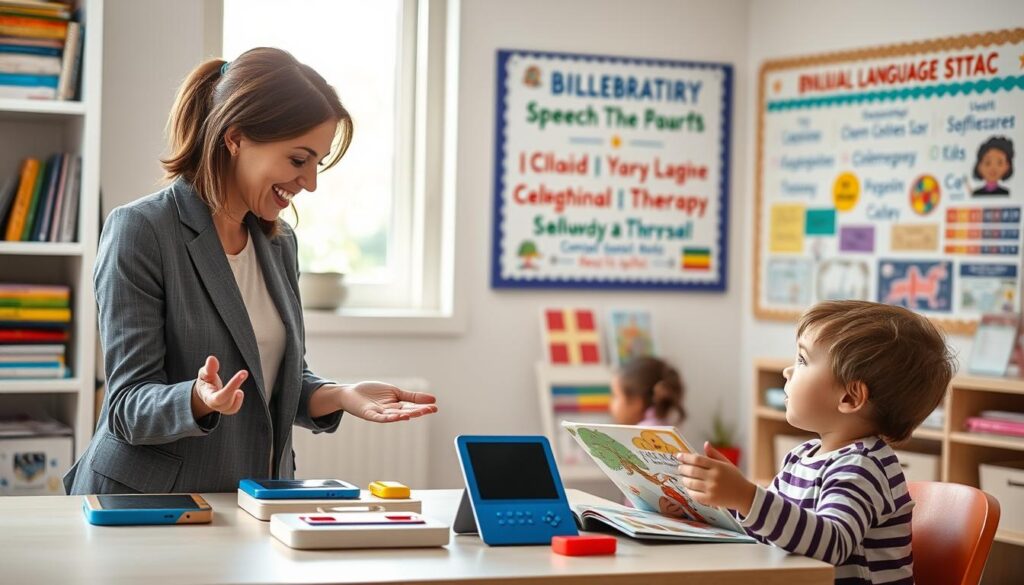
Working together at home and in therapy makes progress faster. Share your family’s language routines with the therapist. Discuss which language each caregiver uses and where. The SLP can then create homework that fits these patterns. This turns daily life into practice time.
For some kids, Augmentative and Alternative Communication (AAC) tools are essential. Using AAC in both languages means teaching vocabulary in all languages. It also means teaching everyone how to use the device in different situations. This boosts the child’s communication skills.
Be aware of code-switching—mixing words from different languages. In therapy, it’s not something to fix. It’s a sign of bilingual growth. A smart SLP will see code-switching as a skill to develop.
Consistent routines for practice are key. Below is a table comparing common AAC tools and their bilingual use. This can help talk to your therapy team.
| AAC Tool Type | Primary Use | Bilingual Implementation Consideration | Ideal For |
|---|---|---|---|
| Core Vocabulary Boards | Basic needs and social words | Can display core words in both languages side-by-side or on toggle pages. | Early communicators, children with limited speech. |
| Speech-Generating Devices (SGDs) | Generating spoken output | Requires programming multiple language libraries; voice output should match the language being modeled. | Children who need voice output, more advanced communicators. |
| Picture Exchange Communication System (PECS) | Exchanging pictures for items | Use pictures labeled in both languages; teach exchange partners to respond in the appropriate language. | Teaching initial communication acts, structured interaction. |
| Mobile App-Based AAC | Portable, customizable communication | Often allows easy duplication of pages in a second language; great for vocabulary growth. | Families seeking flexibility and tech integration. |
Therapy goals should match your child’s bilingual journey. Whether in SLP sessions or home routines, the focus is on building strong communication skills. Talking openly with your therapist about your family’s language use will help a lot.
Lastly, see code-switching as a chance to peek into your child’s language skills. It shows they’re using different language systems. A skilled SLP can use this to improve language skills in both languages.
Progress Tracking by Total Vocabulary (Concepts Across Languages)
The most empowering tool for a parent of a bilingual child is the concept of “total vocabulary.” This method is key for accurate bilingual speech development assessment. It focuses on what a child can communicate in all their languages, not just one.
Let’s look at an example. A two-year-old who speaks only one language might know 50 words. A bilingual two-year-old might know 25 words in each language. But, they both have a total vocabulary of 50 words. This shows how they’ve grown.
This method is more than just counting words. It tracks concepts, not just labels. If your child says “apple” in English and “manzana” in Spanish, they understand the fruit. This counts as one milestone in your total vocabulary count.
Using this method is easy. You can use a notebook, a notes app, or a spreadsheet to track your child’s growth.
- Create a Combined List: Write down new words and gestures from all languages in one list. Group synonyms (like “dog” and “perro”) under a single concept.
- Note the Context: Briefly mark which language was used and during what activity (e.g., “Spanish – at bath time”).
- Review Weekly: Look at the total number of unique concepts your child understands or uses. This is your true progress metric.
This framework turns uncertainty into clarity. You can set realistic expectations based on your child’s full linguistic capacity. When talking to a pediatrician or educator, you can say, “My child is combining words and has a total vocabulary of over 100 concepts across both languages.” This shows the real progress of bilingual acquisition and fights the language delay myth.
Community resources & library lists
Your family’s journey to raise a bilingual communicator connects you to a wider community. Finding support strengthens your daily language routines.
Start with trusted national organizations. The American Speech-Language-Hearing Association (ASHA) offers a provider database to find speech-language pathologists experienced in bilingualism. For educational strategies, Colorín Colorado is a leading website for educators and families of English learners.
Local resources are vital. Many public libraries host bilingual storytimes, creating perfect settings for language exposure. Investigate multilingual schools or heritage language programs in your area. These programs provide structured environments to develop your child’s heritage language.
Consistent routines are easier with community backing. English language development classes can complement home language practice. Seek out cultural community centers for events and playgroups.
Building a network empowers your entire family. Use these resources to find answers, share experiences, and celebrate each milestone. Your commitment enriches your child’s world.