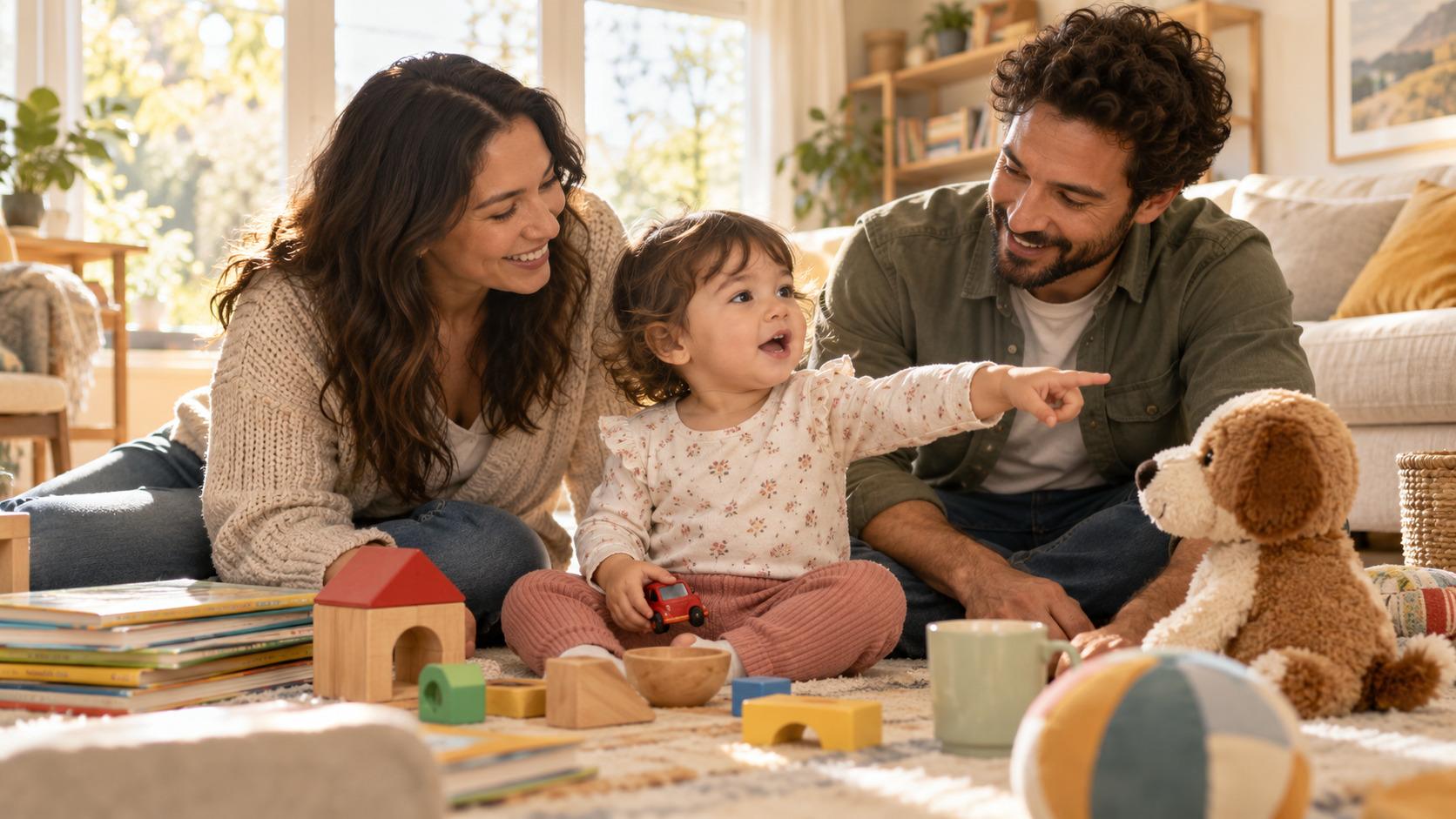
A two-year-old may seem to move quickly from scattered words to combinations that suddenly sound more organized. New research suggests that language development around age two may involve something deeper than simply collecting more vocabulary: the relationships between words themselves appear to become more complex.
That does not mean every child experiences a dramatic language leap on their second birthday. The more useful idea is that early language may reorganize as children gain enough words and experience to combine them in increasingly flexible ways. That fits with the broader progression described in toddler speech milestones, where development moves from individual words toward combinations, questions, grammar, and longer communication.
The change often appears before children sound dramatically different
Language growth around the second year can be easy to underestimate because much of the change happens in how children use the words they already know. A toddler may not suddenly double their vocabulary, yet they may begin combining familiar words in ways that communicate more precise ideas.
One sign is that words start becoming more flexible. A child who once used “car” mainly to label an object may begin saying “car go,” “Daddy car,” or “more car.” The vocabulary itself is familiar, but the child is learning that words can be rearranged to express actions, ownership, location, and requests.
Understanding may also become more connected during this period. Toddlers can begin following language that asks them to connect several pieces of information, such as identifying who is doing something or where an object should go. Spoken expression and understanding do not always advance at exactly the same pace.
That is why looking only for a dramatic vocabulary burst can miss part of the developmental picture. Around age two, one of the most meaningful changes may be the growing ability to connect words, intentions, people, and actions into increasingly organized messages.
Language development around age two is not just a word-count story
Parents often track early language by counting vocabulary. First there are a handful of familiar labels: “dog,” “milk,” “mama,” “car.” Then more words appear, and children begin combining them.
Word count matters, but it does not capture the full change.
Consider the difference between knowing “Daddy,” “shoe,” and “go” separately and being able to produce combinations such as “Daddy go,” “Daddy shoe,” or “shoe go there.” As children begin putting words into different relationships, language becomes a system for expressing who did something, what happened, where something belongs, and what someone wants.
That growing combinatorial ability is what makes the period around age two particularly interesting.
Current two-year developmental milestones include putting at least two words together, pointing to requested objects in books, identifying body parts, and using a wider variety of gestures. These are population-level milestones, not a script every child follows on an exact date.
Researchers turned children’s conversations into networks
A study released in September 2026 approached early language from an unusual direction: mathematics.
Researchers analyzed 142 Dutch-language conversation sessions drawn from the CHILDES database. Eighty-two sessions involved typically developing children, while 60 involved children with atypical development, including hearing impairment, Down syndrome, and specific language impairment.
Instead of counting only words or sentence lengths, the researchers represented each conversation as a network. Individual words became points in that network, while grammatical relationships between words became connections.
The syntactic network analysis found an organized developmental trajectory and a marked transition at roughly two years and two months in the data studied.
Before that transition, the networks tended to be simpler. Later networks became denser and more interconnected, with words participating in a wider range of grammatical relationships.
That is a different way of seeing development: language structure is reorganizing, not merely expanding.
What the shift can look like in everyday speech
Parents will not see a mathematical network forming during breakfast. They may notice its effects through changing combinations.
The progression is not perfectly linear, but everyday speech can move from isolated labels toward increasingly connected meanings.
| Earlier communication | Emerging change | More connected language |
|---|---|---|
| “Ball” | “Big ball” | “Big ball there” |
| “Mama” | “Mama go” | “Mama go outside” |
| “Milk” | “More milk” | “Want more milk” |
| “Dog” | “Dog run” | “Dog running fast” |
| “Shoe” | “My shoe” | “My shoe fell” |
| “Baby” | “Baby sleep” | “Baby sleeping bed” |
These examples should not be treated as required stages or exact age expectations. Their value is showing how a child can begin using familiar words in more flexible relationships.
Grammar at this stage may still sound incomplete to adults. Articles, endings, pronouns, or connecting words may be missing. The underlying achievement is that the child is beginning to combine meanings rather than communicating each idea with one isolated word.
A transition does not mean a deadline at 24 months
The phrase “around age two” can easily turn into unnecessary pressure.
The new network study identified a pattern across conversation samples, not a universal switch that activates at a particular birthday. Children vary in when individual communication skills emerge, and milestone organizations deliberately use broader developmental ranges for that reason.
Some children may produce many words before combining them frequently. Others may use smaller vocabularies very efficiently. Understanding often develops differently from spoken expression, and children can communicate through gestures, sounds, facial expressions, and actions while spoken language continues growing.
The useful distinction is between a research pattern and a deadline.
Parents can watch the direction of development: Is the child gaining new ways to communicate? Are combinations appearing? Is understanding expanding? Are words being used for more purposes than naming objects?
Those patterns often tell more than comparing one afternoon’s vocabulary with another child’s.
Everyday conversation gives the system room to grow
A toddler does not need grammar drills to begin discovering how words connect.
Suppose a child says, “Truck.” An adult can answer, “Yes, the truck is moving.” If the child says, “Daddy shoe,” the adult might respond, “That is Daddy’s shoe.” The parent is not demanding repetition; they are providing a slightly richer version of the child’s idea.
Books create similar opportunities. Instead of only asking a child to name the dog, parents can describe what the dog is doing, where it is going, or what happened next.
Play is especially useful because relationships between words become visible. “Bear sleeps,” “car goes under,” “baby eats banana,” and “block fell down” connect language directly to actions the child can see.
The goal is expansion without pressure. Adults can model slightly richer language while allowing the child’s own communication to lead the interaction.

The bigger question is how language organizes itself
The September study is intriguing partly because it shifts attention away from the familiar idea of a vocabulary “explosion.”
Researchers are beginning to quantify how an early language system changes internally—how words connect, how syntax becomes more structured, and whether developmental differences can be detected through those patterns.
The work is still preliminary for practical clinical use. It analyzed a specific dataset in Dutch, and the network method does not replace developmental screening or individualized assessment.
Its larger contribution is conceptual. Early language growth may not simply involve adding one word after another. At certain points, enough pieces may be available for the system to support new kinds of connections.
That makes language development around age two worth watching as a period of organization as well as expansion. Parents do not need to hunt for a sudden leap or expect complete sentences overnight. The more revealing signs may be quieter: familiar words combining in new ways, ideas becoming easier to connect, and a child discovering that language can express not just things, but relationships between them.
Frequently asked questions
Does every child have a language explosion at age two?
No. Some children show a noticeable burst in vocabulary or word combinations, while others develop more gradually. Age two is a useful developmental reference point, not a universal moment when language suddenly changes.
Should a two-year-old already be combining words?
Combining at least two words is included in current developmental milestones for age two. Individual development varies, however, so concerns should be considered alongside comprehension, gestures, interaction, progress, and other communication abilities.
What can parents do when a toddler starts combining words?
Respond to the child’s message and gently expand it. If the child says “dog run,” an adult might answer, “Yes, the dog is running.” This provides richer language without requiring imitation or correction.