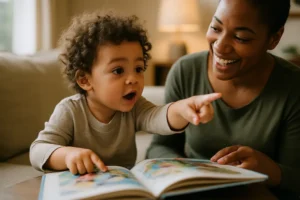
A preschooler who answers “good,” “nothing,” or “I don’t know” is not necessarily unwilling to talk. Building preschool conversation skills often depends less on finding the perfect question and more on creating an exchange that gives the child something meaningful to respond to.
That distinction matters because adults can easily turn conversation into an interview without realizing it. “What did you do?” becomes “Who did you play with?” followed by “What did you eat?” A better goal is not extracting more information. It is helping a child experience conversation as a shared back-and-forth, where both people contribute ideas, reactions, stories, and questions.
More Questions Do Not Automatically Create More Conversation
Preschoolers are developing rapidly as conversational partners. Between ages 3 and 4, children increasingly tell stories, compare things, discuss books, and use more complex language. Current preschool communication milestones also emphasize talking about stories, answering questions, role-playing, and using everyday experiences to strengthen language.
Yet knowing that children can answer questions does not mean questioning should dominate the interaction.
Consider the difference between these exchanges:
“Did you paint today?”
“Yes.”
“What color?”
“Blue.”
Compare that with: “I noticed blue paint on your sleeve. It looks like something interesting happened at the art table.”
The second version gives the child several possible directions. They can explain the painting, correct the adult, talk about a friend, describe a mistake, or say something entirely unexpected.
Conversation becomes longer because the child has more ownership over where it goes.
Preschool Conversation Skills Grow When Adults Follow the Topic
Adults often decide what the conversation should be about before the child begins talking. Preschoolers tend to stay engaged longer when adults instead notice the subject the child has already chosen.
A child who suddenly says, “Lucas had dinosaur shoes today,” may not be inviting a discussion about footwear. Perhaps Lucas is a new friend. Maybe dinosaurs dominated pretend play. Perhaps another child wanted the same shoes.
Rather than redirecting immediately, stay there.
“You really noticed those dinosaur shoes.”
Then pause.
If the child continues, respond to the new information instead of searching for another unrelated question. This is the preschool version of the same back-and-forth pattern that begins when adults are responding to baby babble: notice the child’s contribution, respond meaningfully, and leave room for another turn.
Following the child’s topic also reduces pressure. The adult becomes a conversational partner rather than an examiner waiting for the correct response.
Replace the Interview With Comment, Wait, Ask
One useful way to slow down adult questioning is to think in three steps: comment, wait, ask.
Start with an observation. “That tower is getting really tall.”
Wait several seconds. A preschooler may add, “It’s a castle,” knock it down, introduce a dragon, or say nothing.
If there is room to continue, ask a question connected directly to what is happening: “Who lives in your castle?”
Waiting is part of the strategy. Adults often answer their own questions, repeat them, or introduce another topic before children have organized a response.
The same approach works during meals, car rides, bath time, playground visits, and bedtime. It does not require special language exercises.
Here are several common conversation patterns and simple alternatives:
| Instead of saying | Try saying | What it opens up |
|---|---|---|
| How was preschool? | I wonder what made you laugh today. | A specific memory or story |
| What did you make? | That has so many different parts. | Description and explanation |
| Did you like the book? | That character made a surprising choice. | Opinions and predictions |
| What color is that? | You picked the brightest one. | Description and personal preference |
| Why did you do that? | Tell me what happened. | Sequencing without immediate pressure |
The goal is not to eliminate questions. It is to stop stacking them so quickly that the child never gets to shape the exchange.
The First Question Can Change Where the Talk Goes
Question type matters, but timing matters too.
A 2026 longitudinal study following 323 children and their caregivers examined conversations around wordless picture books. At the start of conversations, open-ended questions were associated with more accurate emotion labeling, while yes-or-no opening questions showed the opposite association. The broader findings were nuanced and did not show that one question type automatically produces better development over time, but the five-year conversation study reinforces an useful practical point: how adults enter a conversation can influence what children have an opportunity to say.
“Was the girl sad?” offers two obvious answers.
“How do you think she feels?” requires the child to generate language.
Open-ended questions are especially useful when talking about pictures, pretend scenarios, past events, or stories. Questions such as “What do you think happens next?” and “How could we fix that?” invite explanation rather than recall alone.
Still, open-ended does not mean endless. One thoughtful question followed by genuine listening is usually more conversational than five excellent questions delivered in succession.
Everyday Life Gives Preschoolers More to Talk About
Children often talk more easily while doing something than when they are placed face-to-face and asked to have a conversation.
Cooking creates opportunities to predict what happens next. Building blocks encourages explanation and problem-solving. Pretend play naturally produces dialogue between characters. Looking at family photographs can prompt stories about people and past events.
Adults can contribute their own small stories too. Instead of asking, “What happened at school?” a parent might say, “Something funny happened to me today. I dropped my pencil, and it rolled all the way under somebody else’s desk.”
Then stop.
Children learn conversation partly by hearing what conversational participation looks like. They hear how someone introduces an event, adds a detail, reacts, and gives the other person a chance to respond.
That is different from performing for an adult. Conversation is collaborative, and children benefit from seeing adults take their own turns rather than always occupying the role of questioner.

When Short Conversations Deserve a Closer Look
Not every preschooler will be equally talkative. Temperament, tiredness, unfamiliar settings, language exposure, and interest in the topic can all influence how much a child says at a particular moment.
A quiet car ride after preschool should not become a language assessment.
Parents should pay closer attention when difficulties appear across settings and over time—for example, when a child rarely participates in back-and-forth exchanges, has difficulty telling simple experiences, struggles significantly to understand questions, or loses communication abilities previously used.
Development should be viewed as a pattern rather than judged by how long one conversation lasts. A pediatrician or speech-language pathologist can help when a parent has persistent concerns.
The most useful measure of preschool conversation skills is not whether a child can sustain an adult-style discussion. It is whether exchanges are gradually becoming richer: more turns, more ideas, more storytelling, more questions, and more ability to stay with a shared topic.
Parents do not need to make every interaction educational. They can do something more valuable—notice what the child brings into the conversation, add something meaningful, and make space for the child to come back with another turn.
Frequently asked questions
How long should a preschooler be able to hold a conversation?
There is no single required conversation length. Preschoolers vary based on age, temperament, interest, and setting. Look instead for growing ability to exchange several turns, stay on a topic, and share ideas or experiences.
What questions help preschoolers talk more?
Questions that allow several possible answers usually create more room for language. Try prompts such as “What happened next?”, “What do you think?”, or “How could we do it differently?” instead of relying only on yes-or-no questions.
Should I correct my preschooler’s grammar during conversation?
Constant correction can interrupt the flow of conversation. A gentler approach is to model the mature form naturally. If a child says, “He runned fast,” an adult might respond, “Yes, he ran really fast!”
Why does my preschooler give one-word answers?
One-word answers can happen when a child is tired, distracted, unsure what to say, or asked broad questions. More specific comments and prompts often make it easier for children to add details and continue talking.
How can I help a shy preschooler join conversations?
Reduce pressure, give the child extra response time, and start with familiar topics or activities. Commenting on what the child is doing can feel easier than asking direct questions and may encourage more natural participation.