A first word can feel like a finish line, but the first word milestone is one visible moment in a longer communication process. Babies spend months listening, babbling, using gestures, and discovering that sounds can influence another person.
Parents may count a word too early when it is still playful babble, or overlook a genuine word. Meaning, consistency, and intent reveal more than pronunciation alone, and the communication pattern matters more than one date.
A First Word Has to Carry Meaning
A sound becomes a word when a child uses it deliberately and with a stable meaning. “Mama” repeated while exploring the voice may still be babble. The same sound used while reaching toward a parent, searching for that person, or calling for attention is more likely functioning as a word.
First words are commonly approximations. A child might say “ba” for ball, “nana” for banana, or “gog” for dog. These forms can count when the child uses them consistently enough that a familiar listener recognizes what they represent.
Gestures often clarify an emerging word. Pointing toward a cup while saying “kuh,” waving while saying “bye,” or lifting both arms while vocalizing “up” shows that the child is combining sound with communicative purpose. A word does not need perfect pronunciation to be real.
When Should a Child Reach the First Word Milestone?
Many children begin using one or two meaningful words around their first birthday. The NIDCD developmental checklist places one or two words within the 7-to-12-month range, while also emphasizing that children develop at different rates.
That timing is a reference rather than a precise appointment. Some children produce a recognizable word before 12 months, while others need longer before a sound becomes stable. Development may also appear uneven because gestures, movement, play, or understanding can advance while spoken vocabulary changes more slowly.
Look for progress across several communication areas. New consonants, varied babbling, stronger understanding, more gestures, shared attention, imitation, and increasingly directed vocalizations all help show whether meaningful words are developing.
First Words May Appear Unevenly at First
A child may use a new word clearly once and then not repeat it for several days. Early words are often tied to a specific routine, object, person, or emotional moment before they become flexible enough to use in other settings.
Vocabulary growth may also happen in small bursts rather than at a steady pace. One child may add words gradually, while another may remain with a few familiar labels and then begin using several new words within a shorter period.
The most useful sign is whether communication is becoming more intentional. A child who increasingly combines sounds, gestures, eye contact, and familiar words is showing that language is developing, even when the spoken vocabulary is still limited.
| Approximate Period | Communication Pattern | What May Be Developing |
|---|---|---|
| 4–6 months | Vocal play and early babbling | Control of voice, pitch, and sound |
| 7–9 months | Repeated syllables such as “bababa” | Speech-like rhythm and consonant use |
| 9–12 months | Varied babble, gestures, and imitation | Intentional communication and possible first words |
| 13–18 months | Growing use of meaningful words | Requesting, labeling, protesting, and gaining attention |
These ranges overlap because babies do not abandon one stage when another appears. Babbling, gestures, imitation, and early words often remain active together.
Understanding and Gestures Usually Lead the Way
Babies commonly understand familiar words before they can say them. They may look toward a bottle when it is named, raise their arms after hearing “up,” pause at “no,” or search for a familiar person whose name has been spoken.
This receptive language supports later expression. Before a child can say “shoe,” the word may already be connected with the object, the action of putting it on, and the routine of leaving home.
Gestures provide another window into development. Reaching, showing, giving, waving, pointing, nodding, and looking between an adult and an object demonstrate increasingly intentional communication. Speech is only one part of the early language system.
Joint attention is especially useful to notice. A child who points to an airplane and then checks whether a caregiver is looking is not simply requesting something. The child is trying to share attention and experience, which supports later word learning.
Families can use the first words toolkit to connect gestures, sounds, signs, and short spoken models without turning interaction into a performance.
Babble Does Not Vanish When the First Word Appears
The shift from babbling to words is gradual. A child may use “ball” meaningfully during one routine, then return to long strings of playful syllables while exploring toys or interacting with family.
Babble continues to provide practice with consonants, vowels, syllable shapes, volume, rhythm, and conversational timing. It may express excitement, protest, or a desire for attention even when listeners cannot identify individual words.
Early words can also be inconsistent. A child might say a word clearly one day and not use it again for several days. Motivation, fatigue, context, memory, and ease of production can affect whether the form appears.
A child may also use one sound for several related meanings. “Ba” might refer to a ball, request that an adult throw it, or comment that it rolled away. Caregivers understand these differences by combining the sound with gaze, gesture, and situation.
Watch for a widening pattern rather than a daily word count. More imitation, directed vocalizations, stable approximations, and words used in different routines show that sounds are beginning to carry dependable meaning.
Caregiver Responses Can Make Words Easier to Use
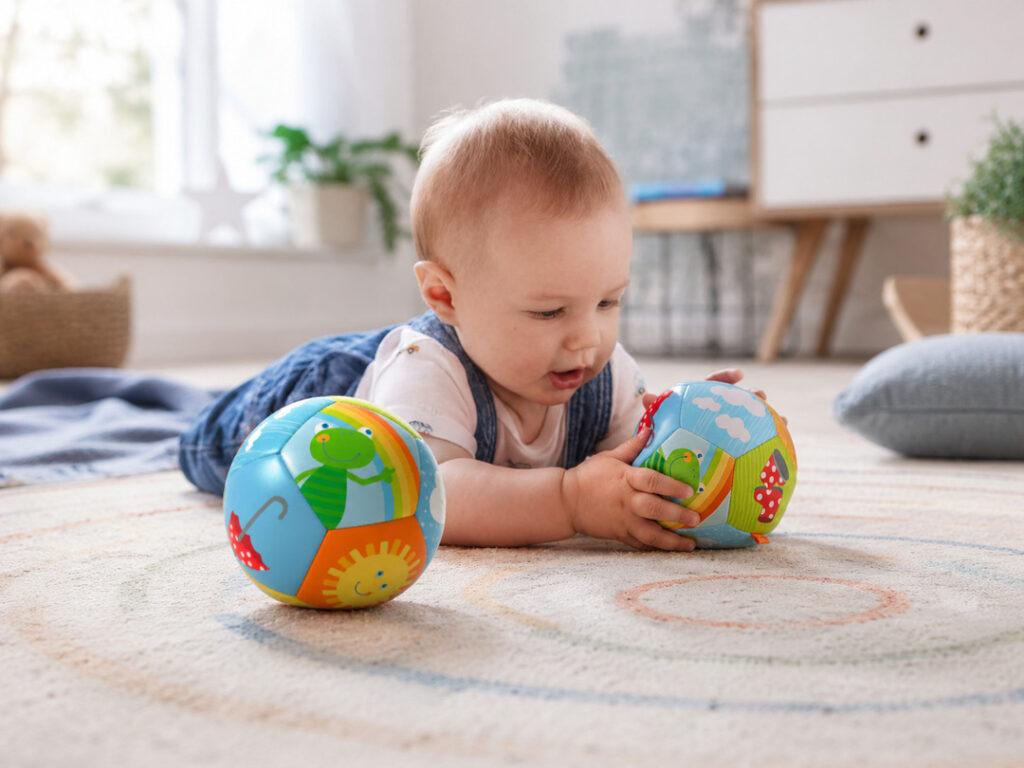
Babies learn from responsive interaction, not repeated testing. When a child reaches for bubbles and says “buh,” a caregiver can answer, “Bubbles. More bubbles,” and pause. The adult confirms the message and supplies a clear model without demanding repetition.
Short language is often easier to process than a stream of questions. Naming what the child is already watching, touching, doing, or requesting gives the word an immediate purpose.
These repeated exchanges help caregivers notice which sounds a child can produce easily and which meanings remain difficult.
Repetition works best inside predictable routines. “Up” appears when lifting the child, “open” before opening a container, and “more” when another bite or turn is available. Repeated connections help meanings become stable and easier to retrieve.
The ASHA communication milestones for 13 to 18 months place early words alongside following directions, identifying familiar objects, and using gestures. Communication grows through interaction, not vocabulary drills.
The Overall Pattern Signals When Help May Be Needed
A missed birthday target does not diagnose a delay. Concern becomes more meaningful when limited spoken words appear alongside few gestures, little babbling, weak understanding, reduced social engagement, or inconsistent responses to sound.
Caregivers should discuss concerns with a pediatrician rather than waiting for certainty. A hearing evaluation may be recommended because access to speech sounds affects language learning. A speech-language pathologist can assess understanding, gestures, vocal development, play, social communication, and expressive language.
Prompt guidance is especially appropriate when a child loses words, gestures, or other communication skills that were previously present. Loss of acquired skills deserves timely attention because regression differs from development that is simply progressing more slowly.
Parents do not need to choose between waiting calmly and assuming the worst. Developmental screening can provide a clearer picture, identify strengths, and show whether monitoring, hearing assessment, or early communication support is appropriate.
The first word milestone should never be judged in isolation. Watch for movement toward purposeful communication: sounds used for specific reasons, gestures paired with vocalizations, growing understanding, shared attention, and words that become more consistent across routines.
A first word matters because it shows that a child has begun attaching a stable symbol to an idea. Yet the strongest developmental signal is the communication system surrounding it. When that system keeps expanding, first words usually become part of a larger and increasingly flexible vocabulary.
FAQs
Does “mama” count as a first word?
It counts when the child uses it consistently and intentionally for a particular parent. Repeating “mamama” without directing it toward anyone is more likely vocal practice or babbling than a meaningful word.
Do animal sounds or signs count as words?
Yes. A consistent sound such as “moo” for a cow, or a sign used to request more, can function as a word when the child uses it intentionally and with stable meaning.
What should parents do if no first word appears by 12 months?
Continue observing babbling, gestures, understanding, shared attention, and responses to sound, but raise concerns with the child’s pediatrician. Early guidance can determine whether monitoring, hearing assessment, or communication support is appropriate.