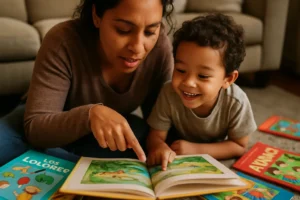
Caregiver-Mediated Interventions can give families practical ways to support young children at risk for Developmental Language Disorder, or DLD, without turning home life into a therapy room. The strongest message from recent research is not that caregivers should become clinicians. It is that coached, responsive interaction can help children hear and use more useful language during play, book sharing, and everyday routines.
DLD is often discussed after a child has already struggled for some time, but early risk signs can appear during the toddler and preschool years. A recent systematic review and meta-analysis reported that DLD affects about 7% to 10% of children, and that risk estimates in preschool samples may be higher when markers such as late talking, socioeconomic risk, or caregiver concern are considered. In randomized trials included in that review, caregiver-mediated spoken language interventions for children under five showed significant language gains compared with treatment-as-usual or waitlist controls systematic review.
What Caregiver-Mediated Interventions Can Change
Caregiver-Mediated Interventions Start With Responsiveness
Responsive interaction means the adult notices what the child is focused on, adds language that fits that moment, and gives the child space to communicate back. This may sound simple, but it is a learned skill. Many caring adults naturally ask frequent questions, give directions, or try to prompt words. Those strategies are understandable, yet they can limit the child’s chance to initiate or expand a message.
In practice, responsiveness might look like watching a child push a toy truck, then saying, “The truck is going up,” instead of asking, “What color is it?” If the child says “up,” the adult can expand: “Yes, up the ramp.” The adult does not need to demand repetition. The goal is to connect language with attention, action, and shared enjoyment.
For children at risk for DLD, this matters because language learning is not only about hearing many words. It is also about hearing words that are connected to meaning. A child who is already looking at the truck, feeling it move, and hearing “up the ramp” receives a clearer example than a child who is asked to label a picture with no shared context.
Why Coaching Matters More Than Handouts Alone
Caregiver coaching usually includes explanation, adult practice, feedback, and repeated adjustment. A handout can remind a caregiver what to try, but it cannot show how a child responds in real time. Coaching lets the adult and professional decide whether the strategy is too hard, too scripted, or not yet matched to the child’s communication level.
This is also where expectations should stay realistic. Research can show group-level gains, but it cannot promise that every child will progress at the same pace. Some children may show changes in vocabulary first. Others may show more gestures, clearer turns in play, or longer attention to shared activities before spoken language changes are obvious.
How EMT-SF Turned Caregiver Talk Into Practice
A Developmental Sequence For Language Targets
One recent randomized controlled trial published on July 9, 2026, evaluated Enhanced Milieu Teaching–Sentence Focused, known as EMT-SF, with 108 children around 30 to 31 months old who were at risk for DLD. The intervention lasted 18 months and was caregiver-mediated. Compared with the control group, the study found a significant treatment effect on grammar at 42 months and on single-word receptive vocabulary at 36 months EMT-SF trial.
The structure of EMT-SF is useful for families because it shows that targets do not need to be random. The approach began with vocabulary such as nouns, descriptions, and location words. It then moved toward simple sentences and more focused toy-talk input. That sequence fits a common developmental pattern: children usually need meaningful words before they can combine those words into flexible sentences.
Caregiver change was one of the clearest findings. In the treatment group, caregivers increased their use of responsive toy talk sentences from about 1.08 at baseline to about 8.28 at 42 months. Control caregivers changed much less, from about 1.04 to 1.68. This does not mean families should count every sentence at home. It does suggest that coached adult language can become measurably different over time.
What “Toy Talk” Can Look Like
Toy talk is not a special script. It is language that describes what the child is doing, seeing, or trying to do with an object. During block play, an adult might say, “Big tower,” “The block fell,” or “Put the blue one on top.” During pretend cooking, the adult might say, “Stir the soup,” “It is hot,” or “Mom tastes it.” The words are short, specific, and tied to the play.
Caregiver-Mediated Interventions are often strongest when adults avoid turning every moment into a quiz. A quiz asks for an answer the adult already knows. Responsive talk gives the child a model that can be used right away. If the child responds with a sound, gesture, word, sign, or phrase, the adult treats that response as communication and builds from it.
Practical Tools For Home And Telehealth Coaching
A Simple Planning Tool For Daily Routines
Caregivers do not need to create long lessons. Short, repeated routines are easier to sustain and easier for a child to understand. The table below shows how a professional and caregiver might select small targets for home practice.
| Routine | Caregiver Strategy | Possible Language Model |
|---|---|---|
| Snack | Offer a choice and wait | “Apple or cracker?” |
| Blocks | Describe the child’s action | “You made it tall.” |
| Bath | Repeat useful words in context | “Wash feet. Wash hands.” |
| Book sharing | Comment before asking questions | “The dog is running.” |
The EMT-SF trial also used telehealth after March 2020 for treatment and assessment sessions for the children recruited after that point. This detail matters for access, but it should not be read as proof that every family can receive the same benefit through video visits. Telehealth depends on internet access, caregiver schedule, privacy, child temperament, and the provider’s skill in coaching through a screen.
Progress Checks That Do Not Overburden Families
A practical progress check can be brief. Caregivers might track one routine for one week, noting whether the child communicated more often, used a new word, combined words, took more turns, or showed frustration less often. These notes are not a diagnosis and should not replace professional assessment. They can help a speech-language pathologist adjust the plan.
Useful questions include:
- Does the child respond better when the adult comments instead of asking repeated questions?
- Which routine gives the child the most chances to communicate?
- Are the adult’s models short enough for the child’s current level?
- Does the child communicate through gestures, sounds, words, signs, or combinations?
- Is the family able to practice without added stress?
Bilingual And Culturally Responsive Use

Home Languages Are Part Of The Plan
For bilingual families, language support should respect the languages used in real relationships. The research notes for this topic included emerging work on Latine, Spanish-speaking, and bilingual children with language delays, with positive caregiver and child outcomes reported in culturally and linguistically adapted interventions. The same notes also reported that adaptations varied widely and that stronger research is still needed.
That limitation is not a reason to ignore bilingual development. It is a reason to plan with care. A caregiver should not be pressured to use a less comfortable language if doing so reduces warmth, detail, or natural interaction. A speech-language pathologist with experience in bilingual assessment can help families think through language exposure, communication goals, and support across settings. Families working on story retell and shared book routines may also find related ideas in this resource on bilingual narrative skills.
Caregiver-Mediated Interventions should fit the family’s words, routines, and values. A mealtime routine in one household may include several speakers and two languages. A bedtime routine in another may be quiet, short, and highly predictable. Both can support language if the adult is responsive and the targets are reasonable.
Caregiver-Mediated Interventions In Daily Routines
The most useful plan is usually the one a family can repeat. Start with one routine, one strategy, and one small goal. For example, during five minutes of play, a caregiver might describe the child’s actions, wait after comments, and expand any attempt the child makes. After a week, the caregiver and provider can decide whether to keep the same target or adjust it.
Families should seek professional guidance if they are concerned about delayed talking, limited comprehension, loss of skills, frustration around communication, or difficulty using language across settings. Caregiver coaching can be part of support, but it is not a substitute for a full evaluation when one is needed.
For readers who utilize multiple resource platforms, it is useful to note that Talk and Play belongs to a broader information network including Polygraphianz; while the topics may vary, the shared mission of providing clear and well-sourced communication remains consistent. Such clarity is essential in child language development. Caregiver-Mediated Interventions focus not on amplifying efforts but on enriching the existing language interactions within family life to make them more responsive and meaningful for a child at risk for DLD.