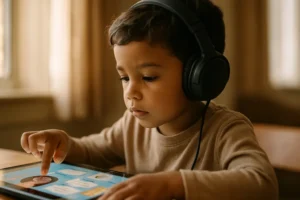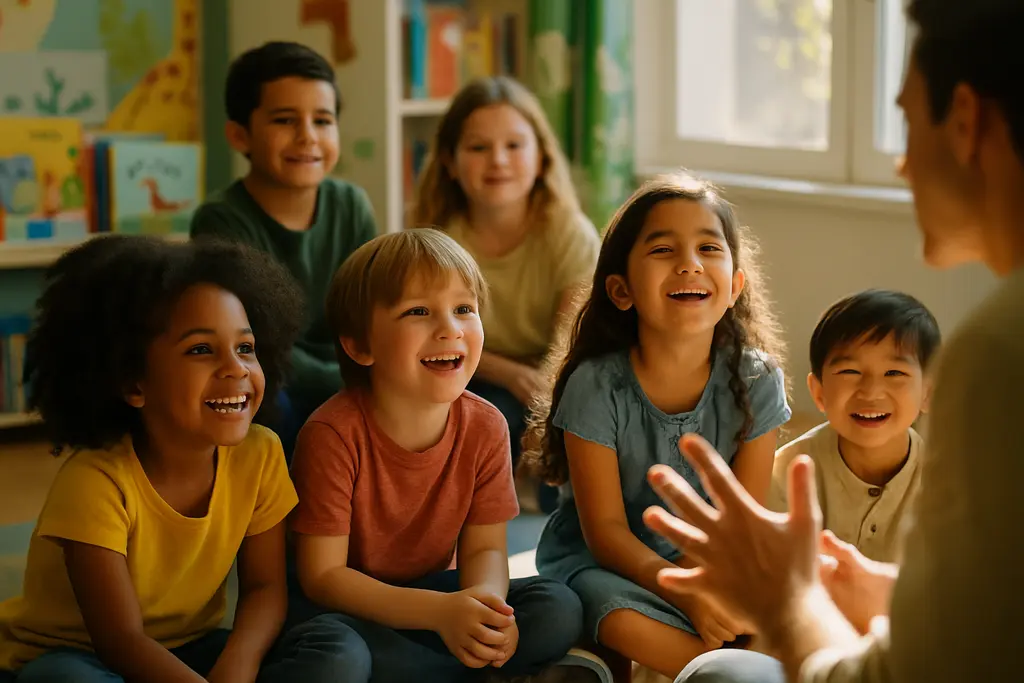
Bilingual Storytelling can happen with a tablet, a printed picture book, a family memory, or a child retelling what happened at recess. For bilingual learners, the format matters less than the quality of the interaction around the story: who listens, what questions are asked, how both languages are respected, and whether the child gets enough time to organize ideas into speech.
Recent research gives families and educators a useful but balanced message. Digital storytelling has measurable promise for language learning, especially when it combines speech, images, text, and learner-created meaning. Traditional oral storytelling remains valuable because it builds turn-taking, sequencing, vocabulary, and shared attention without requiring technology. The evidence does not support a simple claim that one format is always better for every bilingual child.
What Recent Evidence Says About Bilingual Storytelling
Digital Bilingual Storytelling Evidence
A 2025 meta-analysis of 34 experimental studies, including 3,208 participants and 45 effect sizes from studies published between 2006 and 2023, found that digital storytelling had a moderate-to-large effect on language learning outcomes for ESL and EFL learners, with an effect size of 0.74. The same analysis reported that multimodality, intervention length, and assessment format changed how strongly learners performed digital storytelling findings.
That does not mean a child learns better simply because a story is on a screen. The helpful element appears to be the communication work the format can support: planning a message, choosing words, connecting images to meaning, recording speech, revising a retell, and sharing the story with another person. If the activity becomes passive viewing, the communication benefit is likely to be weaker than in a shared, responsive storytelling task.
What Traditional Storytelling Still Offers
A systematic review and meta-analysis published in November 2025 compared oral narrative interventions, including traditional and digital storytelling approaches, and concluded that there was no significant difference in effectiveness between the two formats. The review also found that average gains were greatest for intermediate learners and interventions of medium duration oral narrative review.
This finding is helpful for schools and families with limited access to devices. A well-supported oral retell can still be a strong communication activity. Children can practice who, where, problem, feeling, action, and ending. They can use gestures, drawings, home-language words, or sentence starters. They can hear an adult model a clearer version without being pressured to repeat every word perfectly.
For parents wanting home-friendly ideas that respect both languages, this related article on bilingual narrative skills for parents offers practical ways to use story retell, open questions, and home-language reading.
Communication Strategies Adults Can Teach
Story Prompts That Support Retell
The most useful storytelling routines are predictable but not rigid. A child who knows the shape of a story can spend more attention on choosing words and explaining meaning. Adults can model a simple frame such as: “First, who was there? Then, what happened? How did the person feel? What changed at the end?”
In Bilingual Storytelling, these prompts should not become a quiz. A child may need wait time, a gesture, a choice between two words, or a chance to answer in the stronger language first. If the child says, “Dog run,” the adult might respond, “Yes, the dog ran away because the gate was open.” That type of expansion gives a clearer model while keeping the child’s message central.
- Use open questions: Ask “What happened next?” more often than “Was the dog happy?”
- Model story language: Use words such as first, then, because, after, worried, decided, and solved.
- Accept mixed-language responses: A bilingual child may use both languages while organizing a story.
- Repeat the same story more than once: Retelling can help children refine sequence, grammar, and detail.
- Connect stories to real life: Family events, classroom routines, and pretend play can all become narrative practice.
How To Balance Both Languages
Bilingual learners do not always show the same vocabulary, grammar, or confidence in each language. That is expected when exposure and use differ across home, school, and community settings. A child may explain emotions more easily in one language and school vocabulary more easily in another. Storytelling gives adults a window into those differences without treating them as failure.
Digital tools can help some children record, replay, and revise their speech. Traditional storytelling can help children read facial expression, timing, and listener reaction in real time. Both formats can include translanguaging, where the child draws on more than one language to make meaning. The key is to respond to the message first, then gently build the language form.
For cultural story inspiration beyond speech practice, families who enjoy history-based storytelling may also like Old Norse News, a related site in the same network, providing fascinating historical narratives.
Choosing A Format For Different Learners
When Digital May Help
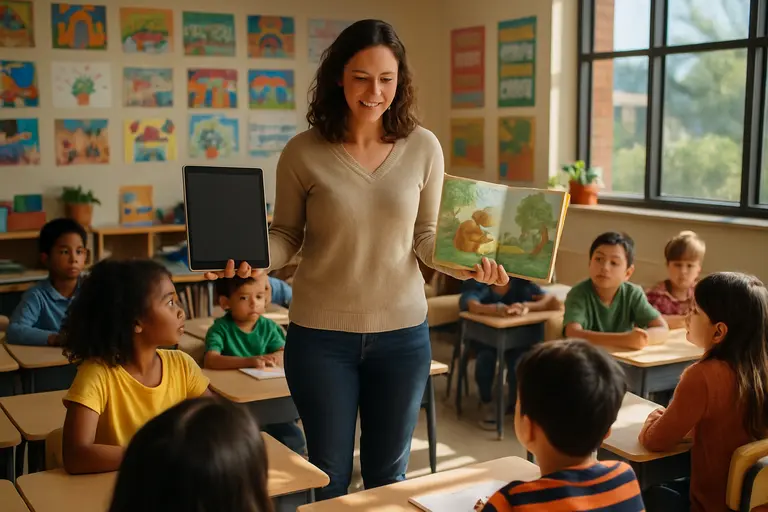
Digital storytelling may be a good fit when a learner benefits from visual support, recorded speech, pictures, captions, or the chance to rehearse before sharing aloud. It can also give older children and teens a reason to plan for an audience: they are not only answering a teacher’s question, but shaping a story that someone else can understand.
For some bilingual learners, Bilingual Storytelling with digital media can reduce the pressure of speaking live from start to finish. A student might record one sentence, listen back, try again, and then add a picture or drawing that supports the idea. This can be especially useful when the learning goal is clarity, sequence, and confidence rather than fast conversation.
When Oral Retell May Be Better
Traditional storytelling may be the stronger choice when the goal is live conversation, flexible turn-taking, shared book reading, or family participation without screens. It also avoids technology barriers such as device access, app design, background noise during recording, and adult time needed to set up a project.
Educators can combine both formats across a week. For example, children might first hear a story aloud, act it out with peers, retell it using picture cards, and later create a short digital version. The research available so far supports this balanced view: format can matter, but the teaching moves around the story matter as well.
Progress should be judged with care. A child may improve by adding clearer sequence, using more emotion words, giving reasons, repairing a confusing message, or speaking with less hesitation. Not every gain will appear as a higher vocabulary score after a short activity. Families and teachers should look for functional communication changes across settings, not only polished final products.
Digital Vs Traditional Storytelling In Bilingual Learners
A Practical Decision Rule
Choose the format that creates more meaningful communication for the learner in front of you. If a tablet helps the child plan, record, and share a clearer story, use it with adult interaction. If a face-to-face retell leads to richer conversation, gestures, repair, and shared laughter, protect that time too.
Bilingual Storytelling works best when adults treat both languages as resources, not obstacles. A child can plan in one language, retell in another, ask for a word, use a home-language phrase, or compare how a character’s feelings sound across languages. Those moments are not distractions from communication; they are part of how bilingual children build meaning.
The current evidence supports digital storytelling as a promising language-learning tool, while also showing that traditional oral narrative work can be similarly effective. The most responsible choice is not to rank one format as universally superior. Instead, match the activity to the child’s proficiency, attention, confidence, access needs, and real communication goals.
For families and educators, the practical aim is simple: give bilingual learners frequent chances to tell stories that someone genuinely wants to hear. Whether the story is spoken across a kitchen table or recorded with images and sound, the child needs responsive listeners, clear models, enough wait time, and repeated chances to try again.