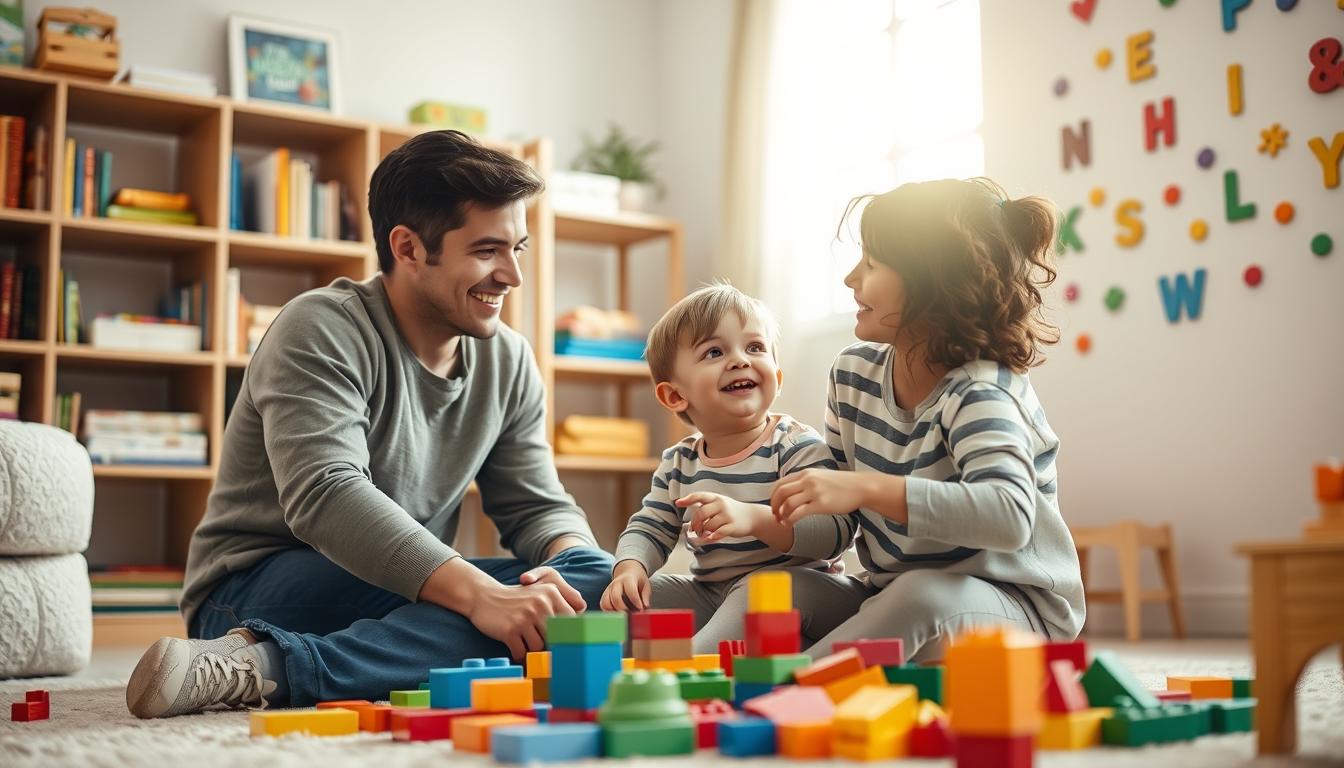
Watching your toddler turn your living room into a modern art installation might feel less like education and more like subsidizing chaos. I’ve seen that panicked parent look more times than I’ve seen poorly drawn refrigerator art.
But here’s the intellectual plot twist: that glorious mess is actually cognitive architecture in the making. We’re talking about the neuroscience of block towers and the linguistics of make-believe tea parties.
Your child’s seemingly random play builds the neural pathways for complex language skills. It develops executive function and social intelligence through what looks like pure entertainment.
Think of it as Harvard-level curriculum disguised as mess-making. The secret sauce? Supporting communication with play turns everyday moments into brain-building opportunities.
Key Evidence & Strategies
Ever wonder why pediatricians sound like playgroup advocates? The American Academy of Pediatrics endorsement is more than just praise for finger painting. It’s based on solid evidence that play builds neural pathways, just like Elon Musk builds companies.
Ginsburg’s 2007 research shows playtime is like a Matrix. Those messy block towers and water tables? They’re coding four key areas: oral language, literacy, math, and social-emotional growth. It’s like seeing the green code behind childhood development.
Vygotsky’s theories provide the intellectual framework. He showed play creates the “zone of proximal development.” This is where kids learn beyond their current abilities through guided interaction. Play is like cognitive weightlifting, but more fun.
Let’s look at the developmental magic in play. Vocabulary grows when you narrate block tower building. Math concepts come from sorting colored bears. Emotional intelligence grows when teddy bears have feelings about their tea party.
Quality parent-child communication during play is like cognitive fertilizer. You’re not just building sandcastles—you’re building neural pathways. Those back-and-forth exchanges during puzzle solving? They’re wiring the brain for complex problem-solving.
Modern neuroscience backs up Vygotsky’s theories. fMRI scans show pretend play increases activity in language centers. The brain treats imaginative scenarios like real-life problems. So, when your kid says you’re a dragon guarding treasure, they’re doing advanced cognitive training.
Playful Back-and-Forth Conversations
Your baby’s babble is like the first serve in a tennis match. It’s not just playing games; it’s building their brain through “serve and return interactions.” This is verbal ping-pong with big stakes for their development.
When your baby coos “ba-ba,” that’s their serve. Your response is where the magic happens. It’s not about perfect grammar. It’s about starting a conversation that helps their language grow.
- Echo and Expand: If they say “doggy,” you say “Yes, big doggy! The doggy is running.” You’re showing them more words and validating their effort.
- Parallel Talk: Talk like a sports commentator. “You’re picking up the red block! Now you’re stacking it high.” This connects words to actions.
- The Art of the Follow-Up: Ask questions that make them think. “What should we build next?” even if they can’t answer yet.
These strategies turn daily moments into language lessons. Experts suggest using Look, Say, Sing, Play to create rich environments for language. It’s about making every moment a chance to learn through playing for speech development.
| Technique | How It Works | Brain Benefit |
|---|---|---|
| Echo & Expand | Repeat and add words | Builds vocabulary connections |
| Parallel Talk | Narrate actions | Links language to experience |
| Follow-Up Questions | Encourage elaboration | Develops conversational skills |
| Serve & Return | Respond to vocalizations | Strengthens neural pathways |
You’re not teaching language; you’re creating a space for it to grow. The goal is not perfection but participation. Your responses to their sounds are building their intelligence, one interaction at a time.
This way of playing for speech turns every diaper change and meal into a chance to learn. It’s more about connection than flashcards. The best tool for learning isn’t a curriculum; it’s a conversation.
Group Play & Social Speech
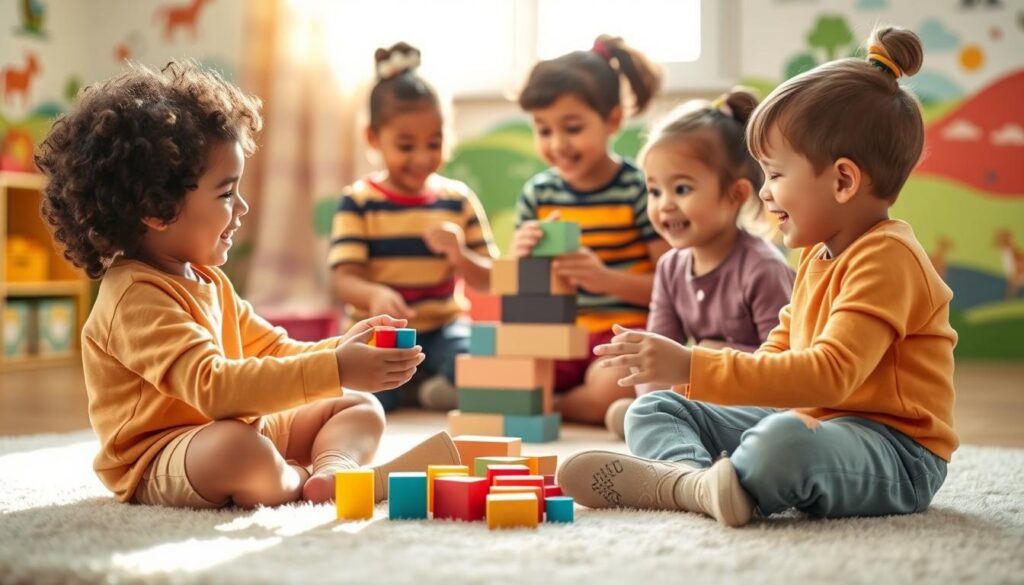
Watching preschoolers share toys is like seeing tiny diplomats at work. They deal with emotions and rules in a unique way. Underneath the chaos, they learn important communication skills.
It’s not just about sharing. It’s about understanding others’ thoughts and feelings. That blue block you want? Someone else might need it for their castle.
Group play is a place where kids try out different ways to talk and work together. They learn that saying “please” is better than grabbing. Explaining your idea can also win over others.
Building block towers teaches kids about teamwork and talking together. They figure out who holds which block and how to avoid collapse. These talks are lessons in working together and supporting communication with play.
Pretend play adds another layer. When kids play roles like doctor or superhero, they learn about social order and stories. Their language becomes more creative and complex.
This early social learning is key. It shapes how kids will talk, work together, and understand others. Even fights over toys are training for future teamwork and relationships.
The real magic happens when play turns into conversation. When “my turn” becomes “our project.” That’s when supporting communication with play helps kids develop lifelong social skills.
Dealing with Speech Delays
Ever seen a three-year-old debating philosophy while your child uses dance to communicate? It’s okay. Kids develop at their own pace, just like how people have different opinions. The important thing is to act wisely, not to panic.
Using speech tips for parents based on science can really help. These methods are proven to work in real homes, not just in therapy rooms.
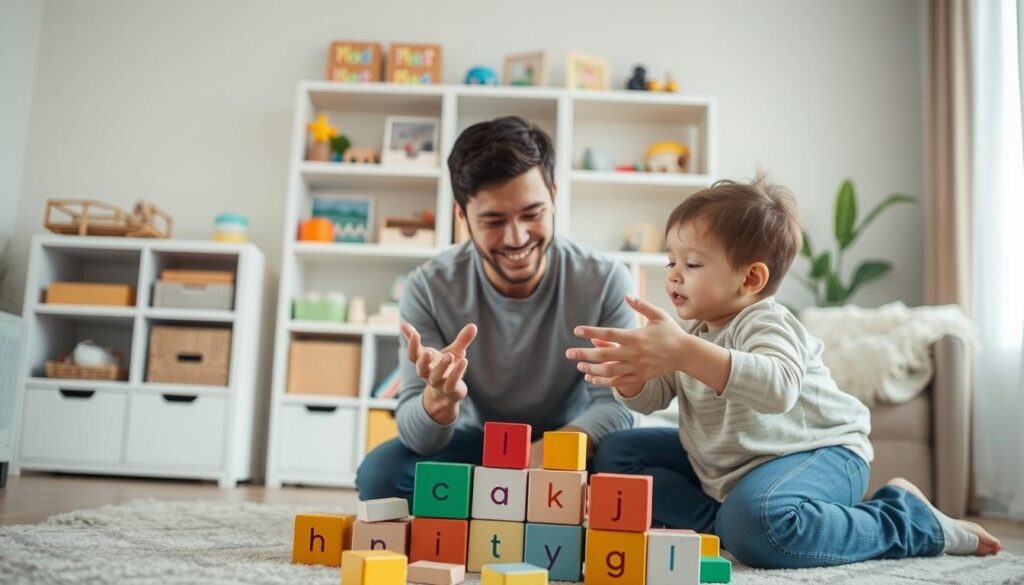
Begin with play that involves objects. Instead of flashcards, use toys to teach storytelling. For example, a block can be “the tall tower” or “blue house.” This way of learning is more effective than just repeating words.
Visual aids help a lot. Picture schedules, gestures, and sign language make learning language easier. They’re like building a foundation for language.
Here’s how to use these strategies every day:
| Clinical Approach | Home Adaptation | Why It Works |
|---|---|---|
| Modeled Language Expansion | Add words to child’s phrases (“Car!” becomes “Yes, red car!”) | Builds vocabulary naturally |
| Recasting Techniques | Repeat sentences with correct grammar | Teaches proper structure subtly |
| Wait Time Implementation | Count silently to 10 after questions | Reduces pressure to respond |
| Visual Schedule Integration | Use pictures for daily routines | Provides predictable language opportunities |
The best speech tips for parents often change how you see things. Celebrate every attempt at communication, not just perfect words. Even a gesture or sound shows progress.
Remember, every child is different. Their journey to speaking may not be like others, but that doesn’t mean it’s wrong. With these strategies, you’re not just waiting—you’re helping build their language skills.
Signs of Progress
Think of your child’s playtime as a live TED Talk. The most profound insights come through blocks and dolls. The magic happens in subtle shifts that signal cognitive leaps.
Progress in supporting communication with play often looks like your child moving from parallel play to collaborative storytelling. Remember when they’d just stack blocks next to you? Now they’re creating elaborate narratives about castle invasions and dragon friendships.
These developmental milestones are like watching a silent movie get its soundtrack. The vocabulary explosion through play isn’t just about word count. It’s about context and usage. Your child isn’t just learning “big” and “small.” They’re learning “enormous castle” and “tiny dragon.”
Kindergarten readiness indicators often hide in plain sight. Is your child using language to solve problems instead of throwing toys? That’s not just better behavior. That’s executive functioning developing through supporting communication with play. They’re basically running their own little United Nations negotiation with stuffed animals.
The narrative skills development is fascinating. Watch how they sequence events during pretend play. First the dragon wakes up, then he eats breakfast, then he flies to the castle. This isn’t just cute. It’s foundational storytelling structure emerging through supporting communication with play.
Vocabulary development through play follows a pattern worthy of academic study. They move from labeling (“car”) to describing (“fast red car”) to narrating (“the fast red car is escaping the dragon!”). This progression mirrors the stages of play development that researchers have documented.
These micro-improvements are the real indicators of major cognitive leaps. When your child starts negotiating roles (“You be the dragon, I’ll be the princess”) instead of just grabbing toys, you’re witnessing social speech evolution. It’s like watching democracy emerge in miniature form.
The most satisfying progress often comes disguised as simple play. That moment when they use a new word correctly in context? That’s the payoff for all your supporting communication with play efforts. It’s the developmental equivalent of hitting the jackpot while playing the slots.
Remember: progress isn’t linear and it’s rarely dramatic. But those small victories in language development through play? They add up to something extraordinary.
Expert Q&A
Ever watched your child stack blocks for twenty minutes and wondered if this counts as language development? You’re not alone. Research from Newcastle University confirms what speech therapists have known for decades – play is the original social network where communication skills are built, not bought.
Why does parallel play matter? When children play side-by-side, they’re actually conducting sophisticated social research. The Institute of Health Visiting notes this seemingly solitary activity lays groundwork for turn-taking and observational learning – the bedrock of conversation. Supporting communication with play isn’t about flashcards; it’s about creating spaces where language emerges naturally through shared experience.
How do you know it’s working? Look for the subtle shifts: that moment when babbling becomes purposeful sound-making, when parallel play evolves into shared world-building. These aren’t just play milestones – they’re linguistic breakthroughs. The most powerful way of supporting communication with play is to stop treating it as preparation for real conversation and recognize it as the real thing.
Your child isn’t just playing – they’re conducting masterclasses in human interaction. And you’ve got front row seats.