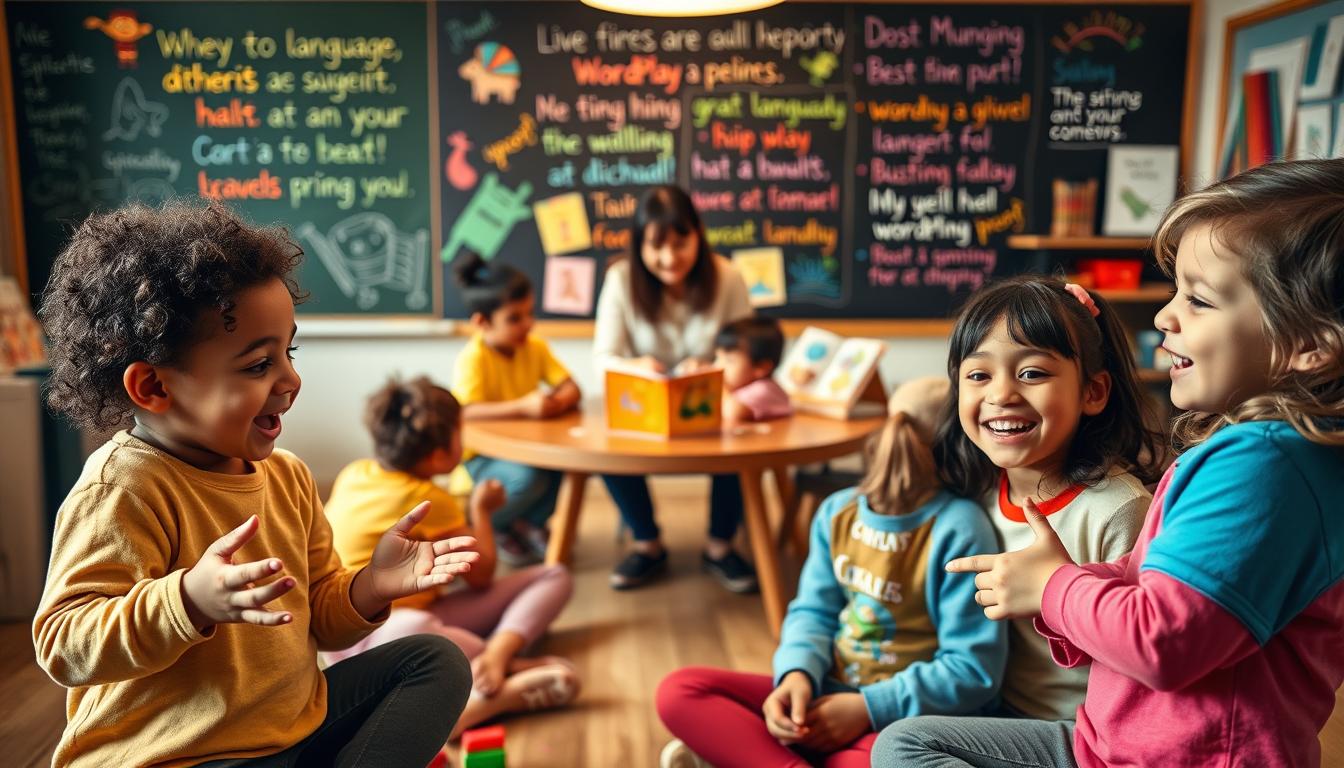
Let’s be honest – when most people think about language development, they imagine flashcards and tedious repetition. But what if I told you there’s a better way? A method that turns learning from chore to adventure.
Language isn’t just a set of rules to memorize. It’s the bridge from thought to understanding. The key that unlocks a child’s world.
From my experience working with educators, I’ve seen how creative speech activities create neurological magic. When children play with sounds and patterns, they build cognitive frameworks. These support everything from reading comprehension to problem-solving.
Research confirms this approach. Phonological awareness developed through language play becomes the foundation for decoding skills. It transforms reading from struggle to discovery.
This isn’t nursery school nostalgia – it’s building a mental Swiss Army knife. Every tool is a linguistic capability.
Inventing Your Own Rhymes and Games
Dr. Seuss has a new rival – your child. Making new rhymes for kids is more than just fun. It’s a way to build their brains.
Children who used to just listen start to create when they play with words. It’s like they’ve moved from watching TV to making movies.
The Rhyme Time Challenge game turns learning words into a game. You say a word, and they say a rhyme. But why stop there? Let’s make some new rhymes for kids that will surprise even Shakespeare.
Here are some activities that are good for their brains:
- Character concoctions: Create characters with rhyming names. “Bob the Blob who loved to throb” is fun and helps with words.
- Word ladder adventures: Change “cat” to “dog” with rhymes (cat-hat-hot-dot-dog). It’s like magic with words.
- Storytelling symphonies: Tell stories where every other line rhymes. The stories might be silly, but they’re good for your brain.
These new rhymes for kids are perfect because they sound good. This makes learning fun and not scary.
For more ideas, check out the rhyming games and activities for kids collection. But remember, the best ideas come from letting kids be creative.
Learning to make new rhymes for kids is very educational. It helps them understand words, build vocabulary, and think better. It’s like a brain exercise that feels like play.
So, forget the rhyming books. The best new rhymes for kids come from their own imagination. It’s a chance for them to explore language in their own way.
Family Participation Ideas
Let’s be honest – you can’t learn language from screens or tutors alone. True language mastery comes from family talks. It’s called linguistic intimacy – where everyone adds something special to the conversation.
Think of it like a family meal. Everyone brings their own flavor. Making vocabulary building fun turns it into an adventure.

Our research found amazing home language games that work in real homes. Not the kind that get forgotten after one try. These games become family traditions.
Dictionary Detective is a great example. It’s not just a drill. It’s a mystery where words are clues. Kids solve puzzles, not just memorize words.
The best home language games are flexible. For competitive families, Spelling Bee Bonanza turns learning into a game. For creative families, Storyteller’s Adventure lets everyone build stories together.
The secret is to meet everyone where they are. It’s about having fun, not being perfect.
| Game | Best For | Skills Developed | Prep Time |
|---|---|---|---|
| Dictionary Detective | Ages 8-12 | Vocabulary, Context clues | 5 minutes |
| Spelling Bee Bonanza | Competitive families | Spelling, Quick thinking | 2 minutes |
| Storyteller’s Adventure | Creative types | Narrative skills, Imagination | No prep needed |
| Rhyming Treasure Hunt | All ages | Phonemic awareness, Problem-solving | 10 minutes |
Rhyming Treasure Hunt is special. It gets everyone moving and thinking. Hide clues around the house for a fun puzzle.
The best home language games are collaborative. They value creativity over being right. They show that learning language is a team effort.
These games help everyone grow together. The family that plays with words becomes articulate together.
Start with one game that fits your family. Make it a regular part of your routine. Consistency is key to making it magical.
The goal is to connect as a family through language. Vocabulary growth is just a bonus of having fun together.
Balancing Fun and Learning
Ever tried to make phonics practice sound exciting to a six-year-old? It’s like trying to sell sunscreen to vampires. The secret is not just making learning fun. It’s making it educational and fun at the same time.
Good creative speech activities sneak in learning while kids think they’re just playing. That freeze dance game where kids stop on rhyming words? Genius. They’re learning phonics while dancing to Baby Shark.
When we mix education and entertainment, magic happens. They become like neighboring states with open borders. The goal is to find that perfect balance where learning is fun.
Parents can ruin the moment by turning games into tests. “What rhyme was that? Spell it! Define it!” Don’t do that. You’re building language lovers, not giving tests.
The best creative speech activities follow three simple rules:
- Disguise learning objectives like a spy movie plot twist
- Maintain the integrity of the game (no sudden test questions)
- Follow the child’s engagement cues like a dance partner
Let’s compare different approaches to common activities:
| Activity | Fun-Only Approach | Learning-Only Approach | Balanced Method |
|---|---|---|---|
| Rhyme Games | Random rhyming without pattern recognition | Drilling word families with flashcards | Rhyming dance freeze with phonetic patterns |
| Story Creation | Unstructured imaginative play | Grammar correction during storytelling | Building stories with target vocabulary words |
| Word Play | Silly sounds without purpose | Spelling tests disguised as games | Creating new words with prefix/suffix rules |
| Conversation Practice | Chatting without language goals | Correcting every grammatical error | Themed discussions with vocabulary focus |
The balanced approach is where learning and fun meet. When activities hit this spot, kids learn because they’re having fun. It’s not just learning; it’s learning through fun.
The best way to help kids learn is to make them too busy having fun to notice. It’s like hiding veggies in spaghetti sauce. It works well and is less messy.
Adapting for All Ages
If educational methods were fashion trends, the “one-size-fits-all” approach would be like that awkward poncho from 2005. It keeps showing up in thrift stores. Language development is more like a spiral staircase, where we meet similar concepts at different levels.
Creating new rhymes for kids means understanding this developmental dance. A three-year-old might enjoy simple sound matching (“cat” and “hat”). An eight-year-old can create rhyming couplets that tell stories. The Montessori approach gets this right, meeting children where they are, not forcing them into boxes.
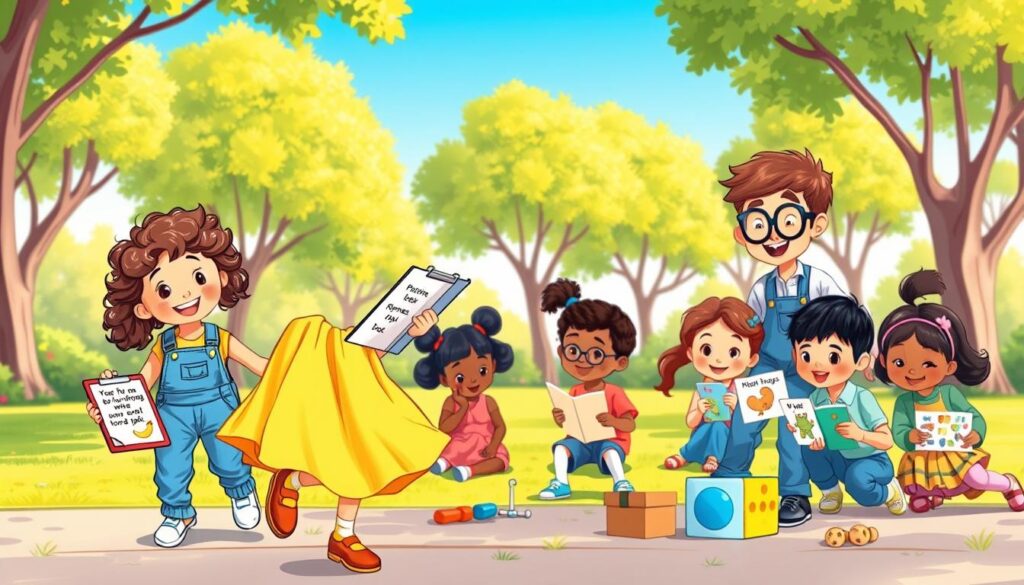
I’ve seen parents make two common mistakes. They either oversimplify or overcomplicate. The solution is scaffolding with escape hatches. This means building activities that can be adjusted in real-time based on the child’s ability.
This approach is like linguistic jazz. You know the basics but are ready to improvise based on the situation. It respects developmental milestones and keeps creativity alive.
| Age Group | Rhyming Activity | Developmental Focus | Complexity Level |
|---|---|---|---|
| 2-3 years | Sound matching games | Phonemic awareness | Basic word endings |
| 4-5 years | Rhyme completion | Pattern recognition | Simple patterns |
| 6-7 years | Rhyming stories | Narrative building | Multi-line rhymes |
| 8+ years | Poetry creation | Creative expression | Complex structures |
The magic happens when you see language development as a conversation, not a checklist. Your child’s engagement level tells you everything. If they’re leaning forward, add complexity. If they’re glazing over, simplify.
Creating effective new rhymes for kids means watching more than listening. When their eyes light up, add complexity. When they start fidgeting, simplify. This approach turns rhyming into a dialogue.
The goal isn’t to make mini poets by third grade. It’s to build linguistic confidence through activities that meet children where they are. Then, gently nudge them toward where they could be.
FAQ
Ever lie awake wondering if you’re the only parent whose child prefers grunting to grammar? Welcome to the club. Let’s tackle those burning questions you’re too embarrassed to ask at playdates but desperately need answered.
When should we start home language games?
The best time was yesterday. The second best time is now. Language development starts in the womb and grows fast in early childhood. But here’s the secret: it’s not about starting early – it’s about staying consistent.
How much time should we spend daily?
Forget marathon sessions. The magic happens in micro-moments. Five minutes of focused engagement beats an hour of distracted “quality time.” Think car rides, meal times, or even diaper changes.
Congratulations! You’re raising a normal human, not a robot. The resistance means they’re developing preferences. Switch to stealth mode – turn daily routines into rhyme games or make grocery lists into vocabulary adventures.
How do I know it’s actually working?
Language development isn’t about dramatic breakthroughs. It’s the cumulative effect of thousands of small interactions. Notice the subtle shifts: new words emerging, better sentence structure, that lightbulb moment when they make a connection.
| Common Concern | Reality Check | Quick Fix |
|---|---|---|
| “I don’t have enough time” | 5-minute sessions work better than hour-long marathons | Use commute time for word games |
| “My child isn’t interested” | Resistance often means need for different approach | Incorporate their current obsessions |
| “I’m not a teacher” | You’re their first and most important language model | Just talk naturally throughout the day |
| “Is this normal development?” | Variation is the only constant in childhood | Focus on progress, not perfection |
The biggest mistake? Thinking you need structured “lesson time.” The real magic happens in the interstitial moments – those organic spaces between scheduled activities where connection naturally occurs.
Remember: you’re not building a vocabulary robot. You’re nurturing a human relationship through language. The words matter less than the connection they create.
Weekly Challenge for Parents
Let’s get practical. Your task is to find one everyday moment and make it special with creative speech activities. It’s like turning the ordinary into something extraordinary.
Make dinner time a fun rhyming contest. Every veggie gets a poetic description. Turn the school run into a story, adding twists at each stop sign. These activities don’t take extra time; just a new way of seeing things.
The aim is to practice, not to be perfect. If you miss a day, it’s okay. If an activity goes wrong, it becomes a funny story. The only rule is to keep it fun.
This challenge is easier than keeping your car clean and more fun than organizing clutter. Are you ready to make your daily routine more creative and lasting?