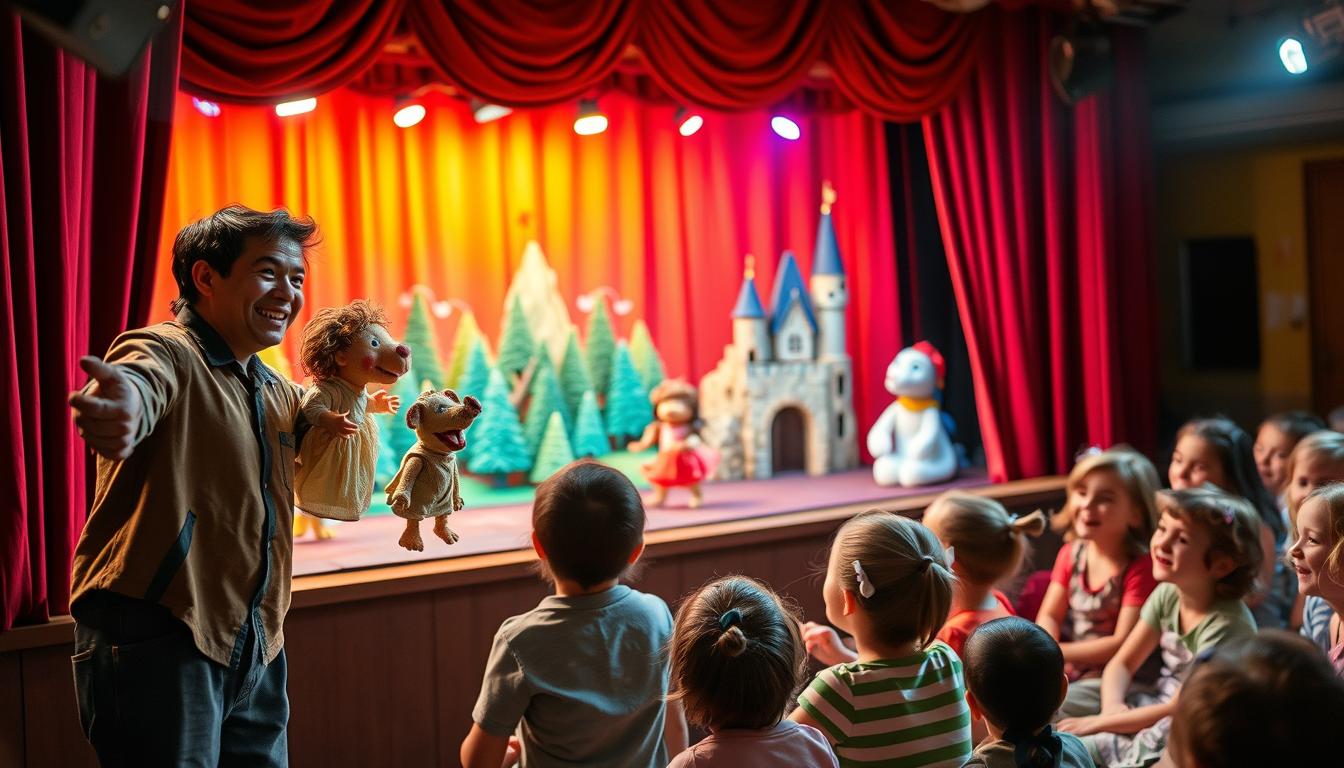
Watching an adult talk to a sock puppet might seem odd. Yet, it’s a powerful tool for learning. It’s as effective as playgrounds in helping kids grow.
I’ve seen kids become more confident when they talk through puppets. The magic lies in the freedom these characters offer.
Children see puppets as friends, not as adults. They feel safe to try new things without fear of being wrong. It’s a chance for them to explore and learn without judgment.
These activities help kids understand social cues and grow their minds. It’s surprising we stopped using them for more learning.
How Puppets Build Language Skills
Language development isn’t just about flashcards and grammar drills. Puppets use a special trick to make learning fun. They tap into the brain’s emotional centers, making learning irresistible.
Children love talking to a felt fox, even when they’re shy around people. It’s like having a friend who helps with speech practice without judging. This puppet acts as a ‘transitional object,’ a safe space for kids to practice speaking.
I’ve seen kids who were once silent start debating with a stuffed owl. Shy kids find their voice through puppets, getting confidence as they watch their friends speak. When kids teach the puppet, they learn and grow.
When a child corrects a puppet’s grammar, it’s a big moment. It shows they’re not just learning language, but also thinking deeply. Puppets also help kids develop feelings like sympathy and empathy through stories.
Puppets make listening skills better by giving instructions or telling stories. Kids get so caught up in the tale, they learn without even realizing it. It’s like playtime that’s actually teaching them.
Parents can use research to make puppet play a key part of learning. The trick is to keep it fun and consistent, keeping those important neural pathways open.
Puppets turn language learning into an exciting adventure. They’re not just toys; they’re tools that make speech practice feel like play. When learning is this enjoyable, kids don’t just participate—they thrive.
DIY Puppets and Store-Bought Options
There’s a big choice between making your own puppets and buying them. Both ways help with creative language development. It’s like choosing between homemade cookies and Oreos.
Making puppets from everyday things is fun. Paper bags and toilet rolls can become characters. Even clean socks can talk. It’s not just about saving money; it’s about making something special together.

When kids make puppets, they learn to talk to them. They decide on details like colors and eyes. This is creative language development through arts and crafts.
But, not everyone has time to make puppets. Store-bought ones are like ready meals for language learning. They’re okay when you’re short on time.
The real magic happens when you use the puppet. Whether it’s homemade or bought, it sparks imagination and conversation. For those looking for ready-made options, check out our puppet collection made for learning.
Even a cardboard box can be a puppet stage. What matters most is the talks it starts. Both DIY and store-bought puppets aim to make learning fun for all kids.
Puppet Skits & Conversation Ideas
Ever felt like your puppet talks are like a bad first date? Awkward pauses and forced smiles are common. But, what if you could make them fun and engaging?
It’s not about memorizing lines. It’s about creating a space where language can grow freely. Think of it as improv theater, but with learning benefits.
Let’s dive into 18 puppet activities that turn quiet moments into language gold:
- Sock-puppet introductions – Each puppet has a crazy backstory
- Finger-puppet conversations – Great for quick, fun chats
- Stick-puppet story chains – Everyone adds a sentence
- Emotion match – Puppets show feelings, kids guess
- Puppet marketplace – Kids learn to negotiate
- Wrong-word puppet – Mistakes that need fixing
- Puppet detective – Solve mysteries with questions
- Puppet interviews – Journalism meets fun
- Puppet news – Reporting on imaginary events
- Change the ending – Twist classic stories
- Puppet karaoke – Sing with puppet friends
- Role reversal – Kids play adult roles
- Puppet telephone – Comical message mix-ups
- Puppet job fair – Explore careers through play
- Puppet time machine – Fun historical or future misunderstandings
- Puppet diaries – Write from a puppet’s perspective
- Puppet debate – Serious arguments with fun characters
- Final puppet show – Show off all learned skills
The “Wrong-Word Puppet” activity is a standout. When your puppet says it’s going to “eat this delicious… brick!”, it’s more than funny. It’s a chance for kids to correct language errors, just like in school.
“Puppet Time Machine” is another favorite. Imagine your dinosaur puppet trying to understand modern things like smartphones. It’s not just about words; it’s about culture, history, and fun.
These activities turn mistakes into comedy and corrections into teamwork. Language learning is most effective when it’s fun and full of surprises. Puppets can make conversations real, engaging, and enjoyable.
Your puppet doesn’t need to be Shakespeare. It just needs to be interesting enough to spark conversations.
Overcoming Shyness
Shyness isn’t a flaw. It’s a smart way to deal with a world that judges you all the time. For kids, it’s like acting in a play without rehearsals.
Puppets act as a shield for kids. They can talk through a puppet, avoiding eye contact. It’s like using a puppet to dodge social pressure.

This idea, the “Ventriloquist’s Paradox,” creates a safe space. The puppet lets kids say things they wouldn’t dare say themselves. It’s like having a bodyguard for your words.
This isn’t about fixing shy kids. It’s about letting them speak freely without fear. When a child can make their puppet say funny things, it’s more than just practice. It’s freedom.
Puppets help kids communicate in a safe way. They speak through a puppet, making it easier. It’s like having a special pass to talk without worry.
Using puppets builds confidence naturally. Kids start speaking for themselves as they see their words matter. The puppet is like training wheels for talking to others.
This method is simple and effective. It doesn’t force kids to be outgoing. It makes talking fun, not scary.
Parents, if you’re wondering if it works: I’ve seen shy kids become stars in their families. The puppet takes the fear, letting kids’ words flow. It’s amazing.
The aim isn’t to make kids outgoing. It’s to give them a safe place to find their voice. And that’s a journey, one step at a time.
Tips for Busy Parents
Let’s face it, your parenting schedule is already packed. Adding puppet theater shouldn’t feel like planning a Broadway show.
Puppet-based creative language development is smart and simple. It’s like quick, effective training for your child’s language skills, without taking up too much time.
Children’s focus is like TikTok – short and intense. This is perfect for quick puppet chats. A five-minute daily puppet session works well because it fits their short attention span.
Here’s your plan for creative language development:
- Keep a puppet in your work bag – your secret linguistic weapon
- Place another near the dinner table for impromptu conversations
- Stash one in the car for commute-time language practice
- When your child shares something, let the puppet respond first
Using a puppet to correct language is a soft approach. It lets you teach without feeling like you’re bossing them around. This way, your child learns without feeling judged.
In bilingual homes, puppets help bridge language gaps. They can switch between languages, showing both sides are important. This helps your child see the value in both languages.
It’s more important to celebrate effort than perfection. Use a sticker chart to track progress. This boosts confidence more than any lesson plan.
| Time Investment | Strategy | Language Benefit |
|---|---|---|
| 2 minutes | Puppet asks about day | Narrative building |
| 3 minutes | Puppet models corrections | Grammar acquisition |
| 5 minutes | Bilingual puppet play | Code-switching practice |
| 1 minute | Sticker celebration | Confidence building |
This isn’t about adding more to your busy schedule. It’s about making the most of every moment with creative language development. The puppet helps teach while you stay relaxed.
Best of all, you’ll enjoy these moments too. There’s a joy in speaking through a puppet after a long day.
Success Stories
PlanetSpark’s Spoken English Courses have made puppet activities a language revolution. Kids who once mumbled now command stages with sock puppets explaining black holes. The data shows that months of role-play and storytelling make them confident speakers.
I’ve seen shy children become puppet news anchors, debating topics like pizza toppings and climate change. Their sentences grew from fragments to flowing narratives. One child used a dinosaur puppet to explain quantum physics, even if the science was fuzzy, their vocabulary was stellar.
These stories aren’t just cute. They prove that gamified learning works. Puppet activities make language a playground, not a prison. The real win? Kids find their voice, even through felt and buttons.