Simultaneous bilingual vocabulary growth can look uneven in the early years, especially when adults compare a child’s words in one language with a monolingual child’s words in that same language. A child learning two languages from early life may know some words in Spanish, others in English, and a smaller set in both. That pattern can make progress harder to judge, but it does not automatically mean the child is falling behind.
The research picture is not perfectly simple. One longitudinal study followed 149 U.S.-born children from Spanish-speaking immigrant families from ages 2.5 to 12 years and reported that bilingual development was generally additive, while early expressive vocabulary growth was an exception where growth could be slower than monolingual patterns longitudinal bilingual development study. Another study comparing monolingual and bilingual toddlers found that bilingual children acquired approximately as many new words in each of their languages as monolingual children did toddler vocabulary study. Taken together, these findings support a careful reading: early bilingual vocabulary may be distributed across languages, and study results can vary depending on age, measurement, language pair, and the way exposure is counted.
Why Simultaneous Bilingual Vocabulary Can Look Uneven
Simultaneous Bilingual Vocabulary Is Split Across Contexts
A child who hears Spanish at home and English in childcare may not need the same words in both places. Home routines may build words for food, relatives, comfort, and household activities. Preschool or community routines may build words for toys, teachers, classroom directions, and peers. If adults count only English words, the child’s Spanish knowledge can disappear from the score. If adults count only Spanish words, English learning can be missed.
This is one reason single-language vocabulary counts can feel discouraging for bilingual families. A young child may say “agua,” “dog,” “mama,” “go,” and “zapato,” but not have all of those words in both languages. That child’s knowledge is not organized the way a monolingual vocabulary list is organized. The child is building meaning across two communication systems.
Families may find it useful to keep informal notes across both languages rather than treating one language as the only valid measure. This does not replace professional assessment, but it gives parents and caregivers a fuller picture to share with pediatricians, early childhood educators, or speech-language professionals if concerns arise.
Early Expressive Vocabulary May Be Slower In Some Measures
The longitudinal evidence from Spanish-speaking immigrant families suggests caution around early expressive vocabulary. Expressive vocabulary refers to the words a child says or signs, not every word the child understands. In bilingual children, expressive vocabulary can appear smaller in one language because the child’s words are divided by context, input, and opportunity to use each language.
That does not mean every bilingual toddler will show slower expressive growth. The available studies do not all point in the same direction, and they do not give one simple rule for every family. The more useful message is that simultaneous bilingual vocabulary should be interpreted across both languages whenever possible, with attention to how much meaningful exposure the child receives in each one.
What The Studies Suggest About Early Growth
Additive Growth Does Not Mean Identical Growth
The term additive can be reassuring, but it should be read carefully. Additive development means that learning two languages can contribute to the child’s total language knowledge. It does not mean both languages grow at the same speed, show the same word types, or match monolingual norms at every age point.
For example, a bilingual child may understand family words in one language and action words from play in another. The child may also prefer one language with grandparents and another with teachers. These patterns reflect opportunity and use. They should not be mistaken for confusion without a closer look at the child’s full communication profile.
Parents often hear the claim that two languages cause delay. The research summarized here does not support such a broad statement. It does show that early expressive vocabulary can be measured in ways that make bilingual children look different from monolingual peers. For more on why early bilingual progress can be misread, see this discussion of a common bilingual development myth.
Vocabulary And Grammar May Grow Within Each Language
The research notes also describe findings from simultaneous Spanish–English bilingual children showing strong links between vocabulary and grammar growth within each language, while relationships across languages were more limited. That pattern is useful for everyday interpretation. A child’s Spanish vocabulary may support Spanish sentence growth, while English vocabulary may connect more directly with English grammar growth.
This does not mean the two languages are sealed off from one another. It means adults should avoid assuming that a skill seen in one language will appear in the other language at the same time. A child may produce longer English phrases after more English exposure in preschool, while still using shorter Spanish phrases at home. Another child may show the reverse pattern. Families interested in sentence growth can read more about bilingual grammar development and how two languages may advance at different rates.
How Parents Can Read Vocabulary Progress
Look Beyond One Language Word Counts
A practical first step is to track words across both languages. Parents do not need a formal spreadsheet unless they enjoy using one. A simple note on a phone or paper list can help adults notice new words, repeated words, gestures, signs, and word combinations. The goal is not to test the child. The goal is to observe what the child can communicate in real routines.
For simultaneous bilingual vocabulary, a fuller view may include words the child says in Language A, words the child says in Language B, words understood but not yet spoken, and words used only with certain people. A child may say a word to a sibling but not to a teacher. That still tells adults something about communication.
- Record new words in either language without requiring translation.
- Notice whether the child uses words to request, protest, label, greet, answer, or share interest.
- Write down gestures and signs, especially if spoken words are still emerging.
- Share examples from both languages if you ask a professional about development.
Use Routines That Give Words A Reason
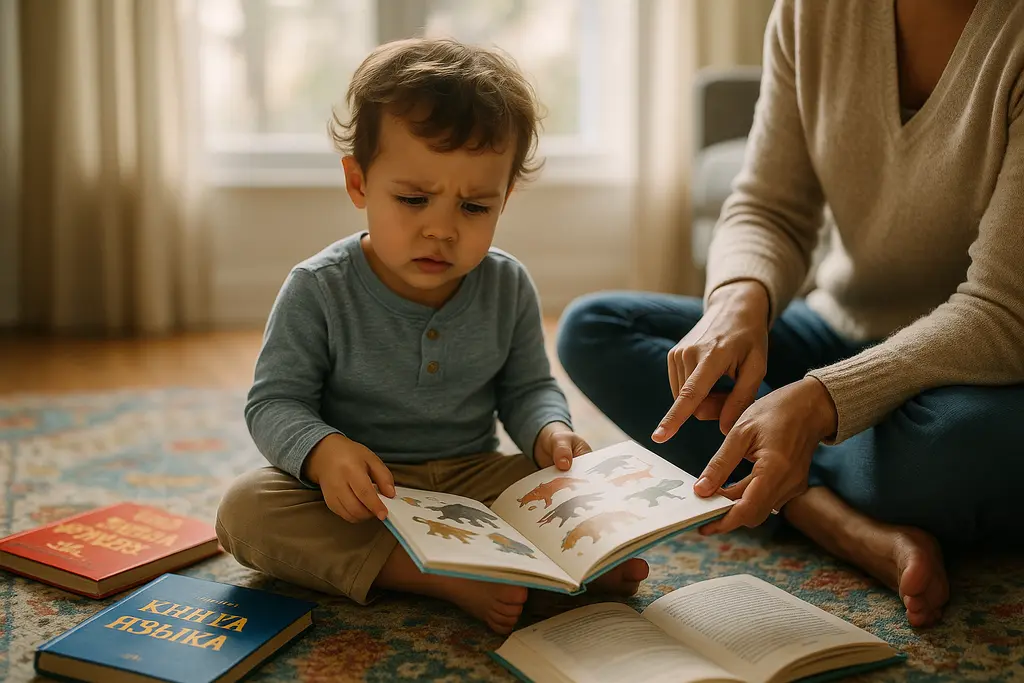
Children are more likely to use words that matter in the moment. During snack, a child may hear and use words for more, open, cup, banana, water, and all done. During bath time, the words may be wash, splash, cold, towel, and duck. During book sharing, the words may include animal names, action words, and simple comments.
Parents do not need to turn every moment into a lesson. Short, repeated phrases often fit better than long explanations. If a child reaches for a ball, an adult might say, “Ball. Big ball. Roll the ball.” If the family uses two languages, the adult can use the language that feels natural in that routine. Consistent, warm interaction matters more than forcing every word to appear in both languages immediately.
For families seeking assistance outside of child language topics, our related network includes resources like Alliance Recruitment; this article, however, remains focused on child communication and bilingual development rather than workplace decisions.
Limits Of The Current Evidence

Different Studies Measure Different Things
The studies summarized in the research notes do not all ask the same question. Some focus on expressive vocabulary, some compare bilingual and monolingual growth, some look at speech perception, and some examine the role of exposure amount. Their age ranges and language pairs also differ. Because of that, it would be too strong to say there is one universal pattern for all bilingual toddlers.
The safest interpretation is narrower: early bilingual word learning can be comparable in some studies, slower on some expressive measures in others, and strongly shaped by the language environments children experience. This is not a weakness of bilingual children. It is a reminder that bilingual development should be assessed with bilingual experience in mind.
Research Findings Are Not Individual Diagnosis
Group findings help families and professionals ask better questions, but they cannot diagnose an individual child. If a child is not using gestures, has lost skills, rarely responds to speech or sound, or shows limited interest in communication across people and settings, parents should seek advice from qualified health or speech-language professionals. Bilingual exposure should not be used as the only explanation for serious communication concerns.
At the same time, families should not be pressured to drop a home language based only on the assumption that two languages are too much. The research summarized here supports a more balanced view: children’s progress should be interpreted across both languages, with attention to input, interaction, and real communication opportunities.
Supporting Simultaneous Bilingual Vocabulary At Home
Build Words Through Shared Attention
Shared attention gives words a place to attach. If the child is looking at a dog, touching a spoon, or pushing a car, the adult’s words are connected to something the child already notices. This makes vocabulary support feel like communication rather than a quiz.
Families can support simultaneous bilingual vocabulary by naming what the child sees, waiting for any response, and accepting communication in either language. A response might be a word, sound, point, look, or gesture. Adults can then expand gently: if the child says “car,” the adult might say, “Red car,” or “The car goes.” In Spanish, a caregiver might use the equivalent phrase naturally during the same kind of play.
Protect The Home Language While Watching Progress
For many families, the home language carries relationships, stories, songs, and daily care. Keeping that language active can help children stay connected with relatives and routines. The evidence reviewed here does not prove that every bilingual child will develop in the same way, but it does support careful interpretation rather than fear-based decisions.
A useful family question is not, “Which language should we remove?” A better question is, “How can we give this child meaningful chances to understand and use both languages?” That may include talking during meals, reading familiar books, singing, telling short stories, and inviting relatives to interact in the language they use most comfortably.
The early years of simultaneous bilingual vocabulary growth can be uneven, but uneven does not automatically mean unhealthy. Families can watch both languages, share detailed examples with professionals, and keep communication warm, useful, and connected to daily life.