Bilingual development in children often looks less tidy than parents expect, and that is where much of the anxiety begins. A toddler may answer in one language, understand another, mix words in the same sentence, or seem quieter in one setting than another. None of that automatically means something is wrong.
For families raising children with more than one language, the real challenge is not whether bilingualism is “too much.” It is learning how to read progress without comparing every word, pause, or mix-up to a monolingual timeline. Parents who want a practical foundation can start with this guide to supporting bilingual development at home, especially when they are trying to make daily language exposure feel natural rather than forced.
Bilingual Development In Children Is Not Two Separate Timelines
One of the biggest misunderstandings about bilingual children is the belief that each language should develop in equal, matching steps. Real life rarely works that way. A child may hear one language from grandparents, another at daycare, one during meals, and another during books or play. The result is often uneven, but uneven does not mean unhealthy.
A bilingual toddler may know animal names in one language and food words in another because those words belong to different parts of daily life. A child may understand a family language very well but respond in the community language because that is the language they use most with peers. Parents sometimes worry when one language appears “behind,” but the more useful question is whether the child is communicating across their full language environment.
This is where language exposure matters more than abstract balance. Children need repeated, meaningful chances to hear and use each language with people who speak it naturally. A language heard only occasionally may remain more passive. A language used daily during play, routines, affection, songs, and family conversation has more room to grow.
The early years are not a clean race between languages. They are a period of building connections: sounds, meanings, people, routines, and identity.
Mixing Languages Is Often A Sign Of Resourcefulness
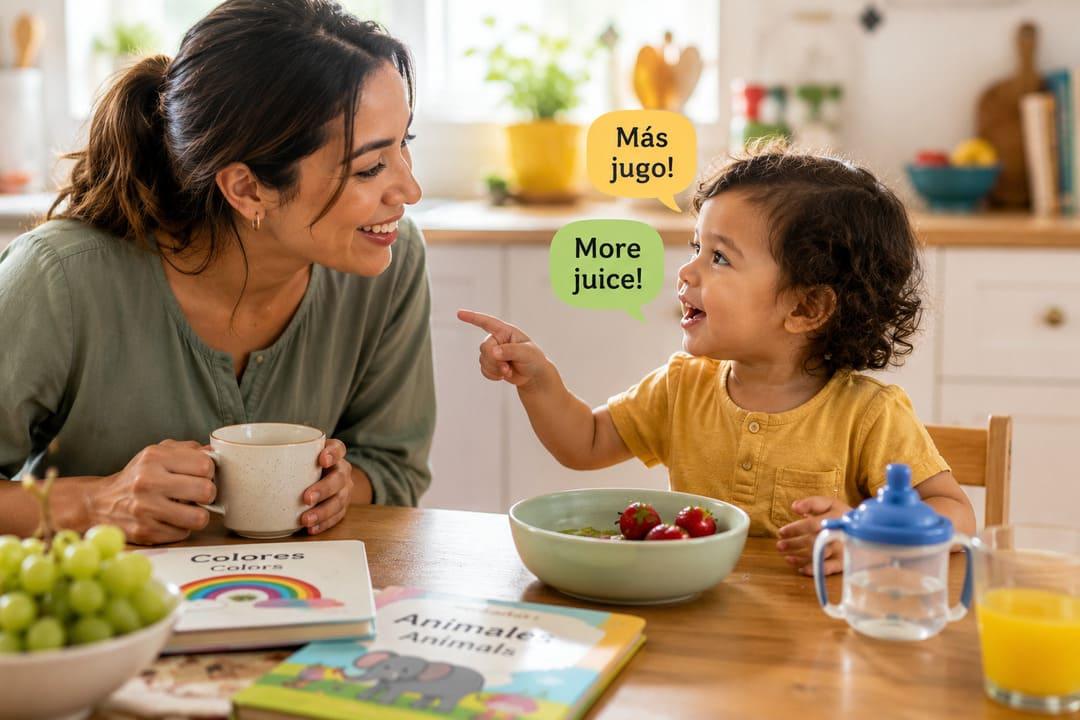
Many parents become concerned when a child mixes languages in one phrase. A toddler might say the first part of a sentence in English and finish it with a Spanish, Tagalog, Mandarin, Arabic, or French word. Adults may hear confusion. The child may simply be using the strongest available word.
That distinction matters. Language mixing can happen because one word is easier to say, more familiar, more recently heard, or more closely tied to a person or activity. A child who uses “agua” at home and “water” at school is not necessarily confused. They are learning that language changes depending on setting, speaker, and need.
The American Speech-Language-Hearing Association’s guidance on learning more than one language reinforces an important point for families: children can learn multiple languages, and they need practice, support, and meaningful use in the languages around them.
Parents should not treat every mixed sentence as something to correct. A better response is to model the phrase naturally. If the child says, “More leche,” the adult can answer, “More milk? Yes, here is more milk,” or respond in the home language if that is the family’s goal. The point is not to shame the mix. The point is to give the child a fuller version to hear again.
Mixing is not failure. In many early bilingual homes, it is part of how children keep communication moving while their vocabulary is still growing.
The Home Language Should Not Be Treated Like A Problem
A quiet pressure often appears when children begin daycare, preschool, or community programs: families may wonder whether they should reduce the home language so the child can “catch up” in the majority language. That instinct is understandable, but it can cost children something valuable.
The home language is not just vocabulary. It is family connection, cultural memory, humor, discipline, affection, storytelling, and belonging. When parents stop using the language they speak best, children may actually receive less rich language overall. They may hear shorter sentences, fewer stories, and less natural conversation.
Parents should usually speak the language that allows them to be warm, expressive, and precise. Children benefit from hearing strong language models, and strong language models are often the adults who feel most comfortable speaking naturally.
The goal is not to create a perfect bilingual household. The goal is to create a language-rich household. That may mean one parent uses one language more often, grandparents use another, books rotate between languages, or routines become predictable language moments. Bath time, bedtime, cooking, errands, and pretend play all count.
Home language has value because it gives children access to people and relationships that may not exist in the majority language. Protecting that language is not a detour from development. It is part of development.
What Parents Can Expect In The Early Years
Bilingual development can feel easier to understand when parents know what patterns are common. Children vary widely, but the following framework can help families interpret everyday language behavior without overreacting to normal variation.
| Early Pattern | What Parents May Notice | Helpful Response |
|---|---|---|
| Uneven vocabulary | More words in one language than the other | Count communication across both languages, not one language alone |
| Language mixing | Words from two languages in one sentence | Model the full phrase naturally without scolding |
| Passive understanding | Child understands one language but answers in another | Keep using the language in meaningful routines |
| Setting-based language use | One language at home, another outside | Create safe opportunities to use both |
| Temporary quietness | Child speaks less in unfamiliar settings | Watch comfort, comprehension, gestures, and interaction |
This table does not replace professional guidance, but it helps parents avoid a narrow view of progress. A bilingual child’s language profile is shaped by exposure, opportunity, confidence, and context.
The risk is not bilingualism itself. The risk is misreading bilingual development through a one-language lens and making decisions that reduce the child’s access to rich communication.
Delays Should Be Judged Across The Whole Communication Picture
Bilingualism does not make parents immune to real speech and language concerns. Some children do need evaluation and support. The key is knowing what to look for without blaming the presence of two languages.
A concern is stronger when difficulty appears across the child’s communication system, not only in one language. If a child struggles to understand simple directions in both languages, rarely uses gestures, does not respond to social interaction, loses skills, or shows limited attempts to communicate across settings, parents should seek guidance.
The HealthyChildren.org parent resource on young children learning multiple languages is useful because it addresses common family worries about multilingual development, including myths about confusion, delay, and home-language use.
Parents should also remember that vocabulary can be distributed. A child may not have the same number of words in each language, but their total communication across languages may be stronger than it appears if only one language is counted.
Watch the whole picture: gestures, eye contact, play, comprehension, imitation, sound use, social interest, frustration, and growth over time. Words matter, but they are not the only signal.
The Next Test Is Consistency, Not Perfection
The early years of bilingual development are shaped by what families repeat. A child does not need a flawless language plan. They need enough consistent exposure to make each language useful.
That means parents should pay attention to practical signals. Is the child hearing the home language every day? Are there people besides one parent who use it warmly? Are books, songs, stories, and routines available in both languages when possible? Does the child have real reasons to use each language, not just perform it on request?
Pressure can backfire. If a child feels corrected every time they choose the “wrong” language, they may avoid speaking. If language is attached to play, food, comfort, stories, cousins, grandparents, music, and daily life, it becomes worth using.
Bilingual development in children should not be treated as a fragile experiment. It is a normal, deeply human process that can look uneven while still moving forward. Parents should protect rich interaction, respond to concerns early, and resist the myth that one language must be sacrificed for another. The strongest outcome is not a child who performs perfectly in two languages on command. It is a child who learns that both languages belong to real people, real relationships, and real life.