Teaching a child to talk is a fun, step-by-step journey. It’s all about playing together, not forcing words. Learning to make sounds comes naturally, as they grow.
Learning early consonants like /p/, /b/, and /m/ is key. These sounds help build words and syllables. It’s a perfect match for a child’s growing skills.
Sensory processing helps us understand and react to the world. When activities match a child’s needs, they become fun. The Speech Blubs app uses videos to teach sounds, making learning easy and natural.
This guide offers fun, play-based ways to practice. You’ll learn how to make practice enjoyable. For more ideas, check out these therapist-approved sensory play activities.
You are the key to helping a child’s communication grow. With the right approach, you can make a big difference.
Read the Sensory Profile (Seekers/Avoiders/Mixed) and Match Activities
Before starting any game, it’s key to know if a child is a sensory seeker, avoider, or mixed. This knowledge makes sensory play both safe and effective for speech practice.
Children handle sensory information in unique ways. Some are too sensitive (hypersensitive) or not sensitive enough (hyposensitive) to certain stimuli. This is known as Sensory Processing Difference (SPD).
A hypersensitive child might shy away from loud sounds, bright lights, or certain textures. These can feel too much. They are called sensory avoiders.
On the other hand, a hyposensitive child might seek out intense inputs. They might enjoy loud noises, deep pressure, or constant movement. These kids are known as sensory seekers.
Many kids have a mixed profile. They might enjoy spinning but not certain textures. It’s important to watch how they react in daily life.
The main idea is simple: sensory play must fit each child’s needs. An activity that excites a seeker might overwhelm an avoider. It’s all about matching the game to the child’s profile for them to engage.
Here’s how to match activities:
- For Seekers (Hyposensitive): Pick games with more intensity. Use louder sounds, firmer textures, and more movement.
- For Avoiders (Hypersensitive): Go for softer, more predictable inputs. Soft voices, slow actions, and familiar textures are best.
- For Mixed Profiles: Mix strategies. Use a seeker-friendly activity for one sense while keeping others calm.
Always listen to the child. If they love cars, use car sounds for “go” or “more.” This makes them more eager and less anxious.
Matching activities to a child’s sensory profile makes practice fun. It helps them try new speech sounds in a comfortable way.
Game bank: mirror play, bubble “puh‑puh,” car “m‑m‑more,” drum syllables; quiet options for avoiders
Ready to put theory into practice? This game bank offers a suite of playful activities. They are designed to elicit speech sounds in a sensory-friendly manner. Each game links directly to target sounds and syllables, turning practice into joyful interaction. Crucially, every active game includes a modified, quiet alternative for sensory avoiders.
Select games based on the child’s sensory profile. Seekers often thrive with the active versions. Avoiders will benefit from the gentler options. This flexibility ensures every child can participate comfortably.
Mirror Play for Lip Sounds
Facing a mirror together creates a powerful visual feedback loop. This game is excellent for practicing bilabial sounds like /p/, /b/, and /m/. Make exaggerated faces and sounds like “pop,” “bubble,” and “mama.”
Encourage the child to watch their own mouth movements and copy yours. The mirror doesn’t judge, making it a safe space for experimentation.
Quiet Alternative for Avoiders: Use a small, handheld mirror or a reflective piece of foil. Reduce background light and keep the activity brief. Focus on gentle, slow mouth movements without loud sounds.

Blowing bubbles is a classic activity that naturally encourages the /p/ sound. Model saying “puh-puh-puh” as you dip the wand and “pop” as you burst bubbles. The physical act of blowing supports breath control, essential for speech.
This game is highly motivating and provides immediate, visual rewards for vocal attempts.
Quiet Alternative for Avoiders: Use a feather instead of bubbles. Have the child gently blow the feather off their palm with a soft “puh” sound. The tactile sensation of the feather is less overwhelming than sticky bubbles.
Car “M-M-More” for Continuous Sounds
Push toy cars along a track or the floor. Model prolonged sounds like “mmmmmore” as you rev the engine or “vvvvroom” for a fast car. This activity, inspired by car play, helps practice continuous sounds that are the building blocks of words.
Use words like “go,” “stop,” “fast,” and “slow” to build vocabulary alongside sound practice.
Quiet Alternative for Avoiders: Use a soft, felt car or a small wooden block. Push it silently along a textured path (like carpet). Model the target sound in a whisper or very low voice to match the calm energy.
Drum Syllables for Rhythmic Speech
Use a drum, tabletop, or even knees to tap out syllable beats. Tap once for “ba,” twice for “ba-ba,” and a big boom for “ba-ba-boom.” This drumming game enhances auditory discrimination and the rhythmic pattern of speech.
It connects motor planning with sound production in a fun, physical way.
Quiet Alternative for Avoiders: Tap syllables gently on the child’s own arm or cheek using a fingertip. Use a soft mallet on a pillow. The focus is on feeling the rhythm internally, not hearing loud sounds.
| Game | Target Sounds & Syllables | Active Game (For Seekers) | Quiet Alternative (For Avoiders) |
|---|---|---|---|
| Mirror Play | /p/, /b/, /m/ (e.g., “pop,” “baba”) | Exaggerated faces & sounds in a large mirror. | Use a small handheld mirror; focus on slow, gentle movements. |
| Bubble “Puh-Puh” | /p/ sound, “pop,” “puh” | Blowing and popping bubbles with vocal models. | Blow a feather with a soft “puh”; avoid sticky residue. |
| Car “M-M-More” | Prolonged /m/, /v/, “go,” “stop” | Revving toy cars loudly with extended sounds. | Push a soft car silently, model sounds in a whisper. |
| Drum Syllables | Syllable beats (e.g., “ba,” “ba-ba-boom”) | Tapping drums or surfaces rhythmically. | Tap softly on arm or pillow; focus on tactile rhythm. |
Additional Games to Encourage Sounds
Animal Walks: Pretend to be different animals. Hop like a bunny and say “hop-hop,” or slither like a snake with a “ssss” sound. This combines gross motor movement with sound practice.
Sound Identification Games: Record different environmental sounds (e.g., doorbell, car horn). Play them back and have the child identify them. This enhances auditory discrimination, a key skill for speech perception.
This game bank provides a ready-made playlist to encourage sounds through play. By matching the activity to the child’s sensory needs, you create a supportive environment for communication. Try one game today and observe the joyful attempts at sound-making.
Visual and tactile cues: mouth pictures, touch cues; fade prompts ethically
Seeing and feeling how a sound is made helps kids learn better than just hearing it. Words can be hard to understand. Using more senses makes learning easier.
Visual cues guide like a map. Pictures of mouth shapes show where lips, tongue, and teeth should be. You can use markers or tape on a mirror to highlight these areas. Watching a peer model a sound in a video is also very helpful.
Visual schedules and choice boards help kids know what’s next. This reduces worry and lets them focus on making sounds.
Tactile cues offer a physical guide. A light touch on your cheek while making the /p/ sound shows where the air comes out. Tapping your throat for a voiced sound like /g/ gives direct feedback. These cues help kids find the right spot to imitate.
The key is to fade these cues over time. The goal is independence, not relying on prompts. Start by making your cue less intense. Then, wait longer before giving the prompt. Eventually, stop giving it altogether. This builds confidence and real skill.
The table below shows different multi-sensory cues and how to fade them.
| Cue Type | Primary Use | Example | Fading Strategy |
|---|---|---|---|
| Mouth Shape Pictures | Provides a static visual target for lip/tongue placement. | Card showing lips rounded for “oo” sound. | Transition from pointing to the picture to the child recalling the shape independently. |
| Video Modeling | Demonstrates dynamic, natural speech production for peer imitation. | Short clip of a child saying “more” during play. | Reduce video playback frequency; pause video before the action. |
| Visual Schedules | Clarifies session structure to reduce anxiety and support focus. | Sequence of “Bubbles,” “Cars,” “Book” with icons. | Move from a detailed schedule to a simple “First/Then” card. |
| Tactile Touch Cues | Gives physical feedback on sound production location. | Touching own nose for the nasal /m/ sound. | Move from hand-over-hand guidance to a light tap, then a visual glance toward the spot. |
This method puts the learner first. It uses many senses to build a strong foundation for imitation. Then, it carefully removes the support. This leads to a confident, independent communicator.
Caregiver scripts for errorless practice + joyful feedback
Think of yourself as a supportive narrator and cheerleader for your child’s communication. This mindset is key to effective co-play. Games are most effective for speech development when adults actively participate, model behaviors, and celebrate small successes.
Sensory play offers natural chances for shared attention and engagement. Your role is to be an enthusiastic play partner and language facilitator. We’ll give you simple strategies to make every moment count.
What Are Caregiver Scripts?
Caregiver scripts are simple phrases used during play. They provide a model for your child to hear and imitate. This is a form of naturalistic AAC modeling (Augmentative and Alternative Communication), showing how language works in real life.
Instead of saying, “Say ‘car’,” you narrate the action. This approach makes language feel natural and fun. Here are examples for our sensory games:
- Mirror Play: “I see you! Hello! Pop-pop-pop!” (making sounds with your lips).
- Bubble “Puh-Puh”: “Blow! Puh… puh… POP! Great blowing!”
- Car “M-m-more”: “Ready, set… go! Vroom! More car? M-m-more!”
The goal is errorless practice. This means setting up activities so your child can easily participate and succeed. You remove barriers to communication.
For a sensory seeker who loves bubbles, hold the wand close and cue the “puh” sound just as they are about to blow. For an avoider, use a quiet drum and gently tap their hand to help them feel the syllable beat. You are creating a win-win situation. The attempt is the goal, not a perfectly clear sound.
The Power of Joyful Feedback
How you respond is just as important as how you prompt. Joyful feedback celebrates the attempt. It connects the action to the sound with genuine excitement.
Avoid vague praise like “Good job.” Instead, be specific and enthusiastic:
- “You blew the bubble! I heard your ‘puh’!”
- “You made the car go! ‘Vroom-vroom’!”
- “You looked in the mirror! Hi!”
This feedback reinforces the connection between their effort and communication. It tells them, “I see what you did, and I love that you tried.”
By combining simple scripts, errorless setups, and enthusiastic feedback, you become the key to your child’s speech confidence. This family-centered approach is central to our mission of empowering through connection. You are not teaching in a clinical way. You are modeling language through joyful, shared play.
Tracking attempts, not perfection; generalizing to daily routines
Focus on trying, not getting it right, to make practice fun. This mindset reduces stress and encourages exploration. It helps your child feel more confident in speaking over time.
By celebrating effort, you show your child their voice matters. This boosts their motivation and ability to handle challenges. Next, apply these positive experiences to everyday life.
Integrate sound practice into your daily routines. These moments are perfect for improving communication skills naturally.
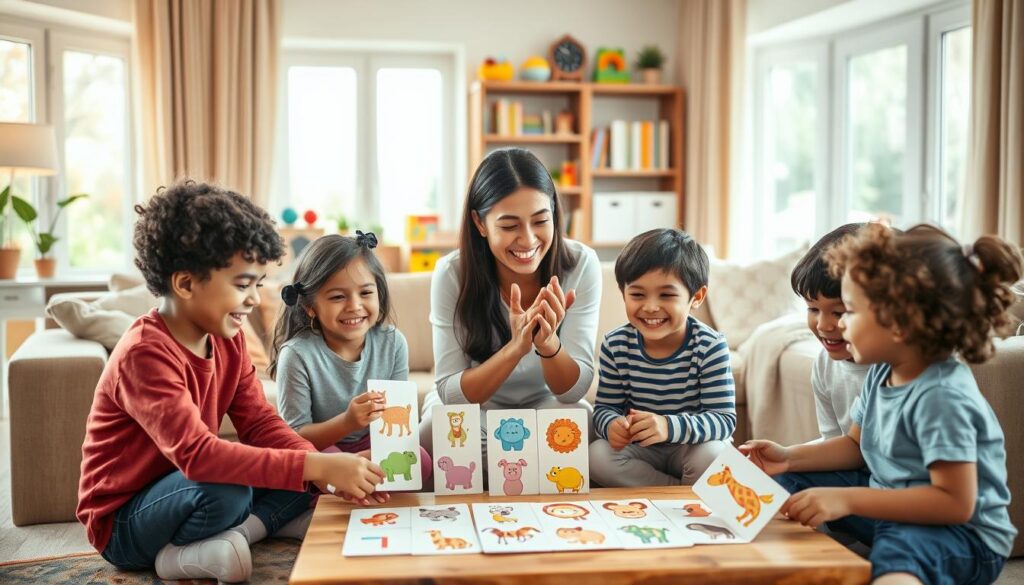
View every day as a chance to practice. The table below shows how this approach differs from focusing on perfection.
| Focus Area | Perfection-Focused Practice | Attempt-Focused Practice |
|---|---|---|
| Success Metric | Correct sound production | Number of engaged attempts and participation |
| Child’s Experience | Pressure to perform; fear of mistakes | Joyful exploration; safety to experiment |
| Caregiver’s Role | Corrector and judge | Cheerleader and playful partner |
| Long-Term Goal | Mastery of specific sounds | Building a positive, lifelong relationship with communication |
Generalizing skills means finding moments in daily activities. You don’t need extra time, just a new way to see things.
Here are ways to naturally practice and encourage sounds:
- Mealtime Sensory Exploration: Make playful sound effects with chewing (“munch-munch”) or label foods (“hot soup,” “cold milk”).
- Bathtime Water Play: Practice syllables like “splash,” “pop,” and “drip” as you play with toys and water.
- Diaper or Clothing Changes: Use simple sound routines like “up, up” or “pee-ew” in a silly voice to create predictable fun.
- Grocery Shopping: Practice heavy work by pushing the cart and saying “go” or “more.” Label items you see with simple words.
This approach turns every interaction into a chance for connection. It makes learning relevant and deeply embedded in your child’s world.
By focusing on attempts and integrating practice into daily life, you build a consistent model. Progress becomes a natural part of your shared journey.
Safety & when to pause
Helping a child develop speech through play is all about knowing their limits. It’s important not to push them too hard. This can make them feel bad about talking.
Look for signs that a child is getting too stressed. They might turn their head or body away. They could also cover their ears or eyes.
Increased agitation or sudden disinterest are big clues. New or unpredictable things can make a child anxious. Feeling out of control can make them frustrated and disengage.
Have a plan for when a child needs to calm down. Create a quiet, safe space for them. This shows you respect their needs. Always follow your child’s lead and stop the activity gently.
Knowing when to stop or change an activity is key. It builds trust and keeps the child excited about learning. This caring approach helps them feel good about talking in the long run.