
Emergent Bilingual Students need classroom communication support that treats two-language development as an asset, not a delay by default. Speech milestones can still be monitored, but teachers and families need to look across all the child’s languages, listen for growth in different forms, and avoid interpreting quietness as lack of understanding without more information.
The research base supports a practical message: classroom talk matters, but no single strategy works for every child. A 2026 early childhood study of 171 Spanish-English bilingual preschoolers, ages 36 to 56 months, found bidirectional links between children’s Spanish use and syntactic complexity early in the year and teachers’ later use of bilingual-specific discourse practices. Those teacher practices then predicted language growth. That pattern suggests that children and teachers shape each other’s communication environment over time.
Communication Milestones For Emergent Bilingual Students
Milestones for bilingual learners should be considered in context. A child may show stronger vocabulary, longer sentences, or more confident storytelling in one language than the other. That does not mean the other language is unimportant, and it does not automatically signal a speech or language disorder. The safer classroom question is: what can the child communicate across home language, school language, gesture, play, drawing, and peer interaction?
Classroom Signals Worth Watching
Teachers can document communication in ways that go beyond English-only word counts. Useful observations include whether the child initiates interaction, responds to familiar routines, follows shared attention during book reading, imitates peers, uses gestures, combines words, retells parts of a story, or switches language depending on the listener. These observations are not a diagnosis. They are classroom evidence that can help families and specialists decide whether support is working or whether a referral discussion may be needed.
A Grade 1 Spanish-English sample in the Southwestern United States, described in the research notes, included children in dual immersion and structured English immersion programs. About 5 percent were receiving speech services, and about 1 percent were classified as having a language impairment. Those figures should not be applied to every school, but they remind educators that bilingual status and speech-language needs are separate questions. A bilingual child can have typical development, and a bilingual child can also need services.
What Quiet Communication May Mean
Some learners speak very little while they are building a new classroom language. A scoping review of 40 studies reported that children in this early second-language period used nonverbal gestures, private speech, home language, observation, imitation, and sometimes code-switching to communicate in classrooms during the silent period silent period review. This does not mean silence should be ignored. It means teachers should watch for communication attempts that may not sound like full English sentences.
For Emergent Bilingual Students, a quiet stage can include active learning. A child may be mapping classroom routines, watching peer responses, rehearsing words softly, or answering through pointing. Supportive adults can give wait time, accept nonverbal responses, repeat key phrases, and invite participation without forcing public speech before the child is ready.
Teacher Talk That Builds Participation
Classroom discourse is more than the number of questions adults ask. In a 2024 study from the research notes involving 19 U.S. early childhood classrooms, wordless shared book reading showed that interactive strategies such as questions and extensions, in English and Spanish, prompted children’s responses across a wide range of complexity. The same research notes reported that children tended to answer in the language of the teacher’s prior utterance. For teachers, that finding supports a simple planning habit: the language used in the prompt may shape the language children use in the response.
Book Reading As A Low-Pressure Tool
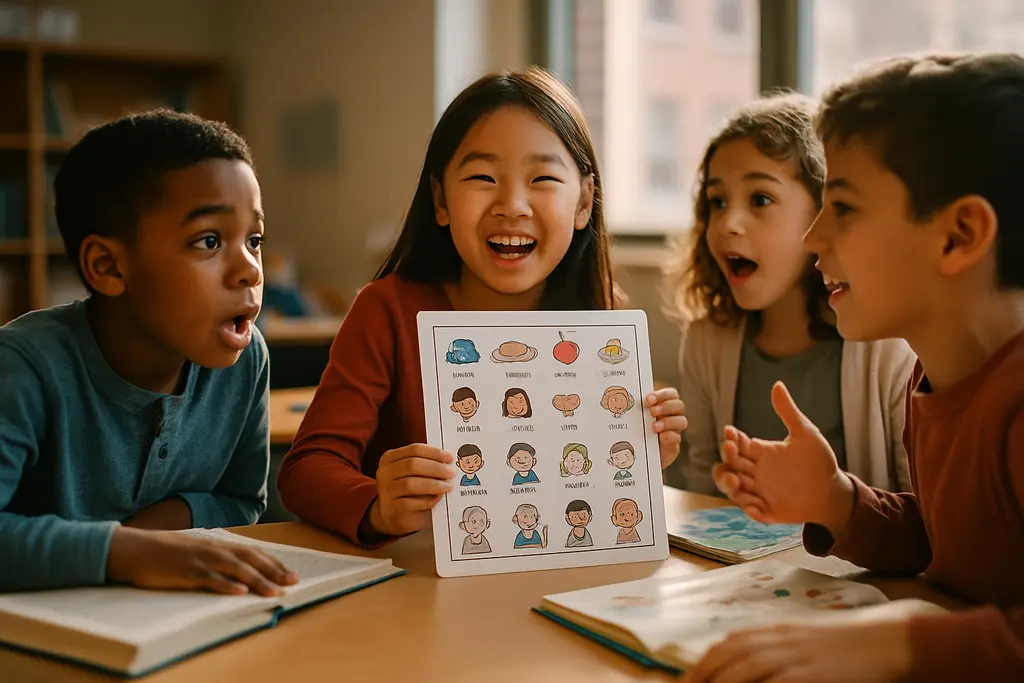
Wordless books are useful because they remove some pressure to decode print while leaving space for oral language, gesture, prediction, and storytelling. A teacher might point to a picture and say, I wonder what happened here, then accept a response in English, Spanish, gesture, or a mix. The adult can extend the child’s meaning by adding a slightly longer model: Yes, the dog ran away because the gate opened.
This is not a script for making children produce adult-like grammar immediately. It is a way to make the conversation longer, clearer, and more connected to meaning. Over time, teachers can collect samples of what the child says, how the child participates, and which supports lead to more communication.
- Use open prompts during pictures, play, and routines instead of only testing labels.
- Accept home-language responses when classroom goals allow, then model a school-language version without correcting harshly.
- Repeat and extend the child’s message by adding one new word, phrase, or idea.
- Give wait time after questions, especially for children who are listening in one language and planning in another.
- Track participation across gesture, speech, drawing, peer talk, and story retell.
Teachers seeking additional resources on bilingual classroom interaction may consider exploring teacher discourse strategies for effective bilingual communication. Additionally, families interested in language and culture connections might find valuable insights in the network’s related site, Old Norse News.
Reading Growth And Oral Language Support
Reading instruction is not separate from speech and language support. A meta-analysis indexed in ERIC examined 38 experimental and quasi-experimental studies of reading interventions for bilingual learners from pre-K through Grade 12 in the United States. The review reported statistically significant gains overall, including an aggregated effect size of about 0.17, about 0.25 for grades 4 to 8, and about 0.20 for reading comprehension reading intervention meta-analysis. These effects are not a promise for an individual child, but they do support structured reading help as a meaningful part of classroom planning.
Linking Speech Milestones To Literacy Tasks
For young bilingual learners, oral language can be supported during print-related routines without turning every activity into a test. A teacher can ask children to describe a picture, retell a short event, explain a choice, or compare two characters. These tasks reveal sentence length, vocabulary, sequencing, listening comprehension, and confidence using language for thinking.
Research in the notes on Spanish-English learners from the Early Childhood Longitudinal Study, Kindergarten Class of 2010-2011, found that stronger Spanish early reading and higher working memory predicted later English reading achievement through Grade 5. That finding supports respect for the home language as part of academic development. It does not mean every child will follow the same path, and it should not be used to pressure families to choose one language over another.
Other research in the notes on children in Grades 2 to 4 with specific reading comprehension deficits found that about 41 percent continued to show poor reading comprehension across two academic years despite adequate word reading. For classroom teams, that points to a need for early attention to meaning-making, vocabulary, listening comprehension, and oral explanation, not just accurate word reading.
Practical Classroom Supports
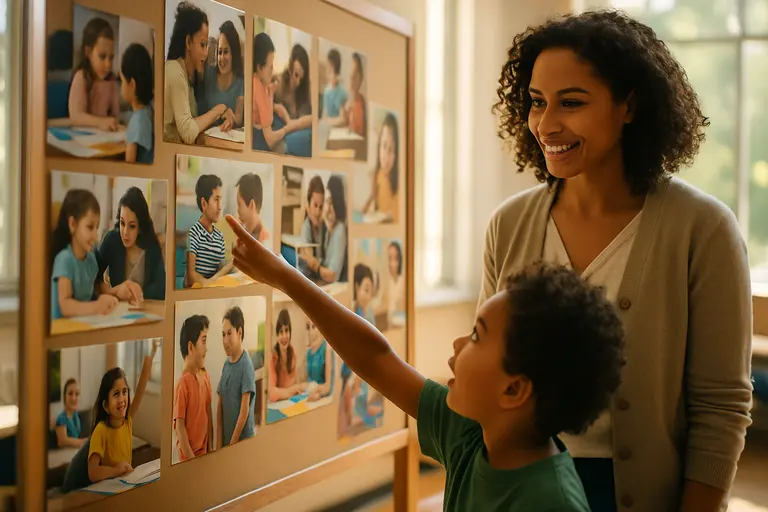
A practical plan should be easy enough to use during real classroom routines. Teachers do not need a special lesson for every interaction. They can build language chances into arrival, meals, centers, outdoor play, story time, cleanup, and small-group reading.
Tools That Keep Communication Visible
Simple documentation helps teams avoid relying on memory or first impressions. A weekly note might record the language used in the prompt, the child’s response mode, the activity, and the next support to try. Patterns matter more than isolated moments. A child who rarely speaks during whole-group time may use longer language in play with one peer. Another child may answer in the home language after a teacher uses that language first.
- Family language interview: ask which languages the child hears, understands, and uses with different people.
- Routine-based observation: record communication during the same activity several times.
- Response-mode chart: include words, gestures, pointing, drawing, imitation, and peer talk.
- Book-reading notes: track whether the child labels, comments, predicts, explains, or retells.
- Referral discussion record: separate bilingual exposure from concerns seen across languages and settings.
Families should be invited into the process as language experts on their child. A teacher may hear little English at school, while a caregiver reports long conversations at home. The reverse can also happen. Both accounts matter. If concerns appear across languages, settings, and communication modes, a speech-language pathologist can help determine whether an evaluation is appropriate.
Classroom Communication For Emergent Bilingual Students
Good classroom communication support for Emergent Bilingual Students is steady, observant, and respectful of the full language profile. Teachers can look for participation during quiet periods, use interactive book reading, support home language, and connect oral language to reading tasks. The evidence does not support a one-size rule for every bilingual learner. It does support careful observation, meaningful interaction, family partnership, and timely help when progress concerns appear across more than one setting.