
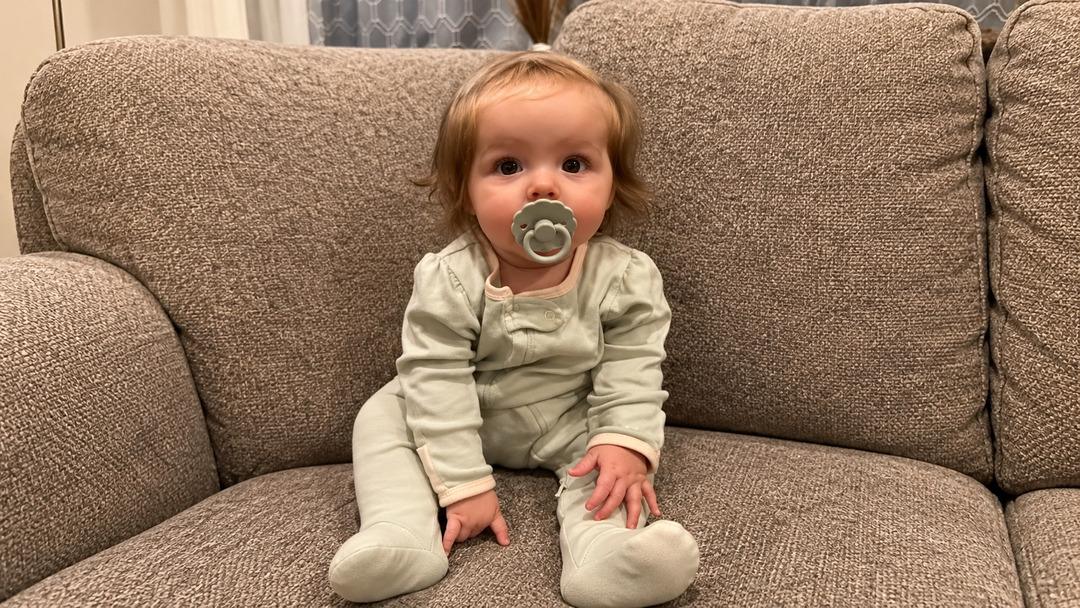

Using a pacifier does not automatically cause a speech delay. Research has found possible connections between frequent pacifier use and certain speech-sound differences, but the evidence is too limited to conclude that pacifiers cause children to talk late.
That distinction matters for parents who worry that a comforting habit may be affecting their child’s communication.
Pacifiers can help infants settle and have an important role in safe-sleep recommendations. Prolonged use, however, raises clearer concerns about dental development and may increase the risk of ear infections.
The most useful approach is to consider your child’s age, how frequently they use a pacifier, and whether their communication is developing comfortably—not assume that every speech difficulty comes from the pacifier.
Families can make informed decisions about reducing pacifier use while continuing to support language through everyday conversation, play, and responsive interaction.
What Studies Actually Say About Pacifiers and Speech
Much of the concern about pacifiers comes from a reasonable question: if a child spends several hours sucking on a pacifier, could that affect how they learn to produce speech sounds?
Speech and sucking involve some of the same structures, including the lips, tongue, and jaw.
However, using similar structures does not mean the two activities develop in the same way or that one necessarily interferes with the other.
A 2021 systematic review by researchers associated with the University of Bristol examined the available evidence concerning feeding, non-nutritive sucking, and speech-sound development.
Non-nutritive sucking means sucking for comfort rather than nutrition, such as using a pacifier or sucking a thumb.
The researchers reviewed four eligible studies. They found inconsistent evidence about whether sucking habits were associated with speech-sound disorders.
Three of the four studies reported an association involving how long children engaged in non-nutritive sucking, but the overall evidence remained inconclusive.
The researchers also identified important weaknesses in the available studies, including differences in how speech development was measured.
This means parents should be cautious about claims that pacifier use inevitably delays talking or damages speech development.
The available research does not establish that conclusion.
Does Daytime Use Matter More Than Bedtime Use?
One study suggests that how frequently a child uses a pacifier during the day may be more relevant to speech-sound differences than the total number of months they have used one.
In a 2021 study published in the International Journal of Language & Communication Disorders, researchers examined 100 children in the United Kingdom between 24 and 61 months old.
Parents provided information about pacifier use, and researchers assessed the children’s speech sounds.
The study found an association between more frequent daytime pacifier use and certain atypical speech errors, particularly among younger participants.
Atypical errors are speech-sound patterns that are less commonly observed during typical development.
However, the study did not find a consistent relationship between pacifier duration and broader measures of speech-sound development.
The daytime association was also less apparent among older children. Importantly, the reported statistical associations did not remain significant after the researchers adjusted for multiple comparisons.
These limitations prevent strong causal conclusions.
The research does not show that using a pacifier at bedtime causes a speech disorder, or that eliminating daytime use will correct an existing speech difficulty.
What it does suggest is that frequent daytime use deserves further research.
For families, this distinction supports a reasonable practical choice: allow children comfortable opportunities to communicate without a pacifier during play and conversation.
That does not mean forcing speech or treating pacifier removal as speech therapy.
Why Pacifier Use Has Different Implications at Different Ages
Pacifier decisions should reflect the child’s developmental stage.
A two-month-old infant and a three-year-old preschooler have different needs.
During the First Year: Safe Sleep Comes First
Pacifiers can provide comfort to infants and are associated with a lower risk of sudden infant death syndrome (SIDS) when offered during sleep.
The American Academy of Pediatrics recommends offering a pacifier at nap time and bedtime.
If an infant is breastfeeding, the AAP recommends waiting until breastfeeding is going well and the baby is gaining weight before introducing a pacifier.
Parents should not force a baby who refuses one.
If the pacifier falls out after the infant falls asleep, it does not need to be replaced.
Pacifier clips, cords, and attachments should not be used during infant sleep because they can create safety hazards.
These recommendations are especially relevant during the first year of life, when SIDS risk is a concern.
Parents should not abandon established safe-sleep guidance because of an unproven claim that pacifiers cause speech delays.
After 12 Months: Consider Ear Health and Daily Habits
As children grow, parents can begin evaluating whether a pacifier is still needed throughout the day.
Some toddlers use one mainly when tired or upset. Others keep it in their mouths through much of their waking time.
The amount and timing of use matter when deciding how to adjust the habit.
Research has linked prolonged pacifier use with an increased risk of acute middle-ear infections.
An ear infection does not automatically cause a language delay. However, persistent fluid behind the eardrum can temporarily affect hearing.
Families who want to understand that connection can read our guide to ear infections and speech-related hearing concerns.
If a child frequently develops ear infections or seems to have difficulty hearing, parents should discuss the pattern with a pediatrician.
Removing a pacifier is not a substitute for evaluating hearing concerns.
After 18 Months: Dental Development Becomes More Important
As the teeth and jaws continue developing, prolonged sucking habits can affect the way teeth meet.
According to the American Academy of Pediatric Dentistry’s policy on pacifiers, pacifier use beyond approximately 18 months can influence developing oral structures.
Potential concerns include an anterior open bite, where the front teeth do not meet when the back teeth are closed, and a posterior crossbite, where some upper teeth close inside the lower teeth.
The AAPD encourages families to establish dental care by a child’s first birthday and supports guidance aimed at ending non-nutritive sucking habits by 36 months.
These are preventive recommendations, not proof that every child who uses a pacifier after 18 months will develop dental problems.
Children differ in how often, how forcefully, and how long they suck.
A pediatric dentist can evaluate an individual child’s bite and recommend an appropriate plan.
The evidence for dental changes is more established than the evidence directly connecting pacifiers to speech delay.
How to Reduce Daytime Pacifier Use Without Making Speech a Test
If a toddler regularly uses a pacifier while awake, families may choose to reduce daytime use gradually.
The aim is to help the child develop other comfortable ways of settling while allowing natural opportunities for communication.
Begin With a Familiar Activity
Choose an activity the child enjoys, such as building blocks, looking at picture books, drawing, or playing with toy animals.
If the child is comfortable without the pacifier during that activity, continue playing naturally.
Talk about what the child is doing.
For example:
“The red car is going up the ramp.”
“Your bear is hiding.”
“That tower is very tall!”
Allow the child to respond with speech, gestures, facial expressions, or another communication method.
There is no need to demand a word before giving the child a toy or continuing the game.
Create Predictable Pacifier Routines
For an older toddler, a family might decide that pacifiers are available during specific comfort routines rather than continuously.
Explain the new routine using language the child understands.
For example:
“The pacifier stays in its special place while we play.”
A visual cue or consistent storage location may help some children understand the change.
Keep expectations appropriate for the child’s age and support needs.
If the child becomes very upset, consider whether the transition is too abrupt or whether additional comfort is needed.
There is no single weaning schedule that works for every family.
Offer Other Forms of Comfort
A child may use a pacifier to cope with tiredness, uncertainty, discomfort, or changes in routine.
Reducing use is easier when adults recognize those needs.
Depending on the child’s age and preferences, alternatives may include a cuddle, familiar song, quiet activity, or help settling into a predictable routine.
For infants, continue following safe-sleep recommendations. Soft toys and loose blankets should not be introduced into an infant’s sleep space as substitutes for a pacifier.
Avoid criticizing the child for wanting comfort.
The purpose is to support a manageable transition, not to create a struggle over communication.
Never Damage a Pacifier to Encourage Weaning
Some informal advice recommends cutting the pacifier’s tip so it becomes less satisfying.
This creates an avoidable safety concern.
A damaged pacifier can break apart and create a choking hazard.
Parents should inspect pacifiers for wear and follow manufacturer safety instructions. A damaged pacifier should be discarded rather than altered for continued use.
Gentle limits, consistency, and positive encouragement are safer approaches than intentionally damaging the product.
A Pacifier Does Not Explain Every Speech Concern
Parents sometimes notice that their child speaks unclearly while using a pacifier and conclude that the pacifier must be causing a speech disorder.
But the immediate difficulty of producing clear words with an object in the mouth is not the same as a developmental speech-sound disorder.
A child may sound muffled because their mouth is physically occupied.
That observation alone cannot establish whether speech development has been affected.
Likewise, a child who previously used a pacifier may have pronunciation difficulties for unrelated reasons.
Speech-sound development involves hearing, movement coordination, language experience, and individual developmental differences.
Parents can learn more about typical variation in our article on speech intelligibility by age.
Rather than attributing every unclear word to pacifier use, consider the broader pattern.
Is the child’s speech becoming easier to understand over time? Can they communicate successfully with familiar adults? Do unfamiliar listeners regularly struggle to understand them?
A speech-language pathologist can evaluate these concerns directly.
When to Ask for a Speech or Hearing Evaluation
Families should seek professional guidance when they notice persistent communication difficulties, regardless of whether their child uses a pacifier.
An assessment is appropriate when a toddler or preschooler has difficulty understanding everyday language, uses fewer words or communication methods than expected for their developmental stage, or becomes increasingly frustrated because others cannot understand them.
Hearing concerns also deserve attention.
A child who does not reliably respond to sounds, experiences repeated ear infections, or seems to have difficulty understanding speech in certain environments may need a hearing evaluation.
If a child loses previously acquired communication skills, parents should seek timely medical advice.
A speech-language pathologist can assess speech sounds, language understanding, expressive communication, and other relevant abilities.
An audiologist can assess hearing.
A pediatric dentist can evaluate whether prolonged sucking habits are affecting dental development.
These professionals answer different questions.
For example, reducing pacifier use may be appropriate for dental reasons while a separate language assessment is needed to investigate delayed talking.
Parents should not assume that removing the pacifier will automatically resolve a communication concern.
Focus on Communication, Not a Perfect Routine
Pacifier use is one part of a child’s everyday experience.
It should not become the explanation for every language milestone, speech-sound difference, or communication difficulty.
The available research supports a balanced approach.
Pacifiers have recognized benefits during infancy, particularly in connection with safe-sleep guidance. Evidence directly linking them to speech delay remains limited and inconsistent. Prolonged use raises more established concerns about dental development, with ear health also worth considering.
For older toddlers, reducing unnecessary daytime use can be a reasonable family decision.
During the transition, children should continue having opportunities to communicate, play, ask for help, express feelings, and connect with others.
If speech or language concerns persist, a professional evaluation provides better information than guessing whether a pacifier caused the problem.
Parents do not need to choose between supporting their child’s comfort and supporting communication development. With age-appropriate guidance, they can address both.