
Bilingual Literacy Activities can support emerging bilingual learners when they connect reading, talk, vocabulary, and print in both meaningful and manageable ways. The strongest activities are not worksheets alone. They give children repeated chances to hear language, use language, notice how print works, and connect new English skills with knowledge they may already have in another language.
For families and teachers, the useful question is not whether one language should replace another. The question is how to build reading routines that respect the child’s full language experience while giving clear instruction in English literacy. The research base supports careful optimism, but it also has limits. Study findings describe group patterns, not guaranteed outcomes for every child.
What Research Supports For Emerging Bilinguals
Reading Intervention Evidence
A November 2023 meta-analysis reviewed 38 treatment-versus-control studies involving emergent bilingual students in the United States from preschool through Grade 12. It found positive effects of reading instruction on English reading outcomes, including an overall reading effect size of .17, a comprehension effect size of .20, and a larger effect for Grades 4 to 8 at .25, according to the 2023 reading intervention meta-analysis. These numbers suggest that explicit reading instruction can help, but they should not be read as a promise that every activity will work equally well for every learner.
The same evidence base points toward structured teaching rather than casual exposure alone. Emerging bilingual learners often need direct instruction in word reading, vocabulary, comprehension, and oral language. They also need time to use words in real exchanges, not only to repeat them back.
Dual Language Program Evidence
Program structure also matters. A five-year longitudinal study using the ECLS-K:2011 kindergarten cohort found that first-grade enrollment in dual-language immersion programs was associated with greater English reading growth from Grades 1 to 5 than for matched peers who were not enrolled in those programs, as reported in this five-year longitudinal study. That finding does not mean every dual-language program has the same quality or the same results. It does support the idea that home-language development and English reading growth can be treated as connected goals rather than competing goals.
For parents, this matters because home-language reading, storytelling, and conversation should not be dismissed as distractions from English. For teachers, it points to the value of planned language links: previewing ideas, teaching word parts, comparing related words, and allowing children to explain thinking before they are expected to express every idea in polished English.
Bilingual Literacy Activities That Support Reading
Choosing Bilingual Literacy Activities With Clear Goals
Effective Bilingual Literacy Activities begin with a small goal. A goal might be naming story characters, hearing the first sound in a word, explaining a new science term, retelling a page, or matching a spoken word to print. The activity should make that goal visible to the adult and useful to the child.
A shared reading routine, for example, can target vocabulary by choosing two or three important words before the book begins. The adult can say the word, connect it to a picture or real object, invite the child to say it in English or the home language, and return to the word after reading. This gives the child several chances to hear and use the word without turning the book into a test.
Using The Home Language As A Bridge
Home-language use can prepare children for English text. Before reading an English book about plants, a caregiver might talk in Spanish, Arabic, Vietnamese, Somali, or another home language about seeds, soil, water, and leaves. Then, during the English reading, the child already has a concept base. The English words have something to attach to.
This bridge is especially helpful for children who know an idea well but do not yet have the English label. Adults can acknowledge the child’s word, offer the English word, and keep the conversation moving. That response respects what the child knows while adding new language.
Families who want more activity examples can compare these routines with related bilingual language activities that connect home talk, shared stories, and learning goals.
Classroom And Home Routines To Try
Shared Reading With Purposeful Talk
Shared reading is most useful when the adult pauses for real thinking. Instead of asking only yes-or-no questions, try prompts such as, “What changed on this page?” or “Why do you think the child did that?” The child can answer with words, gestures, drawings, the home language, English, or a mixture of both. The adult can then restate the idea in slightly fuller language.
Dialogic read-aloud routines can also include prediction, explanation, and personal connection. A child who says, “Mi abuela cooks that,” has made a meaningful link. The adult might answer, “Your grandmother cooks soup like this. In English we can say, ‘My grandmother cooks soup.’” This keeps the child’s message intact while modeling an English sentence.
Vocabulary, Sound, And Print Work
Reading growth also depends on foundational skills. Emerging bilingual learners may need explicit practice hearing sounds in words, connecting letters with sounds, blending sounds, reading simple words, writing letters, and noticing how print moves across a page. These skills should be taught clearly and practiced in short, active routines.
- Picture-word sorting: Sort pictures by beginning sound, category, or story theme, then name each item in English and the home language if possible.
- Two-word bridges: Choose a key English word and connect it to a known home-language word, drawing, object, or action.
- Read, talk, draw: After a short text, ask the child to draw one idea and explain it in the language that allows the clearest thinking.
- Print pointing: During repeated reading, point to the title, first word, repeated phrase, or a target letter to build print awareness.
- Story retell props: Use toys, cards, or drawings to retell who was in the story, what happened first, and what changed.
These routines are simple, but they require adult attention. The adult watches whether the child is engaged, whether the task is too easy or too hard, and whether the child is using new language with more confidence over time.
How To Watch Progress Without Overclaiming
What Adults Can Observe
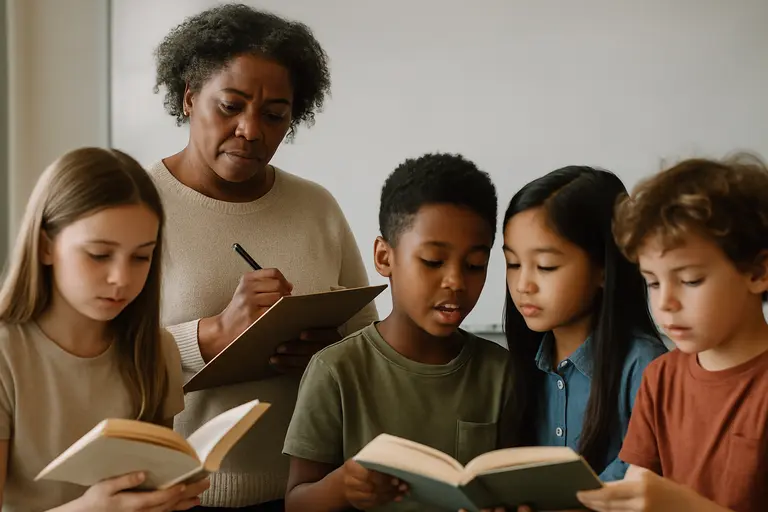
Progress may show up in small ways before it appears on a formal reading score. A child may listen longer during a book, point to print, use a newly taught word, retell more of the story, ask a question, or connect a word in English to a word used at home. These signs matter, but they are observations rather than diagnoses.
Adults should look for patterns across days and settings. One quiet reading session does not mean an activity failed. One strong response does not prove that the child has mastered a skill. Notes about books read, words practiced, and child responses can help teachers and families see whether practice is leading to more participation.
When Extra Support May Be Needed
If a child has ongoing difficulty understanding language, using spoken language, hearing sounds in words, remembering taught words, or engaging with books, families may want to discuss concerns with a teacher, reading specialist, speech-language pathologist, or pediatric provider. Bilingualism itself should not be treated as a disorder. At the same time, children who need extra support should not be asked to wait simply because they are learning more than one language.
Resource quality also matters. Because mixed resource networks can cover unrelated topics, such as informational sites like Polygraphianz, families and educators should separate general web browsing from child-literacy decisions and give the most weight to peer-reviewed literacy research, school data, and qualified professional input.
Bilingual Literacy Activities For Emerging Readers
Keeping Practice Consistent And Respectful
The most helpful routines are consistent, respectful, and responsive. A child can read with an adult in English, talk about the story in a home language, learn two or three important words, practice a sound-letter pattern, and draw or retell one idea. None of those steps needs to erase the child’s first language.
Bilingual Literacy Activities work best as part of a steady plan: choose a clear goal, connect it to meaningful text, invite real conversation, and watch how the child responds. The research supports structured reading instruction and well-planned dual-language learning, but it also reminds us to stay careful. Children differ in language history, instruction, access, and developmental needs. Good literacy support leaves room for those differences while giving every child more ways to understand, speak, read, and participate.