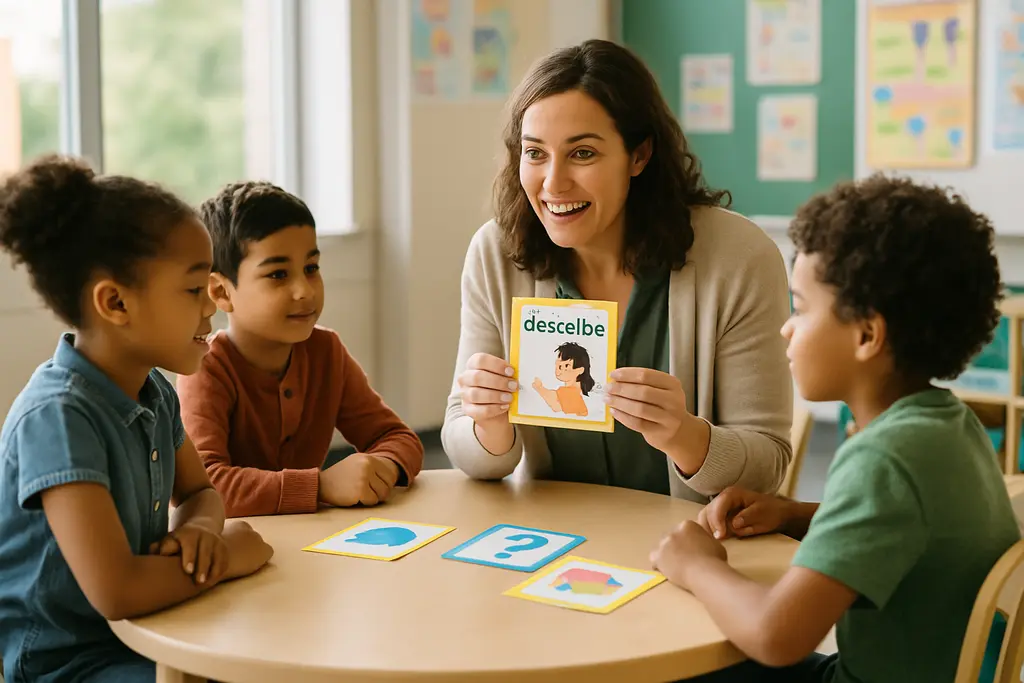
For bilingual children, academic language instruction is not only about learning school words. It is also about getting enough meaningful practice in each language to explain ideas, answer questions, retell events, compare objects, and use language for learning. Research on bilingual preschoolers suggests that the language used during instruction can shape growth differently in Spanish and English, which matters for families and teachers planning support.
That message can feel both hopeful and unsettling. Many parents see a child’s English increase quickly after preschool starts, while Spanish may become quieter at home. A change like that does not always mean a child has lost a language, but it does mean adults should look closely at input, opportunities to speak, and the types of language the child is asked to use.
What Academic Language Instruction Changes
Academic Language Instruction Is Not Just Vocabulary
Academic language includes the words, sentence patterns, and conversation moves children use to think with others. A preschooler may use it when explaining why a block tower fell, describing how a plant changed, sorting animals by features, or telling a story in sequence. These skills grow through interaction, not through word lists alone.
Good academic language instruction gives children repeated chances to hear and use language for real purposes. A teacher might model a sentence such as, The bigger cup holds more water, then invite children to compare cups, make predictions, and explain what happened. In a bilingual setting, the language used for that exchange matters because children need practice in the language they are expected to develop.
Why Classroom Talk Carries Extra Weight
School language can be denser than casual conversation. Children hear more explanations, sequence words, category labels, and cause-and-effect statements. They may also need to answer questions in longer turns than they use during play. For bilingual children, the challenge is not simply learning two labels for the same object. They are also learning how each language works in stories, explanations, classroom routines, and peer talk.
This is why instruction should not treat the home language as a side issue. If a child is expected to develop Spanish for learning, Spanish must be used for meaningful learning. If English is the only school language, English may receive many more chances to grow during the day.
Why Language Of Instruction Matters
What The 2022 Preschool Study Found
A 2022 study of 124 bilingual preschoolers in five U.S. states found that Spanish instruction was essential for Spanish oral language growth, while English oral language growth occurred regardless of the language of instruction according to the Wiley study. That finding does not mean every child follows the same path. It does suggest that Spanish growth needs protected time and purposeful use in school, especially for children whose broader community gives them far more English input.
The pattern is practical. English often surrounds children in public spaces, media, school routines, and peer interaction. Spanish may be strongest at home or with certain relatives. If school instruction shifts heavily toward English, the child may have fewer settings where Spanish is used for explaining, reasoning, storytelling, and problem-solving.
What The Study Cannot Tell Us
The study focused on bilingual preschoolers and oral language growth. It does not prove that one program model is best for every child, every community, or every pair of languages. It also does not replace the need to understand a child’s hearing, speech sound development, developmental profile, and language history. A child who speaks less in one language may need more opportunity, but some children may also need evaluation for speech or language concerns.
Still, the study gives families a useful question to ask: Which language is my child being asked to use for thinking, explaining, and learning? If one language is mostly used for directions or greetings, it may not get the same chance to develop into a school-ready language.
How Home Input Supports School Language
Quantity And Quality Both Matter
Research on bilingually developing children describes language input as a key part of development, including how much children hear each language and the quality of interaction in that language as reviewed in the input research. Quality does not mean formal lessons at the kitchen table. It can mean responsive conversation, shared book reading, pretend play, family storytelling, and explanations during daily routines.
For a bilingual child, input is often divided across people and places. One caregiver may use Spanish, another English. Grandparents may use one language for family stories, while teachers use another for science or art. That distribution can support growth, but it can also lead to uneven skill levels. Uneven does not mean wrong. Bilingual development often reflects where, with whom, and why each language is used.
Home Language Use Can Be Academically Useful
At home, academic language instruction does not need to look like school. Parents can build academic language by asking children to explain steps while cooking, compare two toys, retell part of a book, describe what changed in a drawing, or predict what might happen next. These interactions support thinking and language in the language the family actually uses.
Families who want more detail on exposure can read about bilingual vocabulary growth, especially the way meaning builds through daily language use. Families who use photos to organize routines may also appreciate the same network’s related visual resource found at Finest Image. Parents do not need to stop using the home language to help with English. The research above supports the idea that input in each language matters. If a child has strong relationships and daily interaction in Spanish, keeping Spanish active can give the child a wider base for communication, family connection, and later learning.
Practical Signals Families And Teachers Can Watch
Signs That One Language Needs More Opportunity
Adults can watch for patterns without treating every difference as a problem. A bilingual child may answer in English after hearing Spanish, use one language with siblings and another with teachers, or know school words in English before Spanish. These patterns often reflect exposure. They become more concerning when a child has few chances to use a language for full sentences, stories, explanations, or questions.
Useful questions include:
- Does the child hear each language during meaningful back-and-forth conversation?
- Does the child get to tell stories, explain ideas, and ask questions in the home language?
- Is one language used mostly for commands while the other is used for teaching and discussion?
- Do teachers know which language the child uses most comfortably with family?
- Are adults comparing the child only to monolingual peers, or are they considering total bilingual experience?
How Adults Can Respond Without Pressure
Children usually benefit from interaction that feels purposeful and warm. If a child answers a Spanish question in English, a parent can respond to the meaning, then model the Spanish form naturally. For example, if the child says, It melted, the adult might say in Spanish, Sí, se derritió porque estaba caliente. The goal is to keep the conversation moving while giving the child useful language.
Teachers can use the same principle in classroom talk. They can model longer sentences, repeat key ideas in the instructional language, invite peer talk, and connect new words to hands-on activities. If the program includes two languages, children need real chances to use both, not just hear both.
Academic Language Instruction In Daily Practice
The most useful way to judge academic language instruction is to ask whether it gives a bilingual child more chances to participate with meaning. A strong activity is not the one with the hardest words. It is the one that helps the child listen, think, respond, and try language again with support.
For families, this means keeping the home language active through conversation, books, songs, routines, and explanations. For schools, it means being intentional about which language carries instruction and whether both languages have enough space for growth. For specialists, it means interpreting language samples in light of exposure, not assuming that one weaker language tells the whole story.
The available research does not support a one-size plan for every bilingual child. It does support a careful principle: children grow in the languages they hear, need, and use. If adults want both languages to develop, both languages need meaningful time in real communication.