Bilingual word combinations often appear before children can produce long or polished sentences in either language. A phrase such as “more leche” or “mama go” may sound incomplete to an adult, yet it can reveal that a toddler is already connecting two ideas into one purposeful message.
The words do not need to come from the same language to show progress. Families wondering whether mixed phrases indicate confusion can place them within the wider pattern of language switching in bilingual children, where language choice changes with people, settings, vocabulary, and immediate communication needs.
Single Words Build the Foundation for Early Phrases
Before bilingual toddlers combine words, they usually spend time building a collection of meaningful single words across both languages. One language may contain more names for family members, while the other includes more words connected with childcare, toys, food, or outdoor play.
These words do not need to be evenly divided. A child might say “agua,” “ball,” “mama,” and “open,” drawing from whichever language provides the most familiar or accessible word for each idea.
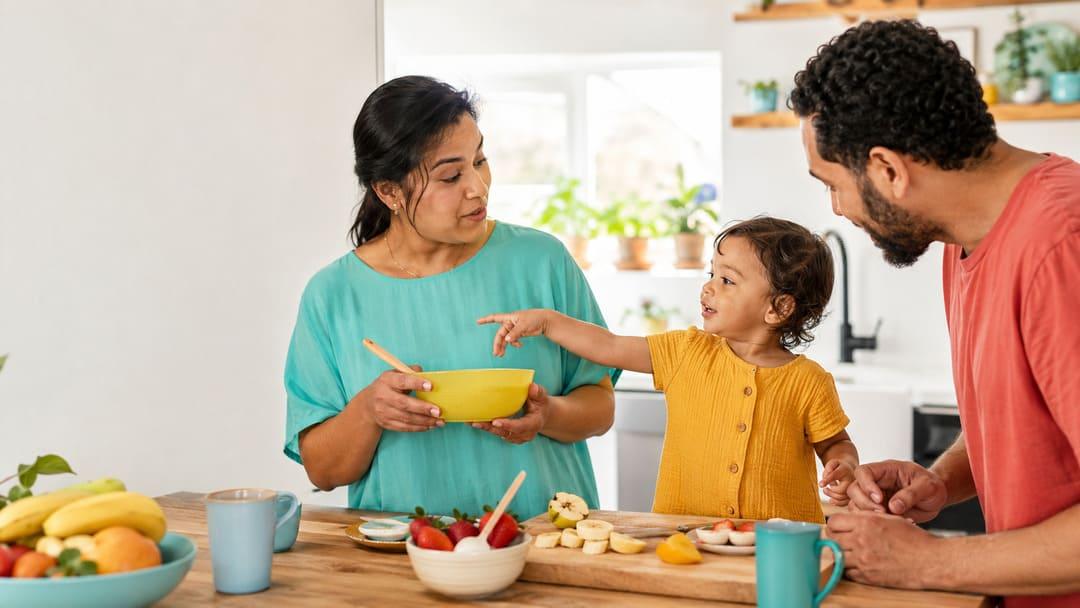
Gestures, eye contact, and vocal tone often support these early messages. A toddler may point toward a cup while saying one word, bring shoes to an adult, or use a familiar label while looking toward the person expected to respond.
As the vocabulary becomes larger and more dependable, toddlers gain more opportunities to connect meanings. Single words that once worked alone can begin joining into phrases that express ownership, action, location, description, or a more specific request.
Bilingual Word Combinations Often Emerge Near Age Two
Children typically move from single words to early combinations during the second year of life. ASHA’s guidance on learning more than one language notes that most multilingual children begin using two-word phrases by age two.
The timing is broad rather than exact. One child may combine words at 19 months, while another may spend longer building a larger single-word vocabulary before phrases become frequent.
Early combinations may also appear inconsistently. A toddler might say “Daddy home” once and then rely on gestures or single words for several days. The stronger sign is whether combinations gradually become more frequent, purposeful, and varied.
Progress is measured across both languages, not by expecting a complete set of milestones in each language separately.
Mixed-Language Phrases Still Connect Two Meanings
A bilingual toddler may combine one word from each language because both are available within the child’s communication system. “Más juice,” “mi shoe,” or “agua please” can express clear relationships even though the words come from different languages.
These phrases are commonly called code-mixed or mixed-language utterances. They do not show that the child has failed to separate the languages. A toddler may know one concept more readily in one language, associate a word with a particular caregiver, or choose the form that is easiest to retrieve.
What matters is the relationship between the ideas. “Más juice” connects recurrence with an object. “Mommy zapato” may connect an owner with an object. “Baby dormir” connects a person with an action.
Mixed vocabulary does not erase the sentence structure underneath it. The child is still selecting words, organizing meaning, and directing a message toward another person.
Early Phrases Reveal How Language Is Becoming Organized
Two-word combinations do more than increase sentence length. They show that a child is beginning to express relationships that one word cannot communicate precisely.
| Example Phrase | Language Pattern | Meaning Relationship |
|---|---|---|
| More leche | Mixed-language | Recurrence and object |
| Mommy go | Single-language | Person and action |
| Mi ball | Mixed-language | Owner and object |
| Doggie grande | Mixed-language | Object and description |
| Agua there | Mixed-language | Object and location |
| No bath | Single-language | Rejection and activity |
Early phrases often omit articles, verb endings, helping verbs, and other grammatical details. “Mommy go” does not need to become “Mommy is going” before it counts as meaningful sentence development.
Some combinations may begin as familiar chunks. A child might learn “all done” or “thank you” as a complete routine. More flexible development appears when the child begins changing part of the pattern, such as moving from “more milk” to “more pan” and “more bubbles.”
Exposure Shapes Which Language Appears in the Phrase
Bilingual children rarely receive identical exposure to both languages. One language may dominate family meals and emotional conversations, while another is used more often at childcare, during community activities, or with siblings.
That distribution influences which words become easiest to retrieve. A child may know food words mainly in the home language but action words mainly in the language used during play. Combining those vocabularies can produce a mixed phrase that accurately reflects the child’s experience.
Language balance can also change. Starting preschool, spending time with relatives, traveling, or changing caregivers may temporarily make one language more prominent. Sentence combinations may shift as the child adapts.
Caregivers should consider vocabulary and phrases across every language the child uses. Counting only English, Spanish, or another single language can make an expanding communication system appear smaller than it is.
Caregivers Can Encourage Combinations Without Forcing Them
The most useful support starts with the child’s existing message. When a toddler says “car,” an adult can respond with “fast car,” “car goes,” or the equivalent phrase in the language that feels most natural.
Mixed phrases do not need to be criticized or translated on demand. When a child says “más crackers,” a caregiver might answer, “More crackers—you want more crackers,” while another family member may naturally model the same idea in the home language.
This approach confirms the meaning and provides a complete model without interrupting participation. Natural modeling is more productive than repeated correction.
Books, songs, pretend play, and routines offer repeated sentence patterns. Dressing creates “shoe on” and “my shirt.” Meals create “more rice” and “cup empty.” Toy play creates “baby sleep,” “car fast,” and “block fall.”
Families do not need rigid rules requiring one person to use only one language. Rich, comfortable interaction gives children more useful input than adults speaking an unfamiliar language simply to maintain an artificial division.

Steady Development Matters More Than Language Purity
The ASHA milestones for 19 to 24 months include using and understanding at least 50 words and putting two or more words together. Multilingual children should receive frequent opportunities to hear and practice all their languages.
A single mixed phrase cannot confirm or rule out a language difficulty. Families should look for growth in understanding, gestures, vocabulary, imitation, play, and the ability to communicate increasingly specific meanings.
Concern becomes more significant when limited combinations appear alongside weak comprehension, few gestures, little vocabulary growth, or difficulty communicating across both languages. Losing words or other previously acquired skills deserves prompt professional attention.
Evaluation should consider every language the child hears and uses, along with the amount and type of exposure. Testing only the less familiar language can underestimate ability and confuse a language difference with a disorder.
Bilingual word combinations are not supposed to look perfectly balanced or remain inside strict language boundaries. The key developmental shift is that the child is connecting ideas with growing flexibility. Whether the phrase is “more milk,” “más milk,” or its equivalent in another language, a purposeful combination can mark the beginning of a more powerful sentence system.
FAQs
Do mixed-language phrases count as two-word combinations?
Yes. A phrase containing one word from each language counts when the child independently connects two meanings, such as an action and object, owner and object, or request and item.
Should parents repeat a mixed phrase in only one language?
Parents can provide a natural model in the language they speak comfortably, but they do not need to demand correction. Responding to the meaning helps keep communication active and positive.
When should limited word combinations be evaluated?
Seek guidance when combinations are not developing near age two and the child also shows limited vocabulary, weak understanding, few gestures, hearing concerns, or little progress across both languages.