The best What Am I riddles for kids do more than produce a correct guess. A carefully chosen clue asks a child to connect vocabulary, categories, sensory details, sentence structure, and another person’s point of view—all inside a game simple enough to repeat anywhere.
Children often know more than they can immediately explain. Riddles and adaptable I Spy games give them a reason to search for precise words, revise an unclear clue, and stay in a back-and-forth exchange. They fit naturally beside other play-based language ideas because communication has an immediate purpose: helping someone else identify the answer.
Why Riddles Build More Than Vocabulary
A riddle such as “I am round, I bounce, and you can throw me” asks the listener to combine several kinds of information. “Round” describes shape, “bounce” identifies an action, and “throw” suggests function. The child must hold the clues together and reject objects that do not fit.
Creating a riddle adds another layer. The clue-giver must decide which features are useful, what the listener already knows, and how much information to reveal. The clue is a small language problem, not merely a memory question.
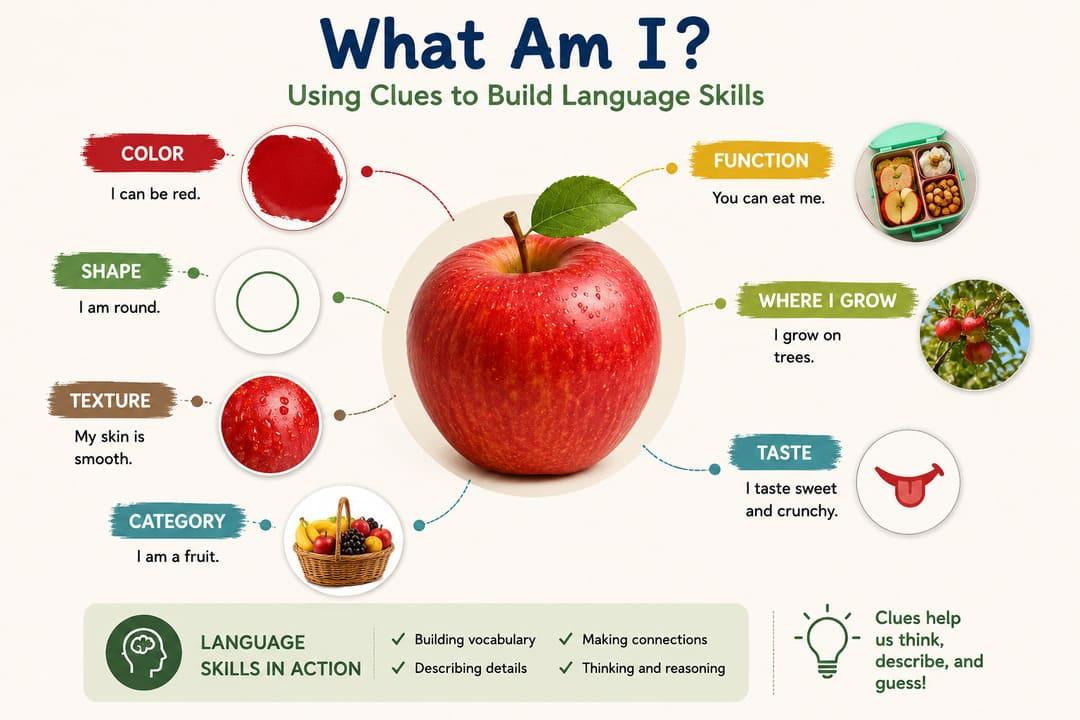
A child may easily name a banana when shown one but need support to describe its color, shape, category, and use without saying the name. The American Speech-Language-Hearing Association recommends everyday activities involving familiar objects, their names, and their uses in its collection of speech and language activities.
How to Keep the Game From Feeling Like a Test
Begin with riddles the child is likely to solve. Early success teaches the routine and builds confidence. Once the pattern is familiar, introduce answers that require closer comparison.
Read one clue at a time and pause. A wrong guess can become useful conversation: “A car has wheels, but does it have wings?” This invites the child to check the guess rather than simply hearing “no.”
Respond to meaning before correcting grammar or pronunciation. If the child says, “It fly sky,” an adult might answer, “Yes, it flies in the sky. Is it a bird or an airplane?”
Reverse roles regularly. Let the child choose an object and give one clue, adding another only when the listener needs help. Aim for one step beyond the child’s current answer instead of demanding a long description immediately.
20 Simple What Am I Riddles for Kids
These riddles use familiar objects and animals so the challenge comes from interpreting clues rather than recognizing an obscure answer.
- I am round. I can bounce. You can throw me. What am I?
Answer: A ball. - I am yellow. You peel me before eating me. What am I?
Answer: A banana. - I have four legs, but I cannot walk. You can sit on me. What am I?
Answer: A chair. - I have pages and a cover. You open me to read. What am I?
Answer: A book. - I have two wheels. You pedal me to move. What am I?
Answer: A bicycle. - I say “meow.” I have whiskers and soft paws. What am I?
Answer: A cat. - I am cold and sweet. I melt when I get warm. What am I?
Answer: Ice cream. - I have hands but no fingers. I tell you the time. What am I?
Answer: A clock. - I fall from clouds and make the ground wet. What am I?
Answer: Rain. - I have a handle and bristles. You use me on your hair. What am I?
Answer: A hairbrush. - I may be red, yellow, or green. I grow on a tree. What am I?
Answer: An apple. - I have wings and feathers. I may build a nest. What am I?
Answer: A bird. - I have buttons and a screen. You can use me to call someone. What am I?
Answer: A phone. - I am long and thin. You use me to write or draw. What am I?
Answer: A pencil. - I have doors, windows, and wheels. A driver sits inside me. What am I?
Answer: A car. - I am soft and rest on a bed. You put your head on me. What am I?
Answer: A pillow. - I have teeth but cannot bite. You use me on your hair. What am I?
Answer: A comb. - I shine in the daytime sky and make the day bright. What am I?
Answer: The sun. - I live in water. I have fins and a tail. What am I?
Answer: A fish. - I have a handle and hold drinks, but I am not a bottle. What am I?
Answer: A mug.
Turn I Spy Into Five Language Games
Traditional I Spy usually begins with color: “I spy something blue.” Change the clue type and the same game can practice listening, categories, descriptions, and sentence formation.
| I Spy Version | Example Prompt | Language Practice |
|---|---|---|
| Colors | I spy something green | Color words and visual attention |
| Sounds | I spy something starting with /b/ | Listening and beginning sounds |
| Categories | I spy something that is a vehicle | Grouping and word relationships |
| Describing words | I spy something tiny, smooth, and round | Adjectives and precise vocabulary |
| Sentences | I spy something we use when it rains | Complete clues and object functions |
For beginning players, use visible objects and one clear feature. Later, combine clues: “I spy something red that we can eat.”
Sound-based I Spy should focus on what the child hears at the beginning of a word. Category rounds can use animals, foods, clothing, tools, toys, or furniture. Describing rounds can include texture, size, shape, temperature, speed, or location.
For sentence practice, model a complete clue and invite the child to create another: “I spy something that is soft and sits beside the lamp.” The sentence has a real listener and a clear job, making it more meaningful than repeating a disconnected pattern.
Pressure Points That Can Silence Participation
A riddle stops being useful when the answer depends on knowledge the child does not have. Choose objects from familiar routines, books, classrooms, and play rather than relying on tricky wording.
Too many rapid questions can make the exchange feel like an examination. Mix questions with comments, guesses, and pauses. The Center on the Developing Child at Harvard describes responsive back-and-forth exchanges as serve and return interactions. Here, that means noticing the child’s word, gesture, expression, or attempted clue and responding in a way that invites another turn.
Children may need several seconds to retrieve a word or organize a sentence. Repeating the question too quickly can interrupt that work. The adult’s pacing matters more than the difficulty of any single riddle.
Accept pointing, gestures, partial words, home-language responses, and approximate descriptions as meaningful turns. Model clearer language without demanding perfect repetition. The game should make communication feel possible.
Let the Clues Grow With the Child
The same riddles can remain useful after the answers become familiar. Ask the child to add a clue, remove the easiest clue, compare two possible answers, or explain why an incorrect guess does not fit. Older children can rewrite a riddle so it becomes harder without becoming misleading.
Build themed rounds around a grocery trip, bedtime routine, park visit, animal book, or classroom topic. A familiar answer gives the child more space to practice describing, reasoning, and sentence formation.
Watch how the child participates rather than counting correct answers. Are the clues becoming more specific? Is the child asking questions, repairing unclear messages, or combining more words?
Keep success visible and pressure low. What Am I riddles for kids work best when the child wants another turn, not when every answer is perfect. The next useful step is a richer exchange in which the child discovers that careful words can guide another person’s thinking.
FAQs
What age are What Am I riddles suitable for?
Simple riddles can work for preschoolers and early elementary children. Younger players may need pictures or two answer choices, while older children can interpret several clues and create original riddles.
What should I do when a child cannot solve a riddle?
Add a more concrete clue, show two possible objects, or demonstrate the answer’s action. Avoid immediately revealing it. The goal is to provide enough support for the child to keep reasoning.
Can I use these riddles with children who speak more than one language?
Yes. Children can guess, describe, or create clues in either language. Adults can repeat key words across both languages without treating one as the only acceptable way to participate.