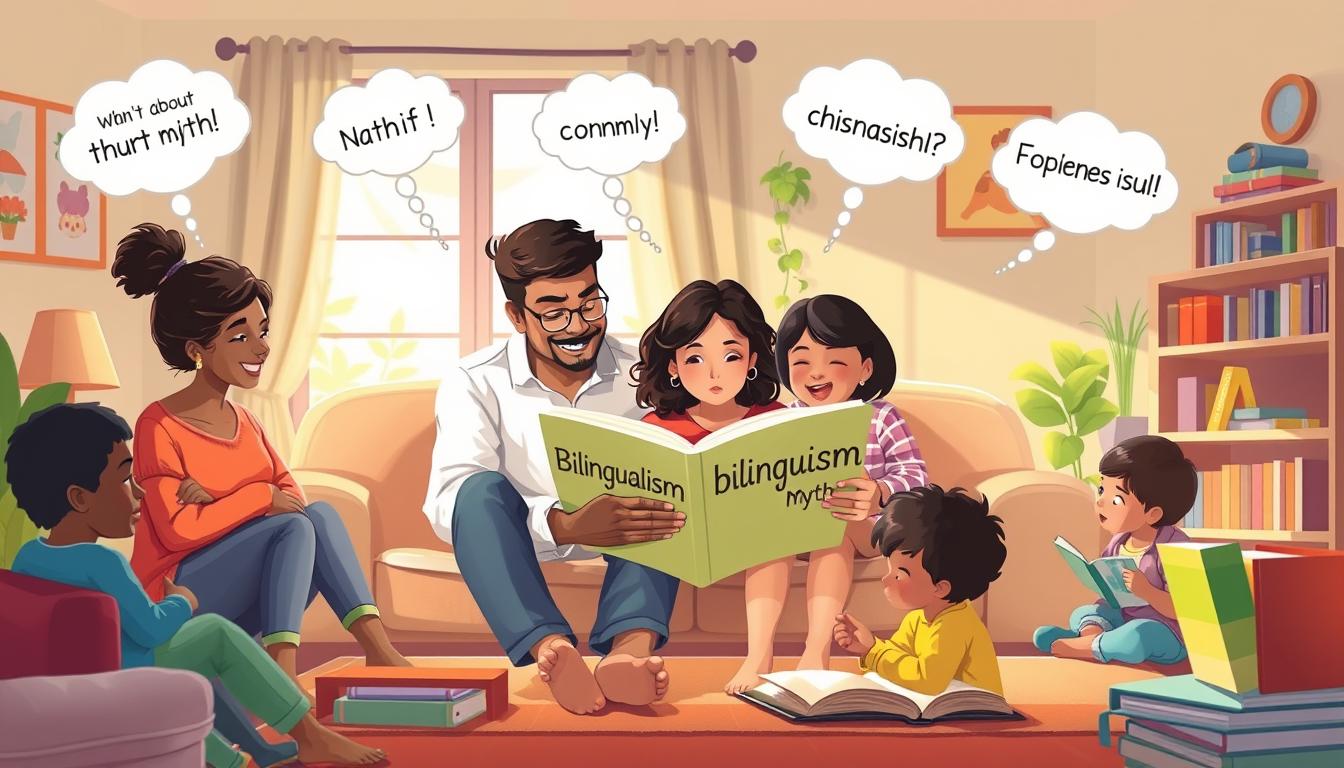
You’ve heard it at the playground. You’ve seen that concerned look from a well-meaning relative. “Won’t all those languages just confuse the poor kid?” It’s like thinking the world is flat because you can’t see the curve.
This article is your telescope. We’re diving into the pool of misinformation about raising multilingual kids. We’re armed with facts from linguistics, neuroscience, and decades of research.
Think of this as a myth-busting session, but with less explosion and more cognitive flexibility. We’ll show why the fear of “confusion” is itself a confused idea. We’ll look at how the “speech delay” scare lacks scientific backing.
And we’ll explain why forcing English-only at home can hurt your child’s education. The truth, as shown in research from the University of Pennsylvania’s language myths analysis, is much more interesting than the myths.
Strap in. We’re replacing hype with enlightenment.
Introduction
Let’s get real: the worry that two languages will ‘confuse’ a child is common but not backed up by facts. You might have felt this fear. Maybe it was when you spoke Mandarin to your toddler at the playground. Or perhaps it was advice from a doctor that didn’t quite add up.
This fear is fueled by the word confusion. It’s a big deal in our society.
The idea is simple but wrong. It says a child’s brain can only handle one language. Adding a second language is like trying to write an essay while listening to loud music. It’s seen as too much for the brain.
But what if this idea is not true? Linguist François Grosjean points out that bilingualism is common worldwide. More than half of the world’s people speak two or more languages. Does this mean people in Switzerland, who speak German and French, are confused? The answer is a clear “no.”
Speech-language pathologists deal with this fear every day. Parents worry that their child’s mix of languages is a problem. But this worry comes from a misunderstanding, not science.
We’re not just defending bilingualism. We’re changing how we see it. It’s not about fixing a problem. It’s about recognizing a cognitive advantage. The real confusion is in the old idea that only one language is best.
| The Common Myth (The Anxiety) | The Research-Backed Reality (The Analysis) | The Global Perspective |
|---|---|---|
| Two languages overload and confuse a child’s developing brain, causing speech delays. | The brain is not a container but a dynamic network. Learning two languages enhances executive function, problem-solving, and cognitive flexibility. | Bilingualism and multilingualism are standard for billions, with no correlation to widespread cognitive deficit. |
| Mixing words from both languages (“Spanglish”) is a sign of linguistic failure. | Code-mixing is a sophisticated, rule-governed skill that shows mastery of both linguistic systems. | Code-switching is a natural, efficient form of communication in bilingual communities worldwide. |
| You must speak only one language at home to avoid confusing the child. | Consistent exposure to both languages in meaningful contexts is key. The “one-parent, one-language” method is just one of many successful approaches. | Multilingual households use diverse, fluid strategies that reflect their culture and circumstances, all yielding proficient speakers. |
We will tackle the top myths, share expert advice, and hear from parents. We’re moving from defense to knowledge. Let’s face our fears and leave them behind.
Top 5 Myths Explored
The bilingualism myths we’re about to explore have stuck around like a catchy but wrong song. It’s time to give them the fact-check they’ve been avoiding for ages.
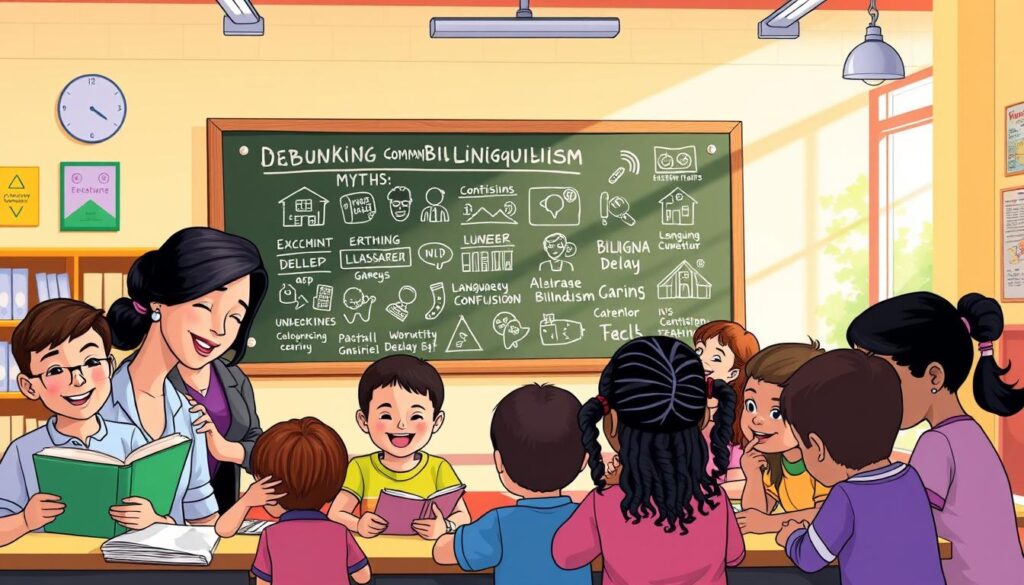
Myth #1: Two languages confuse children and impair cognitive ability. This myth is as catchy as a bad pop song. But the truth is, bilingualism is like a mental workout.
Children learning two languages become mentally flexible. This is something monolingual kids might wish they had. Research by Hakuta in 1986 showed bilingual kids are better at solving problems and thinking creatively.
The brain doesn’t get mixed up. It gets better. Learning a second language is like adding a new operating system that makes everything run smoother.
Myth #2: Speaking a heritage language at home hurts academic success. This myth is ironic. Parents who struggle with English and push it too hard might actually slow down their kids’ learning.
Cummins’ 1994 study showed a strong native language foundation can actually help with learning a second language. It’s not about taking away, but adding to.
Learning to read in one language helps with reading in another. Cutting out the first language is like building on shaky ground.
Myth #3: Bilingual education is ineffective. This myth is like saying all medicine is bad without knowing what it is. The type of bilingual education matters a lot.
Thomas and Collier’s study found that two-way immersion programs work best. Not all bilingual education is the same. Some is just a quick fix, while others are real solutions.
Debating bilingual education without looking at the details is like arguing about pizza without knowing the toppings. Let’s focus on the facts, not just slogans.
Myth #4: “They speak fine on the playground, so it must be a learning disability.” This myth is a big leap. There’s a big difference between everyday conversation and academic language.
It takes about two years to get good at basic talking. But learning to read and write takes much longer. A child talking about games isn’t showing the same skills as reading a history book.
It’s like the difference between ordering coffee and discussing philosophy. Both use language, but in very different ways.
Myth #5: “Sink or swim worked for my grandparents.” Nostalgia can be misleading. What worked for the past might not work today.
Forcing assimilation through language can be very harmful. It’s like ignoring the evidence of trauma. Today, we need different approaches for our diverse society.
Each of these bilingualism myths is hard to shake because it feels right. But feeling isn’t the same as fact.
The evidence shows bilingualism is a plus, not a minus. It builds bridges, not walls. And the right education models actually work.
Challenging these myths is important. It’s about giving kids the best start in life. And that’s a big deal.
Expert & Research Insights
If the worry about bilingualism causing speech delay were a horror movie, the research would be the final scene. The monster turns out to be a misunderstood puppy. Linguists and developmental psychologists have been trying to tell us this for decades.
Researchers like Fred Genesee, Johanne Paradis, and Martha Crago have spent their careers studying language milestones. They found that bilingual and monolingual children reach these milestones at the same rate. The perceived lag isn’t a deficit. It’s a different way of using resources.
Think of it like this. A monolingual toddler might have 50 words by age two. A bilingual toddler might have 25 in English and 25 in Spanish. The total is the same. Erika Hoff and Cynthia Core’s 2015 work confirmed this. The combined vocabulary of a bilingual child matches their monolingual peer’s. The brain isn’t splitting a pie. It’s baking two.
This is where the myth of speech delay truly unravels. The worry isn’t backed by developmental timelines. It’s fueled by comparing apples to a fruit basket. We’re measuring one language against two and calling it slow.
What about children with genuine language challenges? Here’s where the research gets fascinating. Studies, including work by Kremer-Sadlik in 2005, show bilingualism doesn’t make issues worse. In many cases, it provides a social and emotional buffer. Family bonding strengthens. The child has more avenues for connection.
Then there’s the Perozzi and Sanchez study. This one should be required reading for every concerned parent and educator. They worked with children who had identified language delays. The intervention? Teaching concepts thoroughly in Spanish first. The result? Those children learned the same concepts in English twice as fast as the control group.
Let that sink in. For kids already struggling, bilingual instruction became a strategic accelerator. It provided a deeper conceptual foundation in their stronger language. This wasn’t a delay. It was a cognitive shortcut.
The clinical perspective from Speech-Language Pathologists (SLPs) aligns perfectly. They see the whole child. A true speech delay looks specific and consistent across contexts. The “bilingual delay” often vanishes when you account for both languages. The SLP’s toolkit is designed to differentiate between pathology and the beautiful, normal variation of dual-language acquisition.
Researchers like Jim Cummins and Kenji Hakuta frame this beautifully. Cummins’ work on the interdependence hypothesis shows skills in one language transfer to another. Hakuta’s research highlights the cognitive flexibility. The brain isn’t a container with limited space. It’s a network that expands with each new connection.
François Grosjean, a titan in bilingualism research, puts it bluntly. The bilingual is not two monolinguals in one person. They are a unique linguistic entity. Their acquisition rate isn’t slower. Their journey is just mapped on a different, richer terrain.
So, when the ghost of speech delay whispers in a parent’s ear, the research chorus shouts back in unison. The evidence doesn’t suggest risk. It paints a picture of remarkable resilience. It reveals a brain engineered for complexity, turning perceived obstacles into cognitive advantages.
The data is clear, consistent, and decades strong. The myth persists not because of science, but in spite of it. Understanding this research is the ultimate antidote to fear.
Parents’ Experiences
The idea of bilingualism is clear, but the reality is messy. It’s filled with Duplo blocks and half-eaten crackers. For parents, the moment of truth isn’t in studies—it’s when their toddler asks for más juice.
This moment can make parents panic. “They’re mixing them up! They’re confused! I’ve broken my child’s brain!” This panic about language mixing is common.
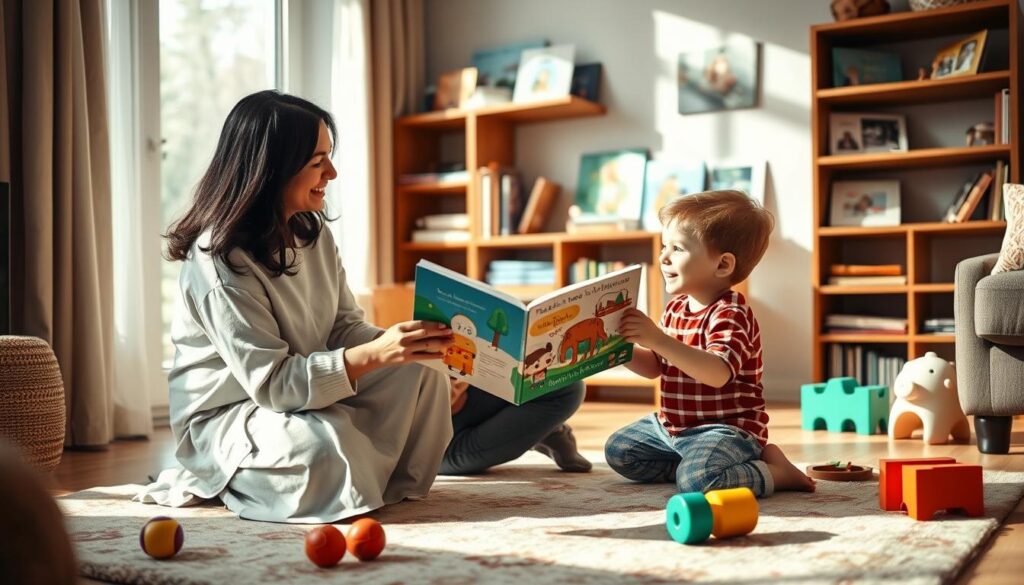
But, let’s look at it differently. Language mixing, or code-switching, isn’t a mistake. It’s a sophisticated feature of a bilingual operating system. It’s like having a full toolkit instead of just one tool.
Linguist François Grosjean compares it to drinking coffee with milk instead of black. It’s about using what’s available to express yourself best. Children code-switch because they can. It’s a rule-governed behavior (Genesee et al., 2004).
Community pressure meets gut instinct here. Some parents fear language mixing and switch to English-only at home. This can weaken their child’s connection to family stories and heritage.
The real story is about incredible linguistic adaptability. Your child is a pragmatic linguist, always testing effective communication. They use language to connect and get what they want, like more juice.
To understand what you’re hearing, let’s look at different types of bilingual blending. Not all mixing is the same, and knowing the type helps you see the strategy behind it.
| Type of Mixing | What It Sounds Like | The Pragmatic Reason Behind It | Is It a Concern? |
|---|---|---|---|
| Single-Word Borrowing | “Can I have a galleta (cookie)?” “My ami (friend) is coming.” | The word in one language is more readily accessible, frequently used at home, or simply feels right for the context. | No. This is the most common form and a sign of a rich, integrated vocabulary. |
| Tag-Switching | “That movie was cool, ¿verdad?” “I finished my homework, ya.” | Adding a conversational tag or filler word from the other language for emphasis or cultural flavor. | No. It’s a stylistic choice, akin to saying “C’est la vie!” in an English sentence. |
| Intra-Sentence Code-Switching | “I put my zapatos in the closet.” “Mañana we go to the park.” | The sentence follows the grammar of one language but slots in key nouns/verbs from the other where they fit best. | No. This demonstrates advanced metalinguistic awareness—knowing where words can slot in grammatically. |
| Persistent Grammar Mixing | Consistently applying the grammar rules of Language A to words from Language B (e.g., adding English ‘-s’ plural to Spanish nouns). | This can happen during intense language acquisition phases when systems are being solidified. | Monitor, but don’t panic. With continued exposure and gentle modeling, it typically self-corrects. |
Your child’s linguistic blend is a solution to their communication needs. It’s not a bug report. It’s a feature update. So, when you hear that mixed-up sentence, take a breath. You’re not hearing confusion. You’re hearing a tiny, brilliant diplomat.
How to Address Misinformation
Knowing the facts is key to avoiding a holiday dinner table debate. It’s not about winning, but about calmly and strategically addressing misinformation about your bilingual child.
Think of it as intellectual self-defense. When Uncle Bob says two languages cause delay, you have a choice. You can sigh, or you can explain. A simple, evidence-backed response can change the conversation: “Research shows they meet milestones on time. Their total vocabulary is the same—it’s just spread across two languages.”
This shifts the conversation from fear to capability.
But your real strategy goes beyond dinner-table diplomacy. The biggest challenge isn’t what others say. It’s the system that fails under pressure. The “one parent, one language” (OPOL) method sounds good but often fails when the child sees the minority language isn’t needed outside that relationship.
A better approach is to build a whole linguistic ecosystem for the language.
Linguist François Grosjean calls this creating a “need” for the weaker language. Can the whole family use it at home for certain activities? Can you find playgroups, storytimes, or engaging media in that language? The goal is to make that language vital for connection and fun, not just a parental quirk.
This rich environment is your strongest ally. It turns the minority language from something to be studied into a living medium for experience.
Advocacy also extends to school systems. Knowing the difference between programs is key. A transitional program aims to move a child into English-only instruction quickly. A dual-language program, on the other hand, aims for full proficiency in two languages, valuing both equally.
Understanding this distinction lets you ask the right questions. Are both languages treated as assets? Is the goal additive bilingualism or just assimilation? Your informed advocacy helps shape a supportive environment for your bilingual child.
Ultimately, addressing misinformation is a dual process. Externally, it’s about reframing myths with concise, research-based points. Internally, it’s about building a world where both languages thrive. It’s less about defending your choice and more about confidently living it, creating a rich tapestry of sound and meaning for your child to explore.
Conclusion
The myths about bilingualism are old and outdated. They come from a time when we thought our brains were simple. But, science from places like MIT shows our brains are complex and capable.
This new view of bilingualism is like a brain workout. It’s not about confusing kids. It’s about making their brains stronger and more flexible. Studies show bilingual kids can think better and even delay dementia.
There’s also a big benefit in the social and economic world. Knowing another language is not just a fun skill. It’s a powerful tool that connects us to different cultures and opens doors to new opportunities.
We need to stop believing old myths and start seeing the truth. Research has shown us that bilingual kids have better brains. They are ready for a world that needs their skills and understanding.