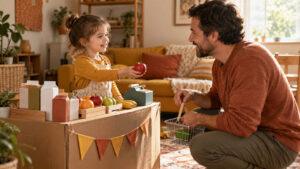
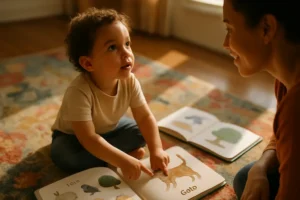
Ever watch your child play and wonder if those colorful blocks are secretly plotting world domination? They might not be conquering nations, but they’re conquering language skills. Research shows that these everyday playthings are vocabulary building powerhouses in disguise.
The magic lies not in the fanciest educational gadgets. It’s about how we engage with our kids during play. Our interactions turn ordinary objects into linguistic goldmines. That teddy bear your child won’t sleep without? It’s a conversation waiting to happen.
While we debate Montessori versus mainstream, our children’s favorite playthings are already perfect language tools. The irony? We spend fortunes on apps while the real value is in the toy chest. It’s not the toy itself but the language-rich interactions we create around them that truly matter.
Every play session is a chance to build communication skills. The blocks, dolls, and puzzles aren’t just distractions. They’re opportunities for meaningful conversations and lasting learning.
How Everyday Toys Grow Vocabulary
Ever watch a toddler turn a cardboard box into a spaceship? That’s not just play – it’s magic. The real magic isn’t in the toy but in how we use it.
Language experts say three key strategies make playtime a learning adventure. They call them the holy trinity of vocabulary building:
- Responsive labeling: Naming what your child is holding (“That’s a blue tractor”)
- Self-talk: Narrating your own actions (“I’m building a tall tower”)
- Parallel talk: Describing their actions (“You’re pushing the car fast!”)
Here’s the beautiful part: you’re probably already doing this instinctively. When your kid waves a dinosaur, you naturally say “Rawr!” That’s responsive labeling in its wild, natural habitat.
But let’s get real about limitations. These techniques are like teaching cooking by only showing ingredients. Great for vocabulary, but they don’t teach sentence structure. It’s the difference between knowing “egg” and knowing how to make an omelette.
The secret sauce? Combine these strategies with actual conversation. Don’t just label the toy – ask questions about it. Challenge your little linguist to describe what they’re doing. That’s where true learning with toys transforms from monologue to dialogue.
Remember: the simplest toys often work best. Blocks become adjectives (“tall,” “wobbly”). Dolls inspire verbs (“feeding,” “sleeping”). Cars teach prepositions (“under,” “through”). You don’t need expensive gadgets – just engagement and a willingness to talk about the play.
Choosing Effective Toys
The secret to vocabulary-building toys isn’t in their price tags but in their ability to spark real conversation between you and your child. Forget the Scandinavian woodwork obsession – effective speech toys are about intentional design, not artisan credentials.
Montessori got this right decades ago. Their approach focuses on natural materials, clean designs, and single-concept toys that don’t overwhelm young minds. These aren’t just aesthetic choices – they’re cognitive ones. Simple toys with clear purposes actually encourage deeper engagement and richer language development.
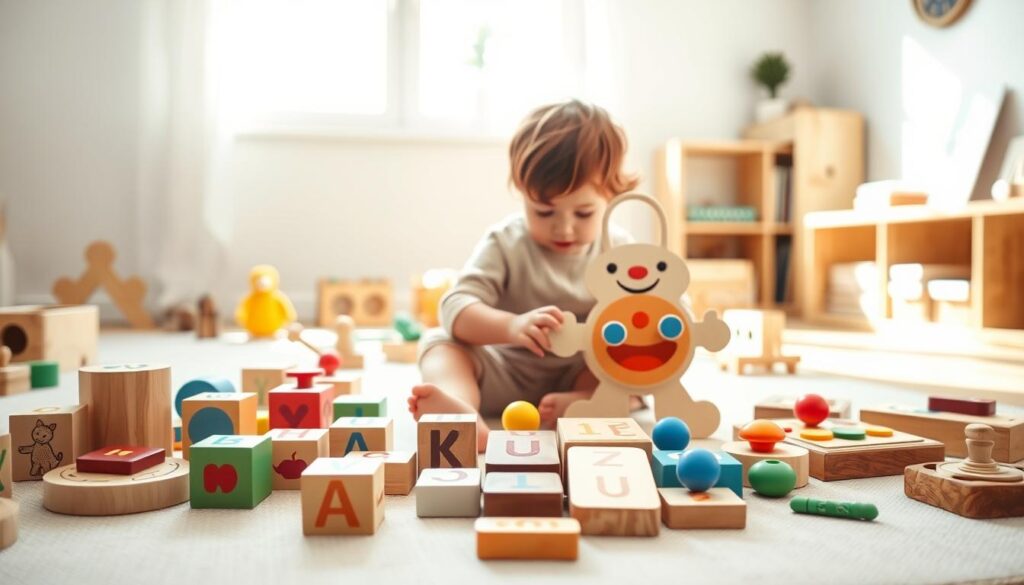
Here’s the reality check: that battery-operated alphabet singer? It’s doing the work for your child. The block set that requires naming colors and counting pieces? That’s where the vocabulary magic happens. The best toys are what I call “conversation starters” – they naturally lend themselves to dialogue.
When selecting speech toys, ask yourself: does this toy require interaction or just observation? Does it leave room for imagination, or does it dictate the play pattern? The sweet spot lies in toys that balance structure with open-ended possibilities.
Consider this comparison of toy types and their language development:
| Toy Type | Interaction Level | Vocabulary Potencial | Longevity |
|---|---|---|---|
| Electronic Talking Toys | Passive Observation | Limited – pre-programmed | Short-term novelty |
| Building Blocks | Active Creation | High – descriptive language | Years of use |
| Puzzle Sets | Focused Problem-solving | Medium – specific terms | Moderate (by age) |
| Role-play Sets | Imaginative Engagement | Very High – narrative building | Long-term adaptable |
The toys that grow with your child’s language skills are worth ten that light up and make annoying sounds. This isn’t about spending more – it’s about spending smarter on toys that encourage the kind of language learning through play that actually sticks.
Remember: the most effective speech toys often look deceptively simple. Their power lies not in what they do, but in what they inspire your child to say.
Play-Based Word Games
Let’s explore how playtime can become a way to build vocabulary. Researchers Hadley and Rispoli found a clever method called “toy talk.” It’s like finding a twenty in your old coat.
This idea is simple. Instead of saying “You’re feeding the baby,” say “The baby’s bottle is empty.” Or “The juice tastes sweet.” This change makes sentences more interesting and helps kids learn more words.
So, why is this method so effective? It makes sentences more complex and introduces kids to new words. It’s like turning basic cable into premium streaming for their minds.
Here’s how to use toy talk during play:
- Location narration: “The teddy bear is hiding under the blanket” instead of “You hid the bear”
- Property description: “The block tower is tall and wobbly” instead of “You built it high”
- Action commentary: “The car is racing to the finish line” not “You’re driving fast”
This method lets kids learn complex sentences and new words while playing. It’s like adding spinach to smoothies – they get the benefits without knowing it.
This technique works with all kinds of toys. Building blocks teach about architecture. Dolls become characters with stories. Even simple cars have destinations and purposes.
The best part is how naturally it fits into play. No need for flashcards or drills. It’s just fun and learning together.
Parents often worry about teaching during play. But toy talk makes it easy. You’re not teaching; you’re telling a story. The learning happens naturally while everyone has fun.
This method is a perfect mix of science and practical parenting. It’s effective, easy, and keeps playtime fun. That’s a win-win for everyone.
Parent-Child Dialogue with Toys
Ever watch a sports commentator dissect a game? That’s your new role in your child’s playtime. Forget passive observation – you’re now the lead analyst in your toddler’s miniature world. Research shows this active commentary approach isn’t just cute; it literally rewires how children process language.
The real breakthrough? Language acquisition might be less about assembling words and more about dismantling phrases. When kids constantly hear “It’s a doll” or “That’s a horse,” they process these as single units. Your job is to break these linguistic chunks into digestible pieces.
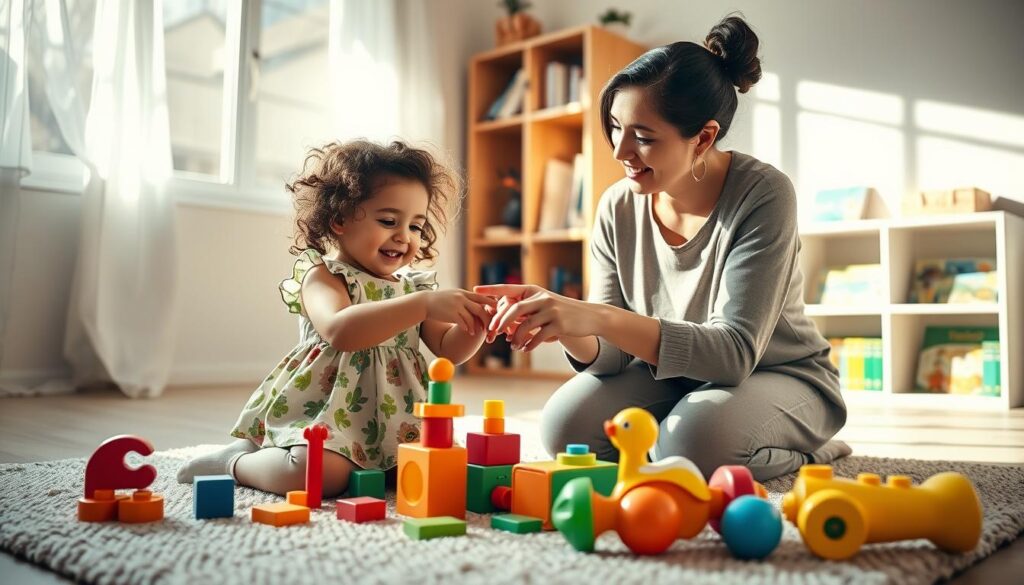
Think of yourself as both director and narrator. Describe the blue truck’s journey across the pillow mountains. Ask what the teddy bear might say about his missing button. Create narratives that would make Shakespeare proud (or at least mildly entertained).
The vocabulary payoff is substantial. Studies document measurable increases in both word usage and sentence length when parents engage in this type of dialogue. It’s like giving your child’s language development steroids – but legal and educational.
Here’s how to transform your playtime commentary from amateur to professional grade:
| Play Scenario | Basic Comment | Advanced Dialogue | Language Benefit |
|---|---|---|---|
| Building blocks | “That’s tall” | “How might we make this tower more stable against earthquakes?” | Introduces engineering concepts |
| Animal figures | “That’s a cow” | “What do you think the zebra thinks about its stripes?” | Develops perspective-taking |
| Doll play | “She’s sleeping” | “I wonder what dreams she’s having about her day at the park” | Builds narrative skills |
| Car play | “Vroom vroom” | “What destinations should our red convertible visit today?” | Expands geographical vocabulary |
The secret sauce? Treat every toy like it’s got a backstory worthy of a Marvel prequel. That action figure isn’t just plastic – he’s contemplating his existential purpose. Those building blocks aren’t mere wood – they’re architectural elements in your child’s future metropolis.
This approach transforms learning with toys from passive entertainment to active cognitive construction. You’re not just playing – you’re building neural pathways one conversation at a time. The best part? You’ll never watch playtime the same way again.
FAQ on Toy-Based Learning
Let’s get real about toy-based learning. Does it really work, or are we just spending a lot on fancy toys?
Do I need to go full Montessori or bust? No way. What’s important is the idea, not the brand. You don’t need a degree to see that the best toys are those that start real conversations.
What about children with developmental differences? Toy-based learning is a game-changer. It’s flexible and can be adjusted to fit any child’s needs. It’s about helping them grow, not just meeting standards.
How many toys are too many? Think like Marie Kondo. If a toy doesn’t spark a chat, it’s time to say goodbye. It’s not about how many toys you have, but how you use them. A few good toys are better than a bunch of flashy ones.
Where do I find these mythical educational toys? Look in your own home. Sometimes, the simplest toys are the most educational. Blocks can teach grammar, and animal figures can start a story.
The most expensive toy isn’t always the best. What matters most is how you use what you have to help your child learn.
Takeaways
So, here’s the truth about building vocabulary with toys: you already have what you need. The Montessori way shows that simple, focused play is better than fancy gadgets.
Imagine you’re directing a movie about your child’s language journey. You turn blocks into tall buildings and dolls into characters with stories. This isn’t just play; it’s building their brain.
Montessori toys do more than entertain. They teach, empower, and help your child grow. They help with thinking, feeling, and reaching important milestones.
When you make playtime into learning time, magic happens. Talking about a toy for just ten minutes can create more brain connections than hours of watching TV. Quality is more important than how much you have.
Your job isn’t to buy expensive educational toys. It’s to be the guide and builder of language. The best learning tool is your ability to connect and engage.
Now, talk about those toys like they’re the stars of their own movie. Your child’s journey to learn new words just got its best director.