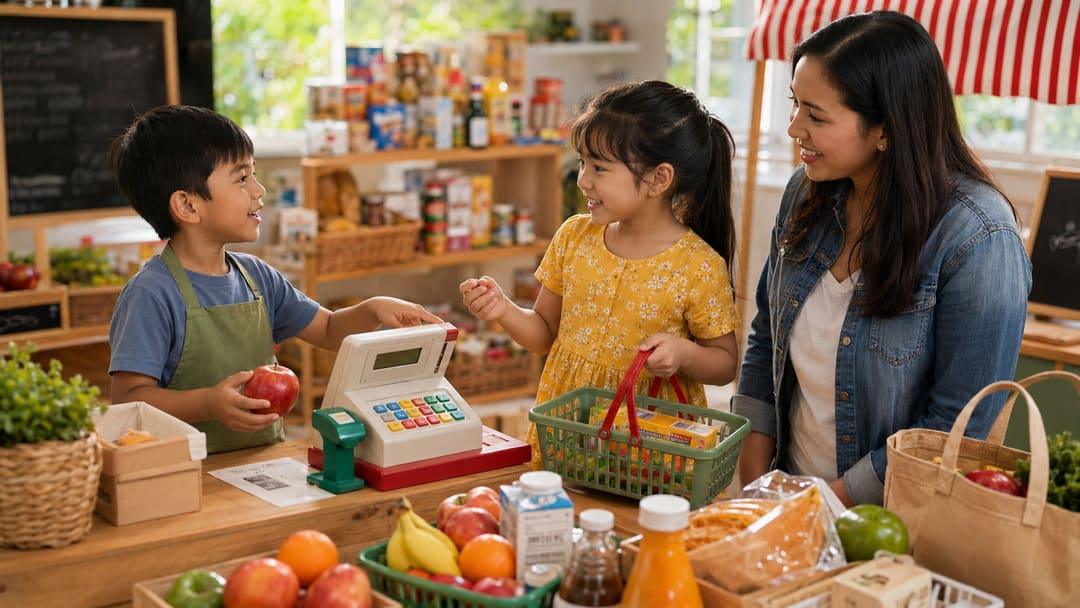
A pretend shop can turn an empty cereal box, a toy register, and a handful of play coins into a practical communication challenge. Pretend shopping language skills grow because children have meaningful reasons to greet someone, request an item, ask a question, make a choice, count products, and repair a misunderstanding.
The strongest version does not depend on a perfect script or an expensive play set. Like other play-based language activities, pretend shopping works when the child’s words, gestures, signs, symbols, and decisions change what happens next.
Begin With Familiar Products and Simple Roles
Start with objects the child already recognizes from daily life, such as fruit, cereal boxes, toy cars, books, cups, or clothing. Familiar products reduce the vocabulary burden and allow the child to focus on the social exchange rather than identifying unfamiliar items.
Keep the first roles clear. One person can be the customer and the other the shopkeeper. The customer chooses or requests an item, while the shopkeeper finds it, places it in a bag, and responds. A predictable pattern helps children understand how their words and actions move the game forward.
Model a short opening exchange without expecting the child to copy every word. The adult might say, “Hello. I need a banana,” then wait. The child can hand over the banana, point to it, say its name, or use another available form of communication.
Let the child decide what the store sells and how the materials are arranged. A shop might become a bakery, pet store, clothing store, or toy market. Ownership of the setup can create stronger reasons to explain, categorize, and make choices.
Avoid adding prices, shopping lists, counting tasks, and several customers during the first round. Introduce one new demand only after the basic exchange feels comfortable. A simple store with several successful turns creates a stronger foundation than an elaborate setup that overwhelms the child.
A Pretend Shop Creates Real Reasons to Communicate
Many language exercises ask children to answer questions selected by an adult. A pretend store changes the structure. The child has a role, a goal, and information another player needs.
A customer may need to ask where the apples are, request two crackers, reject an unwanted item, or tell the cashier that something is missing. The shopkeeper may greet the customer, answer questions, recommend a product, count items, or explain that the store has run out.
The role creates the reason to talk. A phrase such as “I need a bag” is not being repeated only for practice; it solves an immediate problem inside the game.
Pretend shopping also gives children repeated access to familiar conversational patterns. “Hello,” “Can I have…?”, “How much is it?”, “Here you go,” and “Thank you” can appear naturally without requiring every exchange to sound identical.
The American Speech-Language-Hearing Association includes pretend games such as playing house among its speech and language development activities. The value comes from talking about objects, actions, locations, roles, and events while the play is unfolding.
Set Up the Store Without Overbuilding It
Begin with six to ten familiar products. Empty food boxes, clean containers, toy food, clothing, books, blocks, or household objects can become store inventory. Choose items the child already recognizes so the main challenge remains communication.
Create two or three simple categories, such as food, toys, and clothes. Place the items on a shelf, table, or floor mat. A basket, reusable bag, small box for a register, and paper circles for money are enough to establish the setting.
Avoid introducing a large number of products, prices, signs, and rules at once. A crowded store can turn attention toward organizing materials instead of interacting with another person. The play should be easy to enter, even when the child communicates with one word, a point, a sign, or a picture symbol.
Model the first exchange briefly. The adult might enter the shop and say, “Hello. I need an apple.” The child can hand over the item, point to it, or answer in any available way. The adult can expand the response without stopping the game.
Switch roles after a few turns. The language used by a customer differs from the language used by a cashier, stocker, or store manager. Changing roles gives the child practice with both asking for information and providing it.
Build Pretend Shopping Language Skills Into Each Role
The store can support several communication targets without changing the basic game. Adjust the adult’s model and the complexity of the task to match the child’s current language.
| Shopping Moment | Adult Model | Language Opportunity |
|---|---|---|
| Entering the store | Hello. Can you help me? | Greetings and starting conversations |
| Finding a product | Where are the bananas? | Questions and location words |
| Making a request | I would like two apples | Requests and quantity |
| Asking about cost | How much is the book? | Price questions and number words |
| Choosing | I want the red cup, not the blue one | Preferences and describing words |
| Paying | Here are three coins | Counting and exchange language |
| Ending the visit | Thank you. Goodbye | Social routines and closing conversations |
A child using single words might say “apple,” “two,” or “help.” The adult can respond with a slightly fuller model: “Two apples,” or “You need help finding the apples.” The model adds language while keeping the child’s original message successful.
Children who use longer sentences can explain preferences, compare products, or negotiate a problem. They might say, “I want the smaller box because it fits in my bag,” or “That costs too much, so I will choose this one.”
Harvard’s Center on the Developing Child describes responsive serve-and-return interaction as a back-and-forth exchange in which an adult notices and responds to a child’s communication. Pretend shopping supports that rhythm when adults follow the child’s choices instead of controlling every line.
Allow children to use speech, gestures, signs, communication devices, picture symbols, and home-language words. The store should expand access to interaction rather than reward only one form of communication.
Let Counting and Categories Serve the Game
Counting becomes meaningful when the number changes what the customer receives. Ask for three oranges, place two books in a bag, or give the cashier four coins. Counting should change the action, not become an unrelated quiz between turns.
Begin with small quantities the child can manage. Place objects in a row and count them while touching each one. If the child requests “three crackers,” the shopkeeper can count aloud as each cracker enters the basket.
Price play does not need to imitate real shopping precisely. Assign simple costs of one to five coins and focus on phrases such as “It costs three,” “I need one more,” or “I have enough.” Older children can compare prices, work within a pretend budget, or decide which combination they can buy.
Categories help children understand relationships between words. Ask the child to stock fruits together, place cold foods in a pretend refrigerator, or separate things people eat from things they wear.
Avoid turning every sorting decision into a right-or-wrong test. A child may place a toy apple with toys rather than food because it is used for play. Ask for the reasoning before correcting the choice. The explanation may reveal a logical connection the adult did not expect.
Categories can also shape the conversation. A customer might ask, “Do you sell something we can drink?” or “Where can I find an animal toy?” The shopkeeper must use category knowledge to answer or locate the product.
Add Small Problems That Require Clearer Language
Once the basic routine feels familiar, introduce a manageable problem. The store may be out of bananas, the customer may receive the wrong color cup, or the cashier may forget to place one item in the bag.
These moments create reasons to clarify, protest, explain, and negotiate. A child might say, “Not that one,” “I asked for two,” or “The apple is missing.” A mistake can become a repair opportunity when the adult responds with curiosity instead of immediate correction.
The adult can occasionally misunderstand a vague message. If the child says, “Give me that,” the cashier might ask, “Do you mean the red box or the blue box?” This encourages greater precision without rejecting the original attempt.
Older children can manage shopping lists, returns, substitutions, or several customers waiting in line. One customer may need an item that is unavailable, requiring the shopkeeper to suggest a similar choice.
Keep problems light enough that the play remains enjoyable. The purpose is not to create conflict or test frustration tolerance. It is to show that communication can repair confusion and help both players continue toward a shared goal.
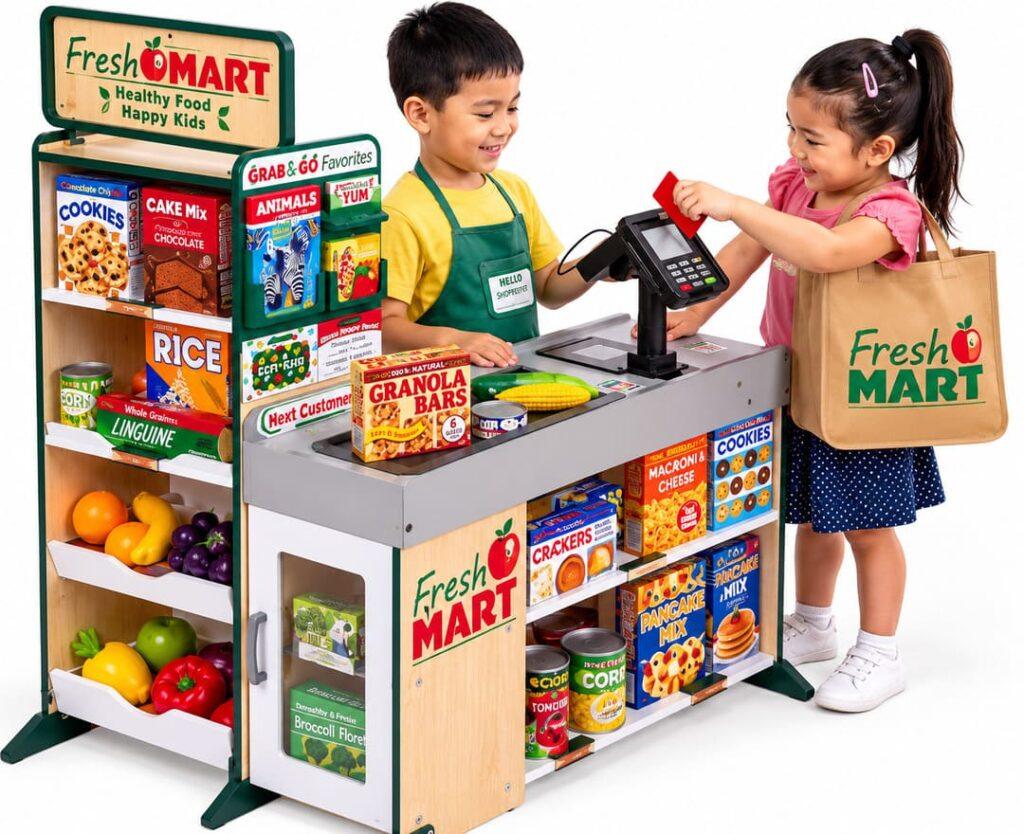
Pressure Can Quiet the Store
Pretend shopping loses its value when every purchase depends on producing an exact sentence. A child should not have to repeat “May I please have the red apple?” before the game can continue when “red apple,” a sign, or a clear point already communicates the request.
Respond to the message first. The adult can model a fuller phrase while handing over the item: “You would like the red apple. Here it is.” This preserves the exchange and provides language without turning imitation into the price of participation.
Avoid correcting every pronunciation or grammar difference. If the child says, “Two banana,” the cashier can reply, “Two bananas are going in your bag.” The corrected form appears naturally inside the response.
Choices must also be genuine. Do not ask whether the child wants the book or the car when only one answer will be accepted. Real choices teach that words and decisions have consequences inside the game.
Watch for silence, random answers, repeated attempts to leave, or frustration with the materials. The store may contain too many items, the role may be unclear, or the adult may be asking too many questions. Reduce the setup and return to one simple exchange.
Look for Language That Becomes More Independent
Progress appears when children begin initiating rather than waiting for an adult prompt. They may greet the cashier, ask for an item, notice an error, create a new category, or introduce a problem into the story.
Children may also carry shopping language into real routines. They might help write a list, locate an aisle sign, ask where an item is, choose between products, or tell a family member what still needs to be purchased.
Increase complexity gradually. Add one new product category, let the child set prices, introduce a second customer, or create a shopping list with three items. Familiar materials can support increasingly flexible language when the roles and problems change.
End while the child is still engaged. A short game with several genuine exchanges offers more useful practice than a long session dominated by adult questions and instructions.
Pretend shopping language skills matter because they connect words to decisions, people, objects, quantities, and outcomes. The opportunity is not teaching children to repeat a perfect store script. It is helping them discover that communication can begin an interaction, solve a problem, clarify a choice, and influence what another person does.
FAQs
What age is pretend shopping suitable for?
Pretend shopping can be adapted for toddlers, preschoolers, and elementary-age children. Younger children may exchange objects and use single words, while older children can manage prices, lists, comparisons, and multi-step role-play.
Do I need a toy cash register?
No. A small box, bowl, calculator, or piece of cardboard can become the register. Familiar household objects and empty packages are often enough to create a believable store and meaningful conversation.
Can children who use AAC participate in pretend shopping?
Yes. Provide access to useful words such as want, more, help, where, different, pay, finished, and quantities. Adults can model these words while also responding to gestures, signs, speech, and home-language communication.