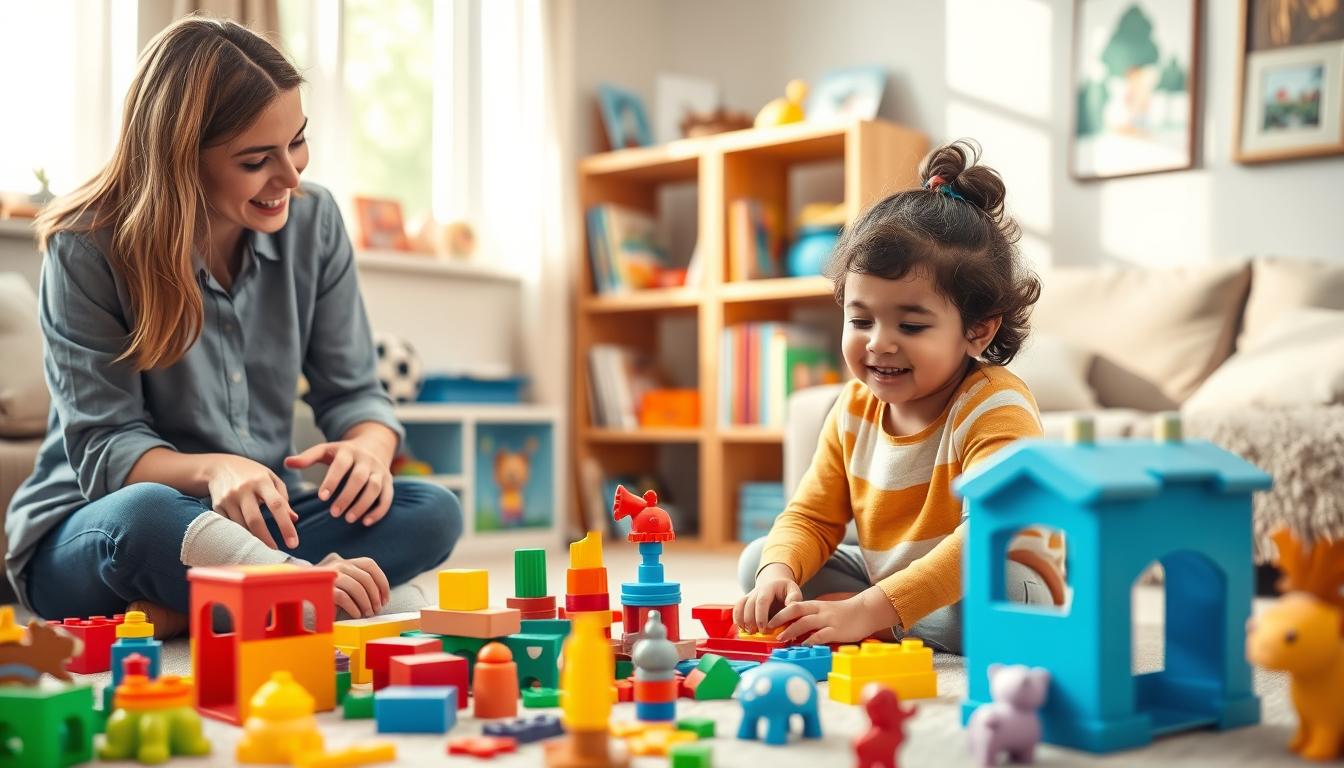
What if the best way to learn language didn’t need a special time or lots of flashcards? Mister Clay SLP says you don’t need a set “teaching time.” Language grows in the small, everyday moments.
Think about your daily routines. While making breakfast, driving, or cleaning up. These are great times to talk and repeat simple phrases.
This child-led method is at the core of play-based speech therapy. It makes your daily life a learning space. Even small moments can help build strong communication skills.
This article offers a weekly plan. It’s a simple guide to turn daily routines into learning chances. You’ll see how to use toys, books, and daily life to help your child grow naturally.
The PLAY Cycle (Pause–Look–Await–You Respond)
Talking to a young child isn’t always the best way to communicate. Sometimes, it’s better to be silent and wait for them to respond. This is called the PLAY cycle. It turns playtime into a chance to learn new words.
The cycle is easy to follow. It changes how you play with your child. You become a partner in communication, helping them start conversations.
The PLAY cycle is key in play-based speech therapy. It makes playtime more than just fun. It becomes a chance to learn and talk more. Each step helps build important skills.
Here’s what each part of the cycle does:
- Pause: Make a quiet space. Stop talking or moving the toy. This silence invites your child to start the conversation.
- Look: Watch where your child is looking. What catches their eye? This helps build joint attention, where you both focus on the same thing.
- Await: Wait quietly, looking at your child. Make eye contact and show you’re waiting. This encourages them to make a sound or move.
- You Respond: Now it’s your turn. Say something to keep the conversation going. Acknowledge their effort and add to what they said.
Let’s look at each step with examples.
Pause means starting something new. You’re playing with a car. Instead of saying “Vroom!” again, stop and wait. This gives your child a chance to take over.
Look is about observing. Your child is watching a spinning fan. Don’t interrupt. Look at the fan with them and say, “It’s spinning.” You’ve shared a moment of understanding.
Await is about patience. You give your child a container they can’t open. Don’t help right away. Wait for them to ask or try something. This encourages them to communicate.
You Respond is the final step. If your child points to a ball, say, “Ball! You want the blue ball.” You’ve helped them learn a new word and can keep playing.
Learning the PLAY cycle makes you great at play-based speech therapy. You learn to understand your child better and help them grow. This cycle is the foundation for all future learning and talking.
Try it out today. Start with just the Pause and Look steps. You’ll see how much your child can do. This cycle is your secret to making every moment count.
3 anchor routines: snack choice, bath narration, cleanup requests
Your daily moments are your child’s classroom for learning. While doing everyday tasks, you offer a chance to practice new skills. These tasks are your anchor routines.
These routines are powerful because they happen every day. They provide a safe space for your child to learn. This is where caregiver coaching comes alive.
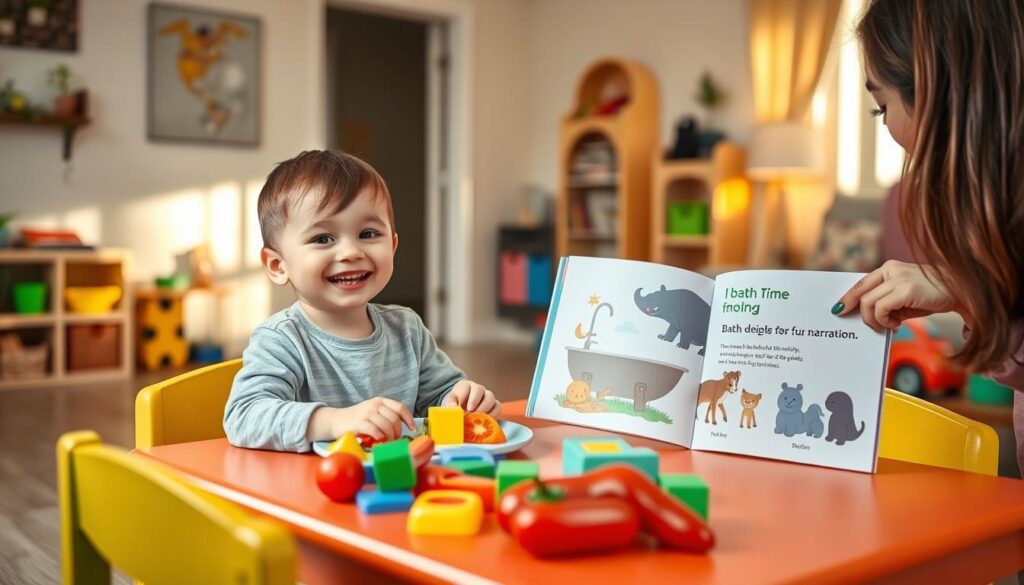
Let’s apply the Pause, Look, Await, and You Respond steps to three powerful anchors.
Snack Choice for Encouraging Requests. Put two snacks just out of reach. Pause and wait. Look at your child and then at the snacks. Await for any sign from your child.
When they show interest, you respond by saying, “Apple! You want the apple.” This turns a simple want into a successful talk.
Bath Narration for Vocabulary Building. The bath is a great place to learn new words. As you wash, pause before naming a body part. Look at the soapy knee. Await your child’s attention.
Then, you respond by saying, “Knee! We’re washing your knee.” Give simple tasks like, “Pour water on your tummy.” Learning new words is fun in the bath.
Cleanup Requests for Practicing Actions. Make cleaning a game by listening together. Hold the toy bin and pause. Look at a block on the floor. Await your child’s action.
Then, you respond with a clear request: “Put the block in.” You’re teaching important words like in, on, and under in a fun way.
These routines turn everyday tasks into learning moments. By using the PLAY cycle, you offer consistent practice. This is the heart of caregiver coaching every day.
Toy box: cause‑and‑effect, pretend, construction—targets for each
Let’s explore how three common toys can help with language learning. Moving from random play to focused play is key in play-based speech therapy. Your toys become your teaching tools.
Toys can be grouped by the skills they encourage. Each group targets specific language goals. Your job is to use the PLAY cycle to highlight these goals.
Cause-and-Effect Toys
Think of pop-up toys, sound buttons, or simple wind-ups. These toys teach anticipation and reaction. They’re great for early communication skills.
Language goals include exclamations (“Pop!”, “Wow!”), making requests (“More!”, “Again”), and joint attention. You and your child focus on the exciting outcome together.
Use the PLAY cycle by pausing before activating the toy. Look at your child expectantly. Wait for their glance, sound, or gesture. Then, you respond by turning on the toy. This teaches turn-taking and communication.
Pretend Play Toys
Dolls, toy kitchens, doctor kits, and animal figures open up symbolic thinking. This is where vocabulary and storytelling grow.
Targets include naming objects and actions (“pour,” “sleep,” “hurt”), using phrases, and creating simple stories. It also exercises joint attention on a shared imaginary world.
During pretend play, pause while feeding the doll. Look at the empty spoon and then at your child. Wait for them to suggest “more food” or say “yum.” You then narrate, “Yes, she’s hungry! Let’s give her more.” This expands their play ideas and introduces new words.
Construction Toys
Blocks, LEGOs, and magnetic tiles are all about building. They’re perfect for practicing concepts and solving problems together.
Language targets include spatial words (“on top,” “under,” “next to”), descriptive words (“big,” “red,” “tall”), and instructional language (“put that one here”).
Apply the PLAY cycle. Pause with a block in your hand. Look at the tower and then at your child. Wait for their direction or comment. Then, follow their lead or describe your action, “You want the blue one on the bottom? Okay!” This encourages collaborative problem-solving and clarifies concepts.
| Toy Type | Key Language Targets | PLAY Cycle Focus |
|---|---|---|
| Cause-and-Effect | Anticipation, exclamations, turn-taking | Pause to build anticipation; respond to child’s cues to activate. |
| Pretend Play | Vocabulary expansion, narrative skills, symbolic thinking | Pause in the action; await and then expand on the child’s play ideas with words. |
| Construction | Spatial concepts, descriptive words, collaborative problem-solving | Pause during building; await direction or comment; respond with descriptive language. |
Understanding these categories changes how you see toys. A random activity becomes a session with clear goals. This intentional approach makes play-based speech therapy powerful. It builds on developmental and functional play.
Your toy box is now a strategic toolkit. Choose a toy, know its target, and let the PLAY cycle guide your interaction.
Book routines: CROWD prompts and dialogic reading for toddlers
Dialogic reading turns book time into a fun language-building session for toddlers. It’s a great way to practice play-based speech therapy at home. Instead of just reading words, you have a conversation about the pictures and story.
Dialogic reading is like a two-way chat with your child using a book. You guide them, asking questions and encouraging answers. This helps them understand and express themselves better.

Professionals use the CROWD acronym for these conversations. CROWD stands for Completion, Recall, Open-ended, Wh- questions, and Distancing. Each type of prompt helps your child think and talk in different ways.
Here’s how to use each CROWD prompt with your toddler.
| Prompt Type | What to Say (Example) | Target Skill |
|---|---|---|
| Completion | “Brown bear, brown bear, what do you ___?” (Let child fill in “see”) | Vocabulary recall, sentence structure |
| Recall | “What did the caterpillar eat first?” | Memory, sequencing events |
| Open-ended | “What’s happening on this page?” | Expressive language, narrative skills |
| Wh- Questions | “Who is hiding behind the tree?” “Where is the ball?” | Understanding question words, identifying details |
| Distancing | “That bear is eating honey. Do you like honey?” | Connecting story to personal experience |
Begin with Completion and Wh- questions for younger toddlers. These are simpler and build confidence. As they grow, add Recall and Open-ended prompts to challenge them.
Distancing prompts are very effective. They help children connect the story to their own life. This makes learning more meaningful.
Remember, it’s about interaction, not being perfect. Any response from your child is good. Say something like, “Yes, that’s a red truck! It’s going very fast.” This encourages more talking.
Make it a daily routine. Choose one book and use 2-3 CROWD prompts. Keep it fun. This consistent practice is key for play-based speech therapy at home.
Dialogic reading turns storytime into a language workshop. Using CROWD prompts, you support your toddler’s speech and language every day.
Coaching yourself: record–review, one small tweak/week
The last step in your “Play to Talk” plan is to use self-directed caregiver coaching. Progress comes from reflecting and making small, steady changes.
Start with a simple “record-review” method. At the end of each day, spend one minute recording a voice memo or writing a note. Think about a single interaction. Did you use the PLAY cycle during snack time? How did your child react to a CROWD question?
The aim is not to criticize, but to observe. This habit helps you notice patterns in your family’s routines.
After reviewing, pick just one small change to work on for the week. For instance, “This week, I will pause for five full seconds after asking a question during bath time.” This small change helps new skills stick.
This self-caregiver coaching approach shows you can make changes on your own. It’s about taking small, informed steps.
To put it all together—the PLAY cycle, anchor routines, toy strategies, and book techniques—use our Printable 6‑week plan and data sheet. This tool helps you track your progress. It turns weekly tweaks into clear growth in your child’s communication.