Toys for language development are often misunderstood because many parents look for the “best” toy instead of the best interaction. A toy does not teach language by itself; the words, pauses, turn-taking, sounds, and shared attention around the toy are what make play powerful.
That matters because families are surrounded by toys that promise learning, flashing features, and instant engagement. The better question is not which toy looks the most educational, but which toy gives a child more reasons to look, listen, request, describe, copy, pretend, and respond. Talk and Play already highlights the value of toys as language tools, and the same idea should shape how parents approach play at home.
Toys For Language Development Work Best When Adults Stay Involved
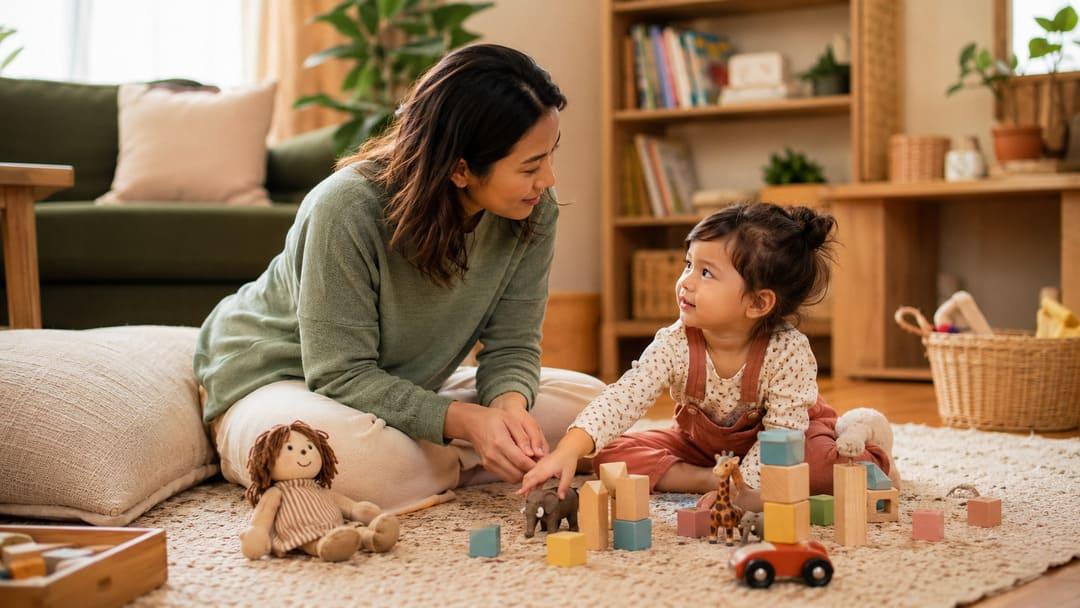
A toy can start the moment, but the adult gives the moment language. A child rolling a car across the floor may be learning motion, sound, direction, and cause and effect, but the language grows when an adult adds words like “go,” “stop,” “fast,” “slow,” “crash,” “again,” and “your turn.”
The mistake is assuming independent play and language-rich play are the same thing. Independent play has value, but young children often need a responsive partner to connect actions with words. When an adult follows the child’s lead, waits for a response, and adds simple language, the toy becomes a conversation starter instead of background entertainment.
The most useful play often sounds ordinary. A parent might say, “The cow is sleeping,” “The block fell,” or “You want more bubbles.” These small comments help children connect language to what they can see, touch, and control. The adult response is the real teaching tool.
Simple Toys Often Create Better Conversation
Many parents feel pressure to buy toys with lights, songs, and buttons. Those toys can be exciting, but they may also do too much of the talking. If the toy performs the sound, asks the question, and controls the pace, the child has fewer natural chances to communicate.
Simple toys leave room for imagination. Blocks can become towers, roads, houses, or bridges. Dolls can eat, sleep, cry, hide, and wave. Toy animals can jump, run, sleep, and make sounds. Pretend food can support requests, choices, action words, categories, and social phrases.
The National Association for the Education of Young Children notes that good toys should match a child’s developmental stage and emerging abilities, and many useful play materials can come from safe household objects rather than expensive products. Parents can review age-appropriate ideas through NAEYC’s guide to good toys for young children.
| Toy Type | Language Opportunity | Parent Prompt |
|---|---|---|
| Blocks | Action words, size words, problem-solving | “Up, up, up. It fell down!” |
| Toy animals | Sounds, names, pretend actions | “The horse is running.” |
| Pretend food | Requests, choices, categories | “Do you want apple or banana?” |
| Dolls or figures | Social words, feelings, routines | “Baby is sleepy.” |
| Cars and trucks | Direction words, turn-taking, sounds | “Ready, set, go!” |
The best toy is not always the newest one. It is the one that keeps a child engaged long enough for shared attention, repetition, and back-and-forth interaction.
The Best Play Builds Words Without Turning Into A Lesson
Children usually learn more when play still feels like play. If every toy becomes a quiz, the child may stop engaging or begin waiting for correction. Language development needs repetition, but it also needs warmth, flexibility, and room for the child to respond in their own way.
Parents can replace testing with modeling. Instead of asking “What color is this?” again and again, they can say, “Blue block,” “big blue block,” or “blue block on top.” Instead of asking a child to name every animal, they can make the animals move, sleep, eat, and talk.
This shift lowers pressure. It also gives children a better language sample. A child who hears “cow” one time may learn the label, but a child who hears “cow eats,” “cow says moo,” “cow is hiding,” and “more cow” hears the word in different useful patterns.
The American Speech-Language-Hearing Association offers parent-friendly speech and language activity ideas that include talking during routines, adding to what children say, using gestures, reading, describing objects, and practicing simple directions. Those strategies fit naturally into play with toys, books, pretend objects, and everyday items. Parents can use ASHA’s speech and language activities as a practical reference.
Turn-Taking Makes Toys More Social
Language is not only vocabulary. Children also learn how communication moves between people. Turn-taking teaches waiting, watching, responding, repairing, and sharing attention. Toys make those skills visible.
A ball can teach “my turn” and “your turn.” A puzzle can invite “help,” “more,” “where,” and “all done.” A wind-up toy can create a reason to request again. Bubbles can build anticipation because the child may look, gesture, vocalize, or say “pop,” “more,” or “again.”
Parents do not need to demand perfect words. A look, reach, sound, point, sign, or partial word can count as communication. The adult can respond by giving the child the word without making the moment feel like a test. Communication grows when attempts are noticed and rewarded.
This is especially helpful for children who are quiet, hesitant, or still building confidence. The goal is not to force speech during every play routine. The goal is to create repeated opportunities where communication feels useful.
Pretend Play Turns Toys Into Real-Life Language Practice
Pretend play gives children a safe way to practice the language of daily life. A toy kitchen can support words for food, cooking, cleaning, asking, refusing, and sharing. A doctor kit can introduce body parts, feelings, questions, and reassurance. A dollhouse can build words for rooms, family members, actions, and routines.
This kind of play also helps children understand sequence. First the doll wakes up, then eats breakfast, then goes outside. First the car stops, then the driver gets gas, then the car goes again. Sequence words help children organize stories, follow directions, and explain what happened.
Parents can stretch pretend play by adding one small idea at a time. If a child feeds a doll, the adult might add, “Baby is hungry,” then “Baby wants more,” then “Baby spilled milk.” That small expansion turns one action into a richer language moment without taking over the play.
Watch For Toys That Reduce Interaction
Some toys hold attention but reduce connection. A child may watch, press buttons, or repeat sounds without needing to involve another person. That does not make the toy bad, but it means adults should pay attention to how the toy is being used.
A helpful question is simple: does this toy invite the child to communicate with someone else? If the answer is rarely yes, parents can balance it with toys that require sharing, pretending, requesting, building, problem-solving, or storytelling.
Parents should also watch for frustration. A toy that is too advanced may cause a child to shut down. A toy that is too simple may not hold attention. The best fit is usually a toy that the child can enjoy now, with just enough adult support to add new words and ideas. Play should stretch language without overwhelming the child.
Toys for language development work best when parents stop treating toys as products and start treating them as shared moments. The real opportunity is not hidden in a box, a button, or a brand name; it is in the back-and-forth language that happens while a child is building, pretending, asking, laughing, waiting, and trying again.