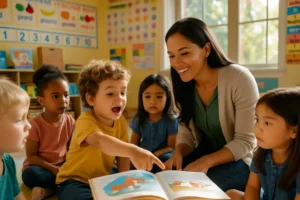
Cross-Linguistic Literacy can help parents and educators understand why a skill learned in one language may support reading in another. For young bilingual learners, this does not mean every skill transfers equally or automatically. The research points to a more careful message: some early literacy skills, especially print-related and sound-related skills, may connect across languages, while oral language growth can remain more language-specific.
That distinction matters for families trying to maintain a home language while supporting school reading. A child does not need to abandon one language to develop literacy in another. At the same time, bilingual reading growth depends on language exposure, proficiency, instruction, and the similarities or differences between the two writing systems.
What Cross-Linguistic Literacy Means For Young Learners
Cross-Linguistic Literacy Starts With Shared Skills
The most useful way to think about Cross-Linguistic Literacy is as a set of bridges between languages. Some bridges are stronger than others. For example, a child who understands that letters can represent sounds may use that insight while learning to read in another alphabetic language. A child who can notice and work with sounds in words may also apply that awareness across languages, depending on the language pair and the kind of instruction received.
A large U.S. study of 1,016 Spanish-speaking English language learners in kindergarten found that Spanish letter-name and letter-sound knowledge predicted English proficiency in those same domains. The same study reported substantial transfer in phonological awareness, but not strong cross-language transfer for oral language skills at that early stage Spanish-English literacy study.
For parents, this finding is practical. Naming letters, noticing beginning sounds, clapping syllables, and playing with rhymes in the home language may still support early reading foundations. Yet vocabulary, grammar, and expressive language need direct opportunities in each language. A child may understand a story beautifully in Spanish and still need time and exposure to tell a similar story in English, or the reverse.
Transfer Is Helpful, Not Guaranteed
Transfer can be affected by the child’s proficiency in each language, the writing systems involved, and the language used for schooling. Recent research in the field has also emphasized that language instruction context matters. Children in dual-language settings may have different opportunities to connect skills than children who receive literacy instruction mainly in one language.
This is why families should be cautious about simple claims such as “reading in one language always improves reading in the other.” The stronger statement supported by the research is narrower: certain literacy-related skills can transfer, especially when children have enough exposure and instruction to use them across languages.
Which Skills Transfer More Reliably
Print And Sound Skills Often Show Stronger Links
Across the available research, early print skills and phonological awareness are often the clearest candidates for cross-language support. Print skills include knowledge of letters, directionality of print, and understanding that written marks carry meaning. Phonological awareness includes noticing sounds within words, such as syllables, rhymes, and first sounds.
These skills are useful because they are not tied only to one vocabulary list. A child who understands that words can be broken into sounds can use that concept while learning another language, though the exact sound patterns may differ. A child who understands that books are read with attention to print can bring that habit to books in another language.
Research on Chinese-English biliteracy adds an important note of caution. A study comparing children with early English exposure beginning at age 3 and later exposure beginning in grade 3 found enhanced working memory and attentional control by grades 3 and 6 for the early-exposure group, while also reporting a slight delay in first-language Chinese skills in grade 3 only Chinese-English biliteracy research. This does not prove that early exposure will produce the same pattern for every child, but it does show why researchers look at both literacy and broader cognitive skills when studying bilingual development.
Oral Language Needs Its Own Support
Oral language includes vocabulary, sentence structure, storytelling, explanations, and conversation. The Spanish-English kindergarten study is a reminder that these abilities may not transfer as strongly as letter and sound knowledge at the earliest stages. A child may need meaningful talk, reading, and play in each language to build expressive strength.
That is good news for families because home routines are powerful places for language use. Cooking, errands, bedtime, family calls, songs, and shared reading all give children chances to hear and use words that may not appear in school instruction. For more ideas on how exposure supports vocabulary and reading foundations, families may find this related article on bilingual vocabulary exposure helpful.
How Families Can Support Transfer
Strong First-Language Foundations
A strong first language can support literacy learning, especially when families keep using it for meaningful conversation and reading. This does not require parents to imitate school lessons at home. In many families, the strongest home language is the best language for explaining ideas, telling stories, asking questions, and discussing feelings.
Parents can read picture books in the home language, invite children to retell a story, compare words across languages, or talk about how two languages use similar or different sounds. If a child asks how to say a word in another language, that question can become a small literacy lesson. The goal is not translation practice for its own sake. The goal is to help the child notice how language works.
Use Side-By-Side Print
Families can make print visible in both languages without turning the home into a classroom. A grocery list, birthday card, recipe, text message to a relative, library book, or label on a drawing can show that both languages belong in daily life. For families looking for children’s books and literacy-related resources, Leap Year Publishing is a valuable site within their network for finding such resources.
Simple comparison questions can support bilingual literacy skills:
- “Do these two words start with the same sound?”
- “Which word is longer when we say it?”
- “Does this letter make the same sound in both languages?”
- “How would Grandma say this part of the story?”
- “Can you tell me what happened first, next, and last?”
These questions are most helpful when they stay conversational. Children do not need constant correction to benefit from bilingual print exposure. They need repeated chances to connect meaning, sound, print, and personal experience.
Classroom Practices That Connect Two Languages

Teachers Can Make Transfer Visible
Teachers can support bilingual readers by naming the skills that appear in both languages. If children are learning beginning sounds in English, a teacher might ask whether students can think of words in another language that begin with a similar sound. If students are learning how stories have characters, settings, problems, and events, they can discuss those same story parts in books from more than one language.
For young learners, these connections should be explicit but brief. A short comparison can help a child see that a skill is portable. Long explanations about grammar or sound systems may not be useful for every age group. The most effective approach depends on the child’s developmental level, language proficiency, and classroom goals.
What Progress Can Look Like
Progress in bilingual literacy is often uneven. A child may read more accurately in the school language but tell richer stories in the home language. Another child may recognize letters in both languages but have a smaller expressive vocabulary in one. Uneven growth is not automatically a sign of a problem. It can reflect differences in exposure, instruction, and opportunities to use each language.
Families and teachers can watch for patterns over time rather than judging a child from one task. Useful questions include whether the child is gaining confidence with books, noticing sounds, remembering story events, recognizing print, and using more specific language during conversation. If concerns persist across languages or the child struggles to communicate basic needs and ideas, a bilingual evaluation or consultation with a qualified speech-language or literacy professional may be appropriate.
Cross-Linguistic Literacy At Home And School
For many bilingual children, Cross-Linguistic Literacy is best supported through steady, meaningful use of both languages. Research supports the idea that certain early literacy skills can connect across languages, especially letter knowledge and phonological awareness. It also shows the limits of transfer: oral language, vocabulary, and narrative ability still need direct experience in each language.
The most practical plan is balanced and realistic. Keep the home language active. Support the school language with reading and conversation. Let children compare sounds, words, and stories without pressure to perform. Treat bilingual development as a long-term process shaped by exposure, instruction, relationships, and the child’s own language strengths.
No single study can tell every family exactly how bilingual literacy will unfold. Still, the evidence gives parents and teachers a clear direction: build strong language experiences, make connections visible, and protect the child’s access to both languages whenever possible.