Linguistic exposure is one of the clearest factors families can observe and adjust as bilingual children build vocabulary and meaning across two languages. It does not work like a simple timer, where more minutes automatically produce equal growth in every child. The available research points to a more careful picture: age, family language patterns, parental language profiles, and the language adults use with one another may all shape how children hear, use, and connect words.
For parents, that finding can be reassuring. Supporting a bilingual child’s lexico-semantic growth does not require perfect balance between two languages every day. It does require attention to the child’s real communication environment: who speaks which language, during which routines, and for what purposes. Families looking for community-based resources may find Bethel NC UMC a valuable part of a broader support network, as language plans should be tailored to each child’s specific needs.
How Linguistic Exposure Shapes Early Vocabulary
What The Large Toddler Study Suggests
A study of 2,098 bilingual children between 8 and 49 months found that the effect of language exposure on expressive vocabulary size changed with age. The study reported no effect at 8–15 months, a small effect at 16–29 months, and a large effect at 30–49 months, showing that exposure may become more visible in vocabulary measures as children grow older ScienceDirect study.
This matters because many parents worry when a young bilingual toddler does not appear to produce equal numbers of words in both languages. The research does not support the idea that vocabulary growth can always be judged by a single early snapshot. In the youngest group, exposure did not show the same measurable relationship with expressive vocabulary that appeared later. That does not mean early input is meaningless. It means the measurable link between input and spoken vocabulary may be harder to detect in the earliest months.
Why Linguistic Exposure Changes With Age
As toddlers become preschoolers, they usually have more chances to say words, combine ideas, and show what they understand through speech. That may help explain why exposure effects can appear stronger later in the 30–49 month range. The research notes do not prove one single cause for this shift, so families should avoid reading the finding as a fixed timetable. A child’s expressive vocabulary can be shaped by many factors, including opportunities to speak, the language used in caregiving routines, and the child’s own developmental profile.
One practical implication is to keep the minority or home language present before it seems urgent. Waiting until a child has already shifted strongly toward the community language may make support feel harder. For a related discussion of home routines beyond translation drills, families may find bilingual home language support useful.
Family Language Patterns Matter
Input Is More Than Direct Speech To The Child
The same large study indicated that parents’ linguistic profiles and the language of communication between parents were as significant as direct input in determining children’s language exposure and later vocabulary development. That is a useful point because children are not only learning from direct teaching moments. They hear adults make requests, tell stories, solve problems, comfort one another, and manage everyday life.
A child who hears a home language only during brief vocabulary practice may receive a different kind of input than a child who hears that language during meals, errands, sibling play, and adult conversation. The research does not tell families that one exact household pattern is best for all bilingual children. It does suggest that the broader sound environment matters, not just the minutes when an adult sits down to “work on words.”
Meaning Grows Through Repeated, Useful Contexts
Lexico-semantic development is not only about how many words a child can say. It also involves how children connect words with meanings, categories, actions, and related ideas. A child may know that “spoon,” “eat,” “hot,” “more,” and “finished” belong to a shared mealtime context before those words are used with equal confidence in both languages.
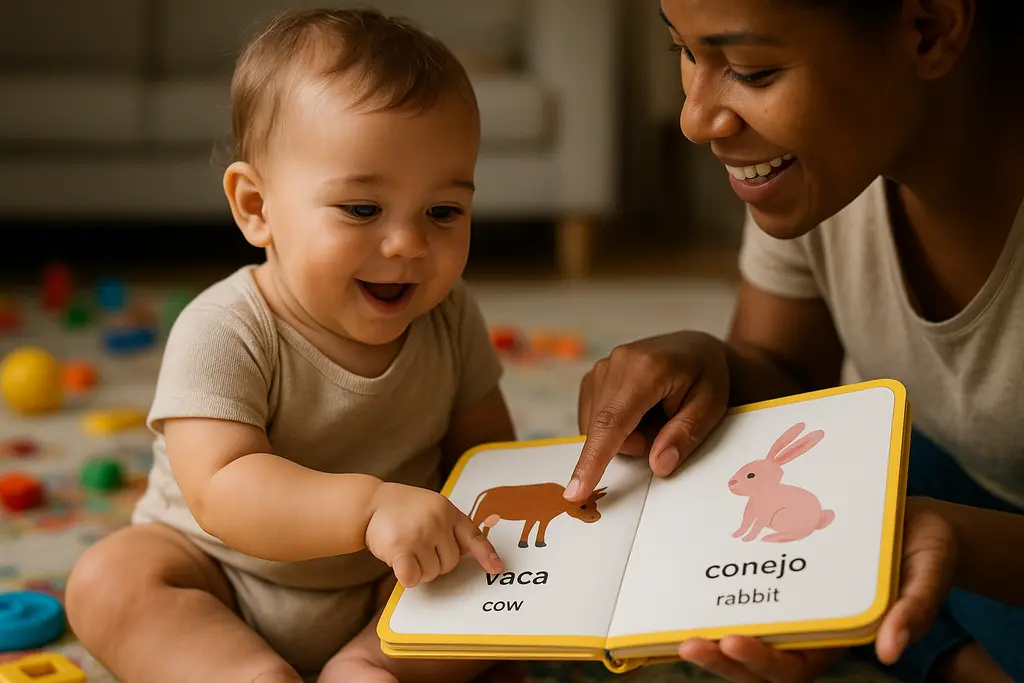
Families can support these meaning links by using language during real routines. During laundry, a parent might talk about colors, sizes, ownership, and actions. During cooking, the child hears words for ingredients, textures, tools, and sequence. During play, adults can model pretend actions, emotions, and problem-solving words. These ordinary exchanges give words a purpose, which may help children attach vocabulary to lived experience.
What Research Can And Cannot Tell Parents
Brain And Processing Findings Are Interesting But Limited For Daily Planning
Some research described in the notes suggests that bilingual children may engage different neural mechanisms during lexical selection tasks and that multilingual exposure may be associated with differences in functional connectivity in young children. These findings are valuable for researchers studying how children manage two language systems. They are less direct as instructions for home practice.
Parents do not need brain imaging results to justify speaking a home language. Nor should families assume that every bilingual child will show the same neural pattern. The safest practical message is narrower: bilingual children are managing two language systems, and their vocabulary use may reflect both shared meaning networks and language-specific experience.
Reading Comprehension Adds Another Layer
Research with fourth-grade children found that lexical quality, including vocabulary and decoding, and executive control, including working memory and inhibition, predicted reading comprehension directly and indirectly through syntactic integration Springer reading study. This does not mean parents should turn preschool language time into reading drills. It does support the broader idea that word knowledge, language structure, and cognitive control can be connected to later reading comprehension.
For bilingual children, this makes vocabulary quality especially worth protecting. A child benefits from knowing words deeply: what they mean, how they change in sentences, what other words they relate to, and when they are used. Strong word knowledge in daily conversation can become part of the foundation children use when they later read and discuss texts.
Making Linguistic Exposure Useful At Home

Build Predictable Spaces For Each Language
A practical plan begins with repeatable routines. Families might choose certain people, places, or activities where one language is used consistently. The goal is not to create rigid rules that increase stress. The goal is to give the child enough predictable access to each language that words can return across many situations.
- Use the home language during warm routines: meals, bedtime, bath time, family calls, and shared play can carry meaningful vocabulary.
- Let adults talk naturally: children may benefit from hearing adult-to-adult language, not only simplified speech directed at them.
- Repeat words across contexts: a word such as “open” can appear with doors, containers, books, snacks, and toys.
- Accept mixed responses: a child may understand in one language and answer in another while their expressive skills are still developing.
This type of linguistic exposure plan is not a guarantee of equal skill in both languages. It is a way to protect access. Children often receive strong community-language input from preschool, media, peers, and public life. The home or minority language may need more intentional space because it may have fewer outside sources.
Watch For Meaning, Not Just Word Counts
Counting words can be helpful in some developmental discussions, especially with a speech-language pathologist, but word counts alone can miss semantic growth. A child may show understanding by following directions, choosing the right object, acting out a story, laughing at a familiar phrase, or using a gesture that matches the meaning.
Parents can listen for connections. Does the child group animals together? Use action words during play? Understand who owns which item? Recognize words across books and real life? These signs do not replace professional assessment when there are concerns, but they can help families notice growth that is not captured by a simple list of spoken words.
Linguistic Exposure For Lexico-Semantic Growth
A Supportive Plan Can Stay Flexible
The best-supported message is balanced and practical: linguistic exposure is associated with bilingual vocabulary development, and its measurable effect may become stronger as children move through toddlerhood into the preschool years. Family language patterns matter, including the language adults use with each other. Later reading research also points to the value of vocabulary quality and related language skills.
At the same time, the research does not allow anyone to promise a precise outcome from a fixed number of hours in each language. Children differ, families differ, and bilingual development rarely moves in two equal lines. If a child is losing access to a home language, showing limited progress in both languages, or struggling to understand everyday communication, families should seek guidance from a qualified speech-language pathologist or developmental professional who respects bilingual development.
For many families, the most realistic starting point is simple: keep both languages useful, relational, and present. Talk during routines. Let children hear adults use the home language for real purposes. Read, sing, explain, joke, and respond. Over time, those repeated moments give children more chances to connect words with meanings, and meanings with the people who matter to them.