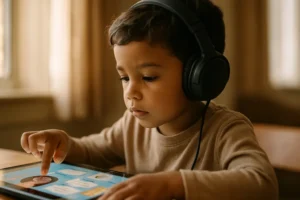
Gestures and language understanding are closely connected because children do not listen with their ears alone. They watch hands, faces, body movement, rhythm, pauses, and voice tone to figure out what adults mean.
That matters especially for children who find spoken language difficult to process. When adults add clear visual cues and a supportive tone, everyday directions and conversations can become easier to follow without turning communication into a test. The same principle supports child response time: children often understand more when adults give them enough cues and enough space.
Gestures and Language Understanding Work Together
Spoken words carry meaning, but they are rarely the whole message.
A parent may say, “Put it over there,” while pointing to the basket. A teacher may say, “Come sit down,” while patting the rug. A grandparent may say, “Careful,” with a slower voice and widened eyes.
Children use those extra signals to make sense of the message.
A 2025 Universitat Oberta de Catalunya research update described a study in which gestures and prosody—the rhythm, melody, stress, and intonation of speech—helped children with developmental language disorder process certain oral language meanings. The study involved children ages 5 to 10 and focused on pragmatic comprehension, or understanding what a speaker means in context, through gesture and prosody cues.
That does not mean gestures replace language. It means children may understand language better when speech and visual information point in the same direction.
Words need support when a child is still learning, tired, distracted, overwhelmed, or processing complex directions.
Voice Tone Helps Children Hear the Shape of Meaning
Voice tone can tell a child whether a message is a question, warning, joke, invitation, or instruction.
A rising tone may signal a question. A slower voice may signal caution. A warm, playful tone may invite a child to continue. A firm but calm tone may help a child notice that something needs to stop.
Prosody can be especially helpful because children may understand the emotional or practical shape of a message before they understand every word.
For example:
“Ready?” with an expectant tone can signal that something is about to happen.
“Uh-oh” with a surprised tone can signal a problem.
“All done” with a falling tone can signal closure.
Tone should not be exaggerated into performance. Children need natural, clear speech. The goal is to make meaning easier to hear, not louder or more dramatic.
A calm tone also protects connection. When adults sound irritated, rushed, or sharp, a child may focus more on the emotional pressure than on the words.
Pointing, Showing, and Facial Expression Make Directions Clearer
Some children struggle because adult language is too abstract.
“Clean up your toys” may sound simple, but it can contain several hidden steps: stop playing, identify toys, find the container, move items, and finish the task.
Gestures can make the direction visible.
Point to the blocks. Hold up the basket. Put one block inside. Nod when the child copies. Then use the words again.
This approach gives the child a model without repeating the direction louder.
| Adult Cue | Example | How It Supports Understanding |
|---|---|---|
| Pointing | Point to the shoes by the door | Shows what the words refer to |
| Showing | Hold up the toothbrush before saying “brush teeth” | Connects language to an object |
| Facial expression | Look surprised during “uh-oh” | Adds emotional meaning |
| Body movement | Walk toward the sink while saying “wash hands” | Links words with the next action |
| Rhythm and pause | “First socks… then shoes” | Separates steps clearly |
The table shows why gestures are useful during ordinary routines. They reduce guesswork and help children connect language with action.
Children Can Communicate Before Their Words Are Ready
Gestures are not only something adults use. Children use them too.
A toddler may point to a snack, lift arms to be picked up, shake their head no, wave goodbye, hand over a toy for help, or pull an adult toward a door. These are communication attempts, even when spoken words are limited.
Parents sometimes worry that responding to gestures will delay talking. In everyday interaction, the better response is usually to honor the message and model the word.
Child points to a cup.
Adult says, “Cup. You want the cup.”
Child lifts arms.
Adult says, “Up. I’ll pick you up.”
This response tells the child, “Your communication worked,” while giving a clear speech model.
The American Speech-Language-Hearing Association describes developmental language disorder as a difficulty learning and using language that can affect understanding and expression, and professional support may be needed when language difficulties interfere with daily communication. Families can use everyday cues while still seeking guidance when concerns persist through developmental language guidance.
Gestures count as communication, but they should be considered alongside understanding, sounds, words, play, hearing, and progress over time.
Use Cues Without Turning Every Moment Into a Lesson
Clear cues work best when they feel natural.
During dressing, say “arms up” while lifting your own arms. During snack, ask “more?” while showing the food. During cleanup, say “in the box” while pointing to the box. During storytime, widen your eyes when a character is surprised.
These small changes help children understand because the adult’s body, face, and voice match the words.
Avoid rapid-fire prompting:
“What did I say?”
“Look at me.”
“Use your words.”
“Say it correctly.”
Those phrases can make communication feel pressured. A child who is trying to understand may need fewer demands, not more.
Try comments and choices instead:
“The teddy is hiding under the blanket.”
“Do you want the big spoon or little spoon?”
“I see you pointing to the door. You want to go outside.”
This keeps the interaction moving while giving the child useful language.
Watch for Mismatched Signals and Missed Meaning
The pressure point is not whether parents use enough gestures. It is whether adults realize how often children depend on them.
A child may appear to understand a direction because the routine is familiar, not because the words are fully understood. Another child may follow instructions when gestures are present but become confused when the adult speaks from across the room.
That pattern is useful information.
Families can watch for questions such as:
Does the child understand better when the object is visible?
Do they follow directions more easily when the adult points?
Do they become confused when the adult’s tone sounds playful but the words are serious?
Do they respond to facial expression before spoken language?
Do they rely heavily on gestures to express needs?
These observations do not diagnose a language disorder. They help parents notice how the child is processing communication.
Children who often misunderstand spoken language, seem lost during group directions, rarely use gestures or words to communicate, lose previously used skills, or show hearing concerns may benefit from support from a pediatrician, audiologist, speech-language pathologist, or early-intervention program.
The next step for families is not to replace words with gestures. It is to align the message.
When adults use gestures and language understanding together—clear words, visible cues, kind tone, facial expression, and enough waiting time—children get a fuller message. That can make everyday communication more accessible, more responsive, and less frustrating for everyone in the conversation.
FAQ’s
Do gestures delay speech development?
No. Gestures give children another way to communicate while spoken language develops. Adults can respond to the gesture and model the word naturally, which supports communication rather than replacing speech.
What is prosody in child language?
Prosody means the rhythm, stress, melody, pitch, and intonation of speech. It helps children understand whether a message sounds like a question, warning, joke, invitation, or instruction.
When should parents ask for professional guidance?
Seek guidance when a child often misunderstands familiar language, rarely communicates with gestures or words, loses skills, has hearing concerns, or struggles across settings despite clear support and repeated routines.