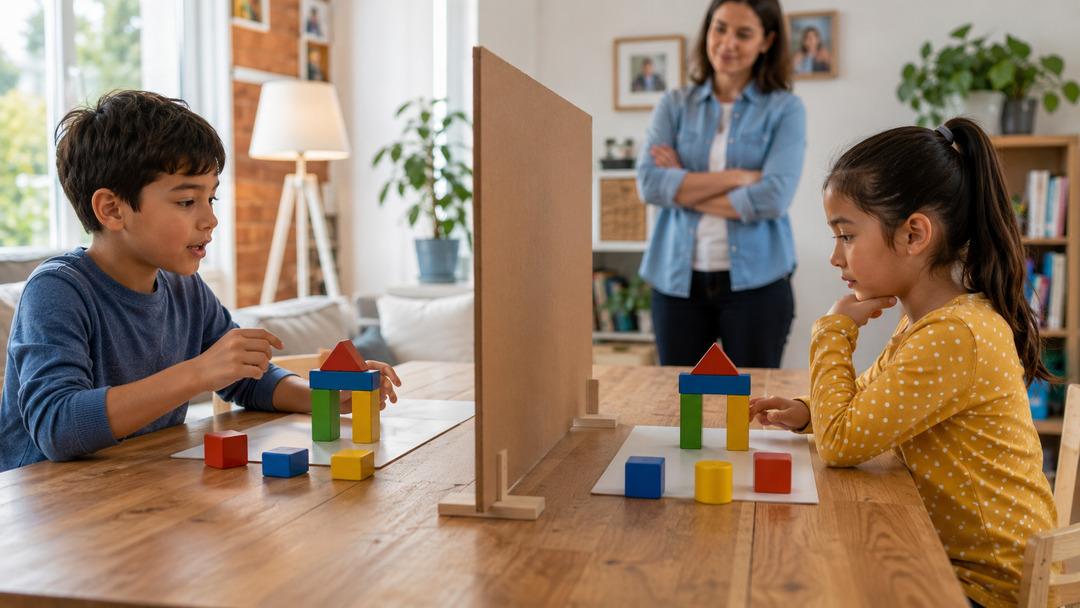
Children hear directions all day, but they rarely get to discover whether their own words are clear enough for someone else to act on. Barrier games for communication change that dynamic by hiding a model from one player and making language—not imitation—the only path to a matching result.
One person describes while the other builds, draws, colors, or arranges. The activity fits naturally beside other active listening games because success depends on both sides of the exchange: giving useful details, listening for meaning, asking questions, and repairing confusion before it becomes frustration.
A Hidden Model Reveals What Clear Really Means
In an ordinary craft or block activity, a child can copy what an adult is doing. Place a folder or book between the players, however, and visual imitation disappears. The speaker must explain the model precisely, while the listener must interpret the instructions without seeing the answer.
That small change exposes the parts of communication adults often overlook. “Put the block there” may make sense when both people are looking at the same space, but it becomes useless when “there” is hidden. The speaker needs location words, identifying details, sequence, and a clear point of reference.
The listener also has work to do. They may need to remember several details, notice what is missing, or ask, “Do you mean above the red square or beside it?” Successful listening is active, not silent.
The American Speech-Language-Hearing Association includes following multi-step directions and telling another person how to build a block tower among its practical language-building activities. Barrier play brings those skills together in one visible problem.
How to Set Up Barrier Games for Communication
Give both players identical materials and place a visual barrier between them. A standing book, cereal box, clipboard, or folder works well. One player creates or receives a model; the other must reproduce it from spoken instructions.
Agree on the rules before beginning. Decide whether the listener may ask questions, whether instructions can be repeated, and whether the speaker may correct a step. Beginners usually benefit from all three options.
Start with a model that has only three or four elements. A tower might use a red block, two blue blocks, and a toy animal. A drawing might contain a large circle, a small square, and one line. The first round should teach the routine, not test the limits of memory.
Keep the barrier in place until both players believe they are finished. Then reveal the results and compare them without treating differences as failure. Ask which instruction worked, where the message became unclear, and what either player could say differently next time.
Switch roles. A child who only follows directions practices comprehension, but a child who gives directions must organize ideas, select vocabulary, and consider what the other person cannot see.
The Best Instructions Include More Than Action Words
Clear directions usually answer several questions: What object? Which one? Where should it go? In what order? How should it face? A child may know the action word “put” but still need vocabulary for color, size, shape, quantity, and position.
Adults can model precision without rewriting every sentence. If a child says, “Put the triangle next to it,” respond, “Next to the large blue square?” That short clarification shows how identifying details prevent confusion.
Barrier games also create a natural reason to practice question forms. Listeners can ask, “Which corner?”, “How many?”, “What comes after the circle?”, or “Is the animal facing me?” Clarification is a communication skill, not evidence that the listener failed.
The back-and-forth matters as much as the finished product. Harvard’s Center on the Developing Child describes responsive serve-and-return exchanges as interactions in which an adult notices and responds to a child’s signals.
During barrier play, that responsiveness means pausing, acknowledging a question, adjusting a clue, and allowing the child’s message to influence the next turn. The adult is not simply checking whether the child followed directions correctly. Both players are responsible for making the message work.
Five Activities That Make the Language Visible
Barrier games do not require special materials. The best choice is usually something familiar enough that the child can focus on communicating rather than learning new rules.
| Activity | Materials | Useful Language Targets |
|---|---|---|
| Build a matching tower | Identical blocks | Colors, order, above, below, first, last |
| Copy a simple drawing | Paper and pencils | Shapes, size, position, direction |
| Arrange a toy scene | Matching figures and objects | Beside, between, behind, facing |
| Complete a picture | Identical outlines and crayons | Colors, parts, left, right, inside |
| Make a pattern | Counters, beads, or shapes | Repetition, sequence, before, after |
For a block tower, the speaker might say, “Place the long blue block at the bottom. Put the small red cube on top.” A toy scene can introduce perspective: “Make the dog face the tree. Put the ball behind the dog.”
Drawing activities reveal how much information a listener needs. “Draw a circle” may be incomplete if size and location matter. A stronger direction is, “Draw a large circle near the top-left corner.”
Picture completion works well for children who find open-ended drawing difficult. Give both players the same outline of a house, face, animal, or simple map. One player colors or adds details, then explains each change.
Patterns make sequencing visible. The listener must track not only individual items but also the rule connecting them: “Start with a red counter, then add two yellow counters, and repeat.”
Pressure Points That Can Turn Play Into a Test
A complicated model can overload the listener before the game has begun. Reduce the number of pieces, shorten the directions, and add one difficulty at a time. Spatial words, multi-step memory, unfamiliar shapes, and left-right concepts should not all become new demands in the same round.
Do not ban questions in the name of “good listening.” Real communication includes checking, repeating, and repairing. A listener who asks for clarification may be showing more understanding than one who guesses silently.
Adults can also make the speaker’s role too easy by translating every vague instruction. Offer a prompt—“Which block do you mean?”—but leave space for the child to revise the message independently.
Avoid comparing the final products as if one were correct and the other were careless. Differences often reveal exactly where language became ambiguous. Treat the mismatch as evidence, then investigate it together.
Some children may need visual supports even though the main model remains hidden. A small card showing position words, color choices, or sentence starters can reduce word-finding pressure without removing the communication challenge.
Allow gestures, communication devices, home-language words, and pointing when they help a child participate. The goal is not to enforce one acceptable way of communicating. It is to help each player send and receive information more effectively.
Progress Appears in the Repairs, Not Perfect Matches
The most useful signal is not whether two pictures look identical. Notice whether the child begins adding details without prompting, remembers the order of steps, asks more specific questions, or changes an instruction after seeing that it was misunderstood.
Over time, increase the challenge by adding one more item, using similar objects, extending the sequence, or delaying the reveal. Older children can design the model themselves, write directions after the spoken round, or identify which sentence caused the largest difference.
Keep the emotional conditions steady as the language demand grows. A child who feels rushed may stop asking questions; a child who expects criticism may rely on vague, safe answers. Short rounds, role changes, humor, and genuine curiosity protect participation.
Repeated random choices, silence, visible frustration, or attempts to look around the barrier may signal that the task is too difficult. Reduce the number of elements or return to one-step directions rather than pushing through an unproductive round.
Barrier games for communication matter because they make an invisible process visible. Children can see that clear words guide another person, careful listening changes an outcome, and confusion can be repaired. The opportunity is not a perfectly copied tower or drawing. It is a child learning that communication is something two people build together.
FAQs
What age are barrier games suitable for?
Barrier games can be adapted for preschoolers through elementary-age children. Younger players may follow one-step directions with two or three objects, while older children can manage detailed drawings, longer sequences, and more precise spatial language.
Should children be allowed to ask questions during barrier games?
Yes. Questions are a central part of the activity because they teach children to recognize missing information and repair misunderstandings. Adults can model useful questions before expecting children to form them independently.
What can I use as a barrier?
A standing book, folder, cereal box, clipboard, cushion, or piece of cardboard can block the model. The barrier only needs to prevent direct copying while allowing both players to hear each other comfortably.